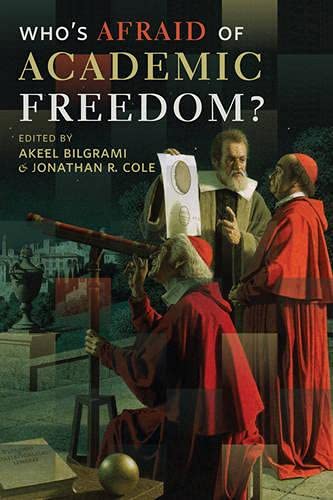

Who's afraid of academic freedom? [electronic resource] edited by Akeel Bilgrami & Jonathan R. Cole.
Editor: New York Columbia University Press [2015]Descripción: one online resource (xvii, 428 pages ) 24 cmTipo de contenido:- 9780231538794 (electronic)
- 378.1/213 23
- LC72.2 .W48 2015eb
| Imagen de cubierta | Tipo de ítem | Biblioteca actual | Biblioteca de origen | Colección | Ubicación en estantería | Signatura topográfica | Materiales especificados | Info Vol | URL | Copia número | Estado | Notas | Fecha de vencimiento | Código de barras | Reserva de ítems | Prioridad de la cola de reserva de ejemplar | Reservas para cursos | |
|---|---|---|---|---|---|---|---|---|---|---|---|---|---|---|---|---|---|---|
| Libro electrónico | Biblioteca de Mayagüez Acceso en línea | LC72.2 .W48 2015eb (Navegar estantería(Abre debajo)) | Disponible | 50000003265773 | ||||||||||||||
| Libro electrónico | Biblioteca Mons. Iñaki Mallona (Arecibo) Acceso en línea | 323.44 (Navegar estantería(Abre debajo)) | Ebook | Disponible | 60000010173372 |
Descripciones mejoradas de Syndetics:
In these seventeen essays, distinguished senior scholars discuss the conceptual issues surrounding the idea of freedom of inquiry and scrutinize a variety of obstacles to such inquiry that they have encountered in their personal and professional experience. Their discussion of threats to freedom traverses a wide disciplinary and institutional, political and economic range covering specific restrictions linked to speech codes, the interests of donors, institutional review board licensing, political pressure groups, and government policy, as well as phenomena of high generality, such as intellectual orthodoxy, in which coercion is barely visible and often self-imposed.
As the editors say in their introduction: "No freedom can be taken for granted, even in the most well-functioning of formal democracies. Exposing the tendencies that undermine freedom of inquiry and their hidden sources and widespread implications is in itself an exercise in and for democracy."
eigm 02/2016
Includes bibliographical references and index.
Instrucciones de uso: Recurso electrónico favor presionar sobre el URL disponible en la parte inferior. En caso de dudas favor consulte al Bibliotecario.
Reseñas proporcionadas por Syndetics
CHOICE Review
Academic freedom, as distilled from the definition by the American Association of University Professors in 1915 and expanded in 1940, is a bedrock of a free university. However, providing a comprehensive definition hardly spells the end of challenges and controversies. Does academic freedom extend to students? Does it pertain to professorial views beyond the field of expertise and/or the classroom? Assaults and dilemmas come from within as well as from without. These 17 essays, complemented by a survey of Columbia faculty presented with some thorny questions, touch on some in-house issues, including discrimination against new disciplines and their devotees, the heavy hand of institutional review boards looking at live-subject research, and the displeasure of those from above who hire and promote. From outside academia, the authors find political outrage and the demand for "self-discipline," demonstrated in recent years in the debate centering on Israel (with case studies telling of canceled speakers and even of terminated faculty). Given the number of essays, there is some repetition, variation in line of approach, and different views of the enemy. Nevertheless, all authors unite for a sober reminder that while academic freedom may be a "given," its proponents can never rest on their laurels. Summing Up: Recommended. Upper-division undergraduates through researchers and faculty; general readers. --Joel T. Rosenthal, emeritus, SUNY at Stony BrookNotas de autor provistas por Syndetics
Akeel Bilgrami is the Sidney Morgenbesser Professor of Philosophy and a professor on the Committee on Global Thought at Columbia University. His books include Secularism, Identity, and Enchantment ; Self-Knowledge and Resentment ; and Belief and Meaning .Jonathan R. Cole is the John Mitchell Mason Professor of the University at Columbia University. For fourteen years, he served as provost and dean of faculties at Columbia. His latest book is The Great American University: Its Rise to Preeminence, Its Indispensable National Role, Why It Must Be Protected .