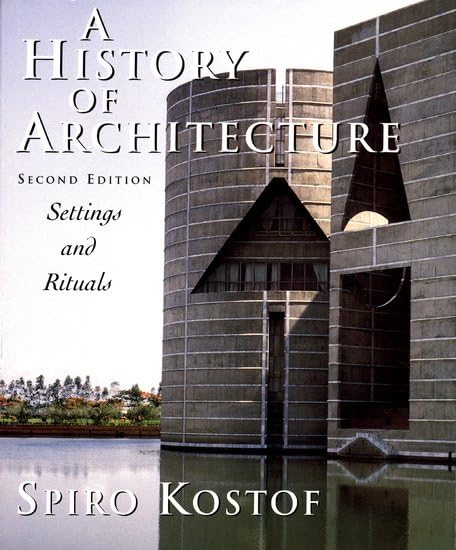

A history of architecture settings and rituals Spiro Kostof; revisions by Greg Castillo; Original Drawings by Richard Tobias. txt
New York Oxford University Press 1995Edición: Second editionDescripción: 792 p. ill.(some col.), maps, diagrms. 29 cmTipo de contenido:- text
- unmediaded
- volume
- 0195083784
- 0195083792
- 9780195083781
- 9780195083798
- 20 720.9
- NA200 K65 1995
| Imagen de cubierta | Tipo de ítem | Biblioteca actual | Biblioteca de origen | Colección | Ubicación en estantería | Signatura topográfica | Materiales especificados | Info Vol | URL | Copia número | Estado | Notas | Fecha de vencimiento | Código de barras | Reserva de ítems | Prioridad de la cola de reserva de ejemplar | Reservas para cursos | |
|---|---|---|---|---|---|---|---|---|---|---|---|---|---|---|---|---|---|---|
| Libro | CARIBET Biblioteca Arquitectura Colección General CARIBET | General NA200 K65 1995 (Navegar estantería(Abre debajo)) | 2 | Disponible | 91000000059105 | |||||||||||||
| Libro | CARIBET Biblioteca Arquitectura Colección General CARIBET | General NA200 K65 1995 (Navegar estantería(Abre debajo)) | 1 | Disponible | 91000000000216 |
Descripciones mejoradas de Syndetics:
When the late Spiro Kostof's A History of Architecture appeared in 1985, it was universally hailed as a masterpiece--one of the finest books on architecture ever written. The New York Times Book Review, in a front cover review, called it "a magnificent guided tour through mankind's architecture," and The San Francisco Chronicle wrote that "Kostof...has enthralled a generation of students.... Now he has done the same thing for the public at large, in an extraordinary book that is a new kind of architectural history." This magisterial work has now been revised and expanded by Greg Castillo, Kostof's colleague and literary executor. Insightful, engagingly written, and graced with almost a thousand superb illustrations, the Second Edition of this classic volume offers a sweeping narrative that examines architecture as it reflects the social, economic, and technological systems of human history. The scope of the book is astonishing. No mere survey of famous buildings, Kostof's History examines a surprisingly wide variety of manmade structures: prehistoric huts and the TVA, the pyramids at Giza and the Rome railway station, the ziggurat and the department store. Indeed, Kostof considered every building worthy of attention, every structure or shelter a potential source of insight, whether it be the prehistoric hunting camps at Terra Amata, or the caves at Lascaux with their magnificent paintings, or a twenty-story hotel on the Las Vegas strip. The Second Edition features a new concluding chapter, "Designing the Fin de Siècle," based on Kostof's last lecture notes and prepared by Castillo, as well as an all-new 16-page color section. Many of the original line drawings by Richard Tobias, as well as some 50 photographs, have also been updated or replaced, for improved clarity. Visually and intellectually stimulating, this book is at once a compelling history and an indispensable reference on all aspects of our built environment. It achieves for architecture what Janson's history accomplished for visual art.
Includes bibliographical references and index.
Tabla de contenidos provista por Syndetics
- A Place On Earth
- 1 The Study of What We Built
- 2 The Cave and the Sky: Stone Age Europe
- 3 The Rise of the City: Architecture in Western Asia
- 4 The Architecture of Ancient Egypt
- 5 Bronze Age Cities: The Aegean and Asia Minor
- 6 Greek Temple and ""Barbarian"" Alternatives
- 7 Polis and Akropolis
- 8 The Hellenistic Realm
- 9 Rome: Caput Mundi
- 10 The World at Large: Roman Concurrences
- Measuring Up
- 11 The Triumph of Christ
- 12 The Mediterranean in the Early Middle Ages
- 13 The Birth of Nations: Europe after Charles
- 14 The French Manner
- 15 The Urbanization of Europe
- 16 Edges of Medievalism
- 17 The Renaissance: Ideal and Fad
- 18 Spain and the New World
- 19 Istanbul and Venice
- 20 The Popes as Planners: Rome 150-1650
- 21 Absolutism and Bourgeoisie: European Architecture 1600-1750
- The Search For Self
- 22 Architecture for a New World
- 23 Architectural Art and the Landscape of Industry
- 24 The American Experience
- 25 Victorian Environments
- 26 The Trials of Modernism
- 27 Architecture and the State: Interwar Years
- 28 At Peace with the Past: The Last Decades
- 29 Designing the Fin-de-Siecle