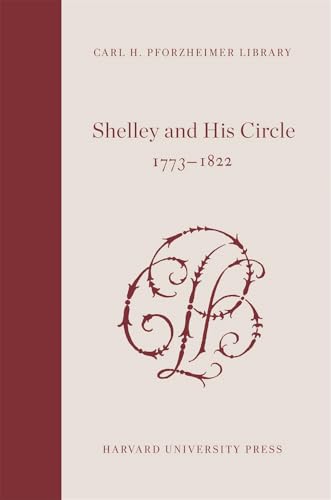

Shelley and his circle, 1773-1822. Edited by Kenneth Neill Cameron.
Detalles de publicación: Cambridge Harvard University Press 1961-<1986 >Descripción: v. <1-8 > illus., ports., maps, facsims. 29 cmISBN:- 0674806123
- 928.2
- PR5431 .A33
| Imagen de cubierta | Tipo de ítem | Biblioteca actual | Biblioteca de origen | Colección | Ubicación en estantería | Signatura topográfica | Materiales especificados | Info Vol | URL | Copia número | Estado | Notas | Fecha de vencimiento | Código de barras | Reserva de ítems | Prioridad de la cola de reserva de ejemplar | Reservas para cursos | |
|---|---|---|---|---|---|---|---|---|---|---|---|---|---|---|---|---|---|---|
| Libro | Biblioteca Encarnación Valdés Colección General bev | 821.7 S545ycb (Navegar estantería(Abre debajo)) | v.1 | Disponible | 80000000874530 | |||||||||||||
| Libro | Biblioteca Encarnación Valdés Colección General bev | 821.7 S545ycb (Navegar estantería(Abre debajo)) | v.2 | Disponible | 80000000874548 |
Descripciones mejoradas de Syndetics:
An essential collection of writings penned by the most celebrated figures of the Romantic era, presented in an authoritative two-volume set.
Volumes V and VI of Shelley and His Circle illuminate a pivotal phase of Shelley's personal and artistic evolution. Spanning late 1816 through 1819, the manuscripts, letters, and journals included here illustrate Shelley's emerging poetic maturity, as well as his developing friendships with Leigh Hunt and John Keats.
These volumes chronicle the writing of The Revolt of Islam, Shelley's epic on the lessons of the French Revolution; the poet's journey to Italy; the deaths of his and Mary's two children; and his literary annus mirabilis in 1819. During this year, he wrote Prometheus Unbound, The Cenci, and A Philosophical View of Reform, which is here presented in a corrected text. The sequence closes in late December 1819 with a series of letters that signal Shelley's growing isolation from his English cadre.
Among the 175 fully transcribed manuscripts in this set are eighty-two penned by Shelley, and many others by William Godwin, Hunt, and Lord Byron. Also included are significant early letters by Edward John Trelawny, in addition to letters and journals of Keats, Thomas Love Peacock, Mary Shelley, Claire Clairmont, Thomas Jefferson Hogg, and Edward E. Williams. An appendix featuring eleven early letters and poems by Byron completes this revelatory set.
"A complete edition of the manuscripts in the Shelley and his circle collection."
Vols. 5-<8 > edited by D. H. Reiman.
Includes bibliographical references.
Notas de autor provistas por Syndetics
Born in Field Place, near Horsham in Sussex, Shelley was educated at Syon House Academy and Eton, where he acquired the sobriquet "Mad Shelley" for his independent spirit. While at Eton he published Zastrozzi (1810), a Gothic novel. Expelled from Oxford because he refused to retract his atheistic beliefs, Shelley quarreled with his wealthy father and was banished from home. Shelley married impulsively and then abandoned his young wife to run off to Italy with the 16-year-old Mary Wollstonecraft Godwin (the daughter of the radical feminist and the anarchist philosopher, who was eventually to write Frankenstein). While in Italy, Shelley became close friends with Byron, and the two became objects of endless, notorious rumor.Shelley's personal character was revered by almost everyone who knew him. Extremely generous toward others, frugal with himself, he strove tirelessly for the betterment of humanity. Prometheus Unbound (1820), a lyrical drama in four acts, calls for the regeneration of society through love and for the destruction of all repressive institutions. The Cenci (1819), a verse drama based on real events, is one of the few plays from the romantic period still produced. Shelley's lyrics are marvelously varied and rich in sound and rhythm. Wordsworth regarded him as the best artist among living poets.Adonais (1821), written to honor the memory of John Keats, is one of the supreme elegies in English.The Triumph of Life, which was left incomplete at his death, has been hailed by T. S. Eliot as the nearest approach in English to Dante (see Vol. 2). The "Ode to the West Wind" and "To a Skylark" are anthologized everywhere. Shelley's early death by drowning ended his career just as it was coming into full flower. A revolutionary in his art and life, Shelley is considered by many to be an inspired polemicist and poetic genius. As one of his contemporaries wrote in Etonian (1821), "He is one of the many whom we cannot read without wonder, or without pain. . . ."
(Bowker Author Biography)