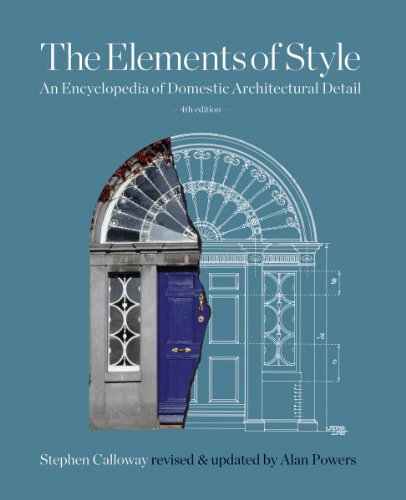
Imagen de portada de Amazon
Imagen de Amazon.com
Imagen de cubierta Syndetics
Portada de Syndetics
Imagen de OpenLibrary

The elements of style : an encyclopedia of domestic architectural detail / Stephen Calloway revised & updated by Alan Powers txt

Por: Colaborador(es): New York : A Firefly Book, 2012Edición: 4th editionDescripción: 592p. ill. 28 cmTipo de contenido:
Tipo de medio:
Tipo de soporte:
ISBN:
  • 9781770850866
  • 1770850864
Tema(s): Clasificación CDD:
  • 728
Clasificación LoC:
  • NA 2850  C355 2012
Valoración
    Valoración media: 0.0 (0 votos)
Existencias
Imagen de cubierta Tipo de ítem Biblioteca actual Biblioteca de origen Colección Ubicación en estantería Signatura topográfica Materiales especificados Info Vol URL Copia número Estado Notas Fecha de vencimiento Código de barras Reserva de ítems Prioridad de la cola de reserva de ejemplar Reservas para cursos
Libro CARIBET Biblioteca Arquitectura Colección General CARIBET General NA2850 C35 2012 (Navegar estantería(Abre debajo)) 1 Disponible 91000000032698
Total de reservas: 0

Descripciones mejoradas de Syndetics:

Praise for previous editions:
One of the most borrowed books in our library.
--This Old house

A dizzying amount of detailed pictorial information ... clearly and fascinatingly captioned.
--World of Interiors

The Elements of Style is the most comprehensive visual survey, period by period, feature by feature, of the key styles in American and British domestic architecture from the Tudor period to present day. A valuable reference guide, the book is designed for owners of period houses, restorers, architects, interior designers and all those interested in our architectural heritage. This revised edition includes a fully updated chapter covering the Contemporary era (1975--present) and a new list of suppliers and resources.

More than 3,000 analytical drawings and historical engravings, 500 color and 1,000 black-and-white photographs provide a clearly presented guide to the features appropriate for every part of a building. Major components, such as doors, windows, walls, floors, ceilings and staircases, the small but important embellishments, such as molding and door hardware, and permanent or semi-permanent fixtures, such as lighting and wallcoverings, populate this wide-ranging encyclopedic resource.

A system of color-coded tabs enables the reader to compare specific features as they have evolved over time. Additional information on restoration and maintenance, biographies of key architects, and a detailed glossary are included.

Periods covered:
Tudor and Jacobean (1485-1625)
Baroque (1625-1714)
Early Georgian (1714-1765)
Colonial (1607-1780)
Late Georgian (1765-1811)
Regency and Early 19th Century (1811-1837)
Federal and Empire (1780-1850)
British Victorian (1837-1901)
American Victorian (1840-1910)
Arts and Crafts (1860-1925)
Art Nouveau (1888-1905)
Edwardian (1901-1914)
American Beaux Arts (1870-1920)
Twenties and Thirties
The Modern Movement (1920-1950)
Beyond Modern (1950-1975)
Contemporary Era (1975-present)

include index

Extracto provisto por Syndetics

Foreword "For a man's house is his castle:, wrote Sir Edward Coke at the beginning of the 17th century. The phrase has become a cornerstone of the way we think and live. Yet, by a stroke of historic irony, the great lawyer's memorable line was penned at the very time when Inigo Jones was building the first modern house in England, the Queen's House at Greenwich -- that precocious expression of polite taste and perfect monument to a new domestic ideal. From this date on people cared for their houses not merely as strongholds of safety and domestic wealth: they loved them for their architecture. Today we are heirs to a legacy of fine building and to a continuing fascination with the details and stylistic elements which give our houses their character. In Britain, and in the United States too, that interest in old houses has become something of a national obsession. The desire to know and understand the history of our homes has never been stronger. We are, perhaps more than ever before, aware of the crucial importance of our great architectural traditions and the central position they occupy in what we have come to call our heritage. At the heart of this concept of heritage lies our idealized image of the period house, which, great or small, ostentatious or plain, has come to epitomize so many of our notions of civilization. The study of the architectural evolution of the country house in England and the United States, and of urban and village building, has a long and distinguished history. But in recent years, academic interest in the planning, stylistic development and detailing of historic houses has increasingly become linked with the more passionate and practical enthusiasms of the conservation movement. As a result, the houses we live in have become a major concern -- the subject of both a large body of scholarly and investigative endeavor and often intense public discussion and debate. One of the foremost defenders of traditional values in design and workmanship, the Prince of Wales, has repeatedly stressed the influential role which fine architecture can play in our everyday existence. As the protagonist of a humane architecture based on human scale and sound techniques and materials, he has championed the idea that good building is not only an index of civilization, but also an important contributory factor in the quality of life which we enjoy. Today, those who value the best of the old in our heritage are convinced of its relevance to the new. But there is, it has to be said, a great deal that must be learned or re-learned. In recent decades more modern tendencies have prevailed, and we have come perilously close to losing much of the rich vocabulary and even the grammar which gave our architectural language in previous ages its subtlety and fluent charm. What we need now is a return to visual literacy, an understanding of all the elements and details of the house as they have changed through five centuries. To promote such an understanding, which alone can be the only proper basis for conservation, restoration and sensitive design, is one of the main aims of this book. We have sought to create within the compass of a single volume a practical sourcebook for all those who care about our heritage of domestic architecture in Britain and the United States. The vast body of illustrative material that has been drawn together here includes specially commissioned photographs of houses, reproductions of engraved plates from the key architectural publications of each period, and drawings based on a wide variety of archival material, including old photographs and measured drawings (often of buildings now demolished), rare prints and builders' pattern books. The images used to illustrate each chapter have been selected by the individual authors, each of whom has made a particular study of his or her period. For each chapter the chief aim has been to show the development of standard forms but also to illustrate some of the influential high-points of architectural achievement and something of the variety that has always characterized domestic buildings. Primarily, The Elements of Style , is intended as a visual and documentary resource for people concerned with the details of houses, whether as owners, conservators, architects, interior decorators or designers. For the student and the interested general reader the book can also be used as a way to trace the history of the British and American house. Between the practical approach and the academic there is no real division of interests: a chief desideratum in each case is sympathy for matters of detail, a belief in the importance of accuracy at the most meticulous level. The overall plan of this book is a simple chronological one, period by period, style by style. The main chapters deal with what we may define as polite architecture: that is, buildings which aim, with whatever degree of success, at observing the architectural rules and at being fashionable, or in later periods buildings which conform to nationally prevalent types. Houses which fall outside this rather general definition -- modest country dwellings, traditional structural types in use over a long period, and distinct regional variations on standard forms -- are dealt with separately in chapters devoted to vernacular building. British vernacular is treated separately from the end of the Tudor period: before then the two strands have been combined, for the distinctions between vernacular and polite in that era are so blurred as to be misleading, even meaningless. Under American vernacular, the coverage is of rustic and regional features from Colonial times to the mid-l9th century. Inevitably these chapters are highly selective: given the multiplicity of localized styles, this book can do no more than illustrate some of the highlights of vernacular domestic architecture. Similarly, although Britain and the United States are treated separately in the first half of the book, the chapters on Arts and Crafts, Art Nouveau, the Twenties and Thirties, and the Modern and Beyond Modern styles combine material from both sides of the Atlantic, in order to emphasize the close connections that exist in an age of international influences. This approach has brought about some interesting juxtapositions, such as the work of Charles Rennie Mackintosh in Glasgow and the early houses of Frank Lloyd Wright in the United States. The Elements of Style is nor a book about great architects: although inevitably their names and works appear among these pages, their stories are told elsewhere, and the interested reader will have no difficulty in tracking down more information. Nor is it a study of grand houses to the exclusion of the more modest. We have chosen to place the greatest emphasis on that category which the 18th-century architect and his builder called the "good middling sort of house"; for in such houses we may discern much of the genius of each age and in full measure those qualities which the first architectural writer in English, Sir Henry Wotton, required of all fine building: "Firmness, Commodity and Delight". Stephen Calloway Excerpted from The Elements of Style: An Encyclopedia of Domestic Architectural Detail All rights reserved by the original copyright owners. Excerpts are provided for display purposes only and may not be reproduced, reprinted or distributed without the written permission of the publisher.

Reseñas proporcionadas por Syndetics

Library Journal Review

Calloway (curator of prints, Victoria and Albert Museum), assisted by a dozen other style experts from both sides of the Atlantic, addresses the concerns of amateur and professional preservationists with the new edition of this guide to period styles in Great Britain and the United States from the Renaissance to the present. Each chapter begins with a concise overview of a period style (e.g., Colonial, Baroque, Edwardian Beaux Arts) and is followed by pages teeming with illustrations of representative doors, windows, fireplaces, and other structural/decorative elements. The stylistic analyses are sometimes questionable-e.g., Wright's Robie House as Art Nouveau?-but generally succeed in capturing each period in lively and penetrating detail. Reviews of the first two editions acclaimed Elements as an exhaustive, brilliantly illustrated handbook and this new edition differs but slightly from the earlier two. Its directories of British and North American suppliers are updated and the coverage of post-1920 Modernism, the weakest and most problematic subject in all three editions, has been revised and expanded. An excellent reference for libraries serving active historic preservationists, but other libraries owning earlier editions need not splurge.-David Solt?sz, Cuyahoga Cty. P.L., Parma, OH (c) Copyright 2010. Library Journals LLC, a wholly owned subsidiary of Media Source, Inc. No redistribution permitted.

CHOICE Review

Readers will find no shortage of encyclopedias, dictionaries, and glossaries that define, illustrate, and chronicle the world of architecture. Elements of Style, however, is singular in its presentation, scope, and comprehensiveness. Devoted to fashionable British and American domestic architecture from 1485 to the present, this reference book depicts the development of the interior environment. The richly illustrated chapters depict architectural features such as doorways, staircases, fireplaces, walls, and windows. Original line drawings, images from trade catalogs, and photographs illustrate details of woodworking, tiling, wall treatments, and light fixtures. Chapters are organized chronologically; each features a short essay on overarching themes and influences, written by a museum professional or academic. Each architectural feature is assigned a color tab; someone interested in, for example, the development of doors across time may flip through all the orange tabs. First published in 1991 and revised in 1996 and 2005 (CH, May'06, 43-4997), this volume now has a new chapter, "Contemporary Era," that covers 1975 to the present; it does not significantly update the other chapters. Buying the new edition is not necessary for libraries that own the previous one(s); overall, though, this book is a staple for any university library with an architecture or interior design department. Summing Up: Recommended. Libraries lacking the previous editions; lower-division undergraduates through professionals/practitioners. A. H. Simmons National Gallery of Art

Notas de autor provistas por Syndetics

Stephen Calloway is Curator of Prints and Books at the Victoria and Albert Museum, London, and author, lecturer and consultant on architecture, interior design and the history of taste. He has contributed to numerous periodicals, including The World of Interiors and Architectural Digest , and is the author of Twentieth-Century Design and Baroque Baroque .

Alan Powers is a Senior Lecturer at the University of Greenwich School of Architecture and Landscape, London. He is the author of several books on English architecture and decorative arts, including Living with Books, and is a regular contributor to Country Life and other magazines.

Elizabeth Cromley is Professor of Architecture at Northeastern University, Boston. She is the author of Alone Together: A History of New York's Early Apartments , and co-editor of a variety of essays and books on vernacular architecture.

Compartir
logopucpr-y-vive

Contáctanos

¡Queremos saber de ti!

Tel. 787.841.2000 Ext. 1801

bibliotecavaldes@pucpr.edu

⁣Búscanos en las redes

© 2026 Desarrollado por Ignite Online • All Rights Reserved • Powered by Koha.