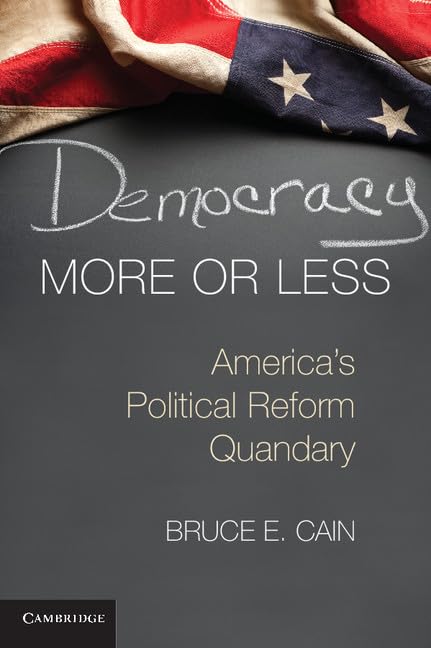

Democracy more or less America's political reform quandary Bruce E. Cain.
Idioma: Inglés Series Cambridge studies in election law and democracyEditor: New York, NY Cambridge University Press 2015Descripción: ix, 251 pages 24 cmTipo de contenido:- 9781107612266 (pbk)
- Democracy -- United States
- Representative government and representation
- Political participation
- Political culture
- Polarization Social sciences
- Democracy
- Law
- Polarization Social sciences -- United States
- Political participation -- United States
- Political culture -- United States
- Representative government and representation -- United States
- United States
- 320.973 23
- JK 1726 .C35 2015
| Imagen de cubierta | Tipo de ítem | Biblioteca actual | Biblioteca de origen | Colección | Ubicación en estantería | Signatura topográfica | Materiales especificados | Info Vol | URL | Copia número | Estado | Notas | Fecha de vencimiento | Código de barras | Reserva de ítems | Prioridad de la cola de reserva de ejemplar | Reservas para cursos | |
|---|---|---|---|---|---|---|---|---|---|---|---|---|---|---|---|---|---|---|
| Libro | Biblioteca de Derecho Mons. Fremiot Torres Oliver Colección General biblioteca derecho | JK 1726 .C35 2015 (Navegar estantería(Abre debajo)) | c. 1 | Disponible | 70000000900014 |
Descripciones mejoradas de Syndetics:
Why do American political reform efforts so often fail to solve the problems they intend to fix? In this book, Bruce E. Cain argues that the reasons are an unrealistic civic ideal of a fully informed and engaged citizenry and a neglect of basic pluralist principles about political intermediaries. This book traces the tension between populist and pluralist approaches as it plays out in many seemingly distinct reform topics, such as voting administration, campaign finance, excessive partisanship, redistricting, and transparency and voter participation. It explains why political primaries have promoted partisan polarization, why voting rates are declining even as election opportunities increase, and why direct democracy is not really a grassroots tool. Cain offers a reform agenda that attempts to reconcile pluralist ideals with the realities of collective-action problems and resource disparities.
Includes bibliographical references and index.
1. The ascendancy of reform populism -- 2. Reform pluralism -- 3. How much transparency? -- 4. Participation paradoxes -- 5. Reform cycles -- 6. Fair representation -- 7. Raising the political ethics bar -- 8. Election administration or policy? -- 9. A blended reform agenda.
"Why do American political reform efforts so often fail to solve the problems they intend to fix? In this book, Bruce E. Cain argues that the reasons are an unrealistic civic ideal of a fully informed and engaged citizenry and a neglect of basic pluralist principles about political intermediaries. This book traces the tension between populist and pluralist approaches as it plays out in many seemingly distinct reform topics, such as voting administration, campaign finance, excessive partisanship, redistricting, and transparency and voter participation. It explains why political primaries have promoted partisan polarization, why voting rates are declining even as election opportunities increase, and why direct democracy is not really a grassroots tool. Cain offers a reform agenda that attempts to reconcile pluralist ideals with the realities of collective-action problems and resource disparities"-- Provided by publisher.
Tabla de contenidos provista por Syndetics
- 1 The ascendancy of reform populism
- 2 Reform pluralism
- 3 How much transparency?
- 4 Participation paradoxes
- 5 Reform cycles
- 6 Fair representation
- 7 Raising the political ethics bar
- 8 Election administration or policy?
- 9 A blended reform agenda