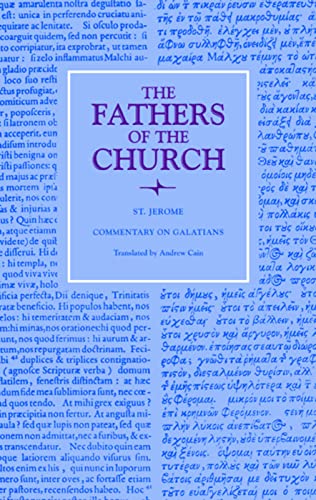

Commentary on Galatians / St. Jerome ; translated by Andrew Cain.
Idioma: Inglés Lenguaje original: Latín Series The Fathers of the church ; v.121Washington, D.C. : Catholic University of America Press, ©2011Descripción: xxv, 283 pages ; 22 cmISBN:- 9780813201214 (cloth : alk. paper)
- BR65.J473 C6413 2011
| Imagen de cubierta | Tipo de ítem | Biblioteca actual | Biblioteca de origen | Colección | Ubicación en estantería | Signatura topográfica | Materiales especificados | Info Vol | URL | Copia número | Estado | Notas | Fecha de vencimiento | Código de barras | Reserva de ítems | Prioridad de la cola de reserva de ejemplar | Reservas para cursos | |
|---|---|---|---|---|---|---|---|---|---|---|---|---|---|---|---|---|---|---|
| Libro | Biblioteca Encarnación Valdés Colección General bev | 281.1 F252 I (Navegar estantería(Abre debajo)) | v.121 | Disponible | 80000002424656 |
Descripciones mejoradas de Syndetics:
Prior to the middle of the fourth century, the exegesis of St. Paul had been monopolized by Greek and Syriac commentators. Then, in the space of half a century (c. 360 - c. 409), there appeared no less than 52 commentaries by six different Latin authors. This sudden flurry of literary activity has been dubbed the western "Renaissance of Paul." Jerome's commentaries on four Pauline epistles (Galatians, Ephesians, Titus, Philemon), which he composed in 386 shortly after establishing himself in Bethlehem, occupy a central place in this relatively short but prolific segment of the history of Pauline exegesis in Latin.
Jerome was the greatest biblical scholar of the ancient Latin church, and his Commentary on Galatians is one of the crowning achievements of his illustrious career. It far outclasses the five other contemporary Latin commentaries on Galatians in its breadth of classical and patristic erudition, Hebrew and Greek textual criticism of the Bible, and expository thoroughness. It is unique also because it is the only one of the Latin commentaries to make the Greek exegetical tradition its main point of reference. Jerome's Commentary in fact preserves, in one form or another, a treasure-trove of otherwise lost Greek exegesis, particularly Origen's Commentary on Galatians, from which he worked very closely when composing his own work.
Jerome's Commentary on Galatians is presented here in English translation in its entirety. The introduction and notes situate the Commentary in its historical, exegetical, and theological contexts and also provide extensive coverage of ancient and modern scholarly debates about the interpretation of Paul's epistle.
ABOUT THE TRANSLATOR:
Andrew Cain is associate professor of classics at the University of Colorado at Boulder. He has published widely on Jerome and other late Latin writers. He has authored The Letters of Jerome: Asceticism, Biblical Exegesis, and the Construction of Christian Authority in Late Antiquity and has co-edited Jerome of Stridon: His Life, Writings, and Legacy as well as The Power of Religion in Late Antiquity.
Includes bibliographical references and indexes.