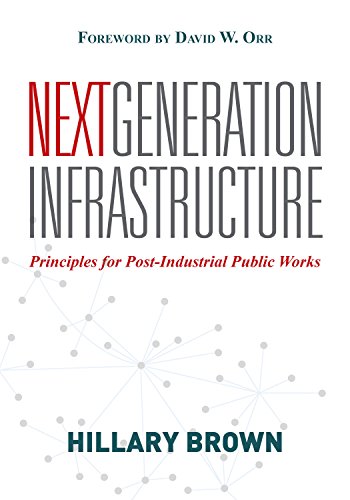

Next Generation Infrastructure : principles for post-industrial public works. / Hillary Brown. txt
United States of America : Island Press , 2014Descripción: xv, 241p. ill. ; 27cmTipo de contenido:- text
- unmediaded
- volume
- 9781610911818
- 9781597268059
- 1597268054
- 363.60973 23
- HC110.C3 B76 2014
| Imagen de cubierta | Tipo de ítem | Biblioteca actual | Biblioteca de origen | Colección | Ubicación en estantería | Signatura topográfica | Materiales especificados | Info Vol | URL | Copia número | Estado | Notas | Fecha de vencimiento | Código de barras | Reserva de ítems | Prioridad de la cola de reserva de ejemplar | Reservas para cursos | |
|---|---|---|---|---|---|---|---|---|---|---|---|---|---|---|---|---|---|---|
| Libro | CARIBET Biblioteca Arquitectura Colección General CARIBET | General HC110.C3 B76 2014 (Navegar estantería(Abre debajo)) | 1 | Disponible | 91000000038356 |
Descripciones mejoradas de Syndetics:
The 2007 bridge collapse in Minneapolis-St. Paul quickly became symbolic of the debilitated interstate highway system--and of what many critics see as America's disinvestment in its infrastructure. The extreme vulnerability of single-purpose, aging infrastructure was highlighted once again when Hurricane Sandy churned its way across the northeast United States. Inundating New York City's vital arteries, floodwaters overwhelmed tunnels and sewers; closed bridges; shut down the electrical substations that control mass transit; curtailed gas supplies; and destroyed streets, buildings, and whole neighborhoods. For days and on into weeks, failures triggered by floodwaters deprived millions of electricity, heat, and water services.
How can our complex, interdependent utilities support an urbanizing world, subject to carbon constraints and the impacts of climate change? How might these critical networks be made more efficient, less environmentally damaging, and more resilient? Such questions are at the heart of the approaches and initiatives explored in Next Generation Infrastructure . With a better understanding of the possible connections between different services, not only can inadvertent disruptions be reduced, but crosscutting benefits and lower costs will be possible. Next Generation Infrastructure highlights hopeful examples from around the world, ranging from the Mount Poso cogeneration plant in California to urban rainwater harvesting in Seoul, South Korea, to the multi-purpose Marina Barrage project in Singapore. Five bold organizing objectives are proposed that, in the hands of decision-makers and designers, will help bring about a future of multipurpose, low-carbon, resilient infrastructure that is tightly coordinated with natural and social systems.
In their conception and design, the innovative projects highlighted in Next Generation Infrastructure encourage us to envision infrastructure within a larger economic, environmental, and social context, and to share resources across systems, reducing costs and extending benefits. Through this systems approach to lifeline services, we can begin to move toward a more resilient future.
Include index
Contents :
Foreword by David W, Orr xi --
Acknowledgments xv --
Chapter 1 Introduction : Bold Endeavors Needed 1 --
Chapter 2 Toward Infrastructural Ecologies : Interconnected, Multipurpose, and Synergistic Systems 17 --
Chapter 3 Greening Heat and Power : An Integrated Approach to Decarbonizing Energy 41 --
Chapter 4 Advancing Soft Path Water Infrastructure : Combined Constructed and Natural Systems 69 --
Chapter 5 Destigmatizing Infrastructure : Design of Community Friendly Facilities 97 --
Chapter 6 Creating Resilient Coastlines and Waterways : Hard and Soft Constructions 127 --
Chapter 7 Combating Water Stress and Scarcity : Augmented Sources and Improved Storage 149 --
Chapter 8 Ways Forward : Think Systematically, Experiment Locally 171 --
Notes 199 --
Index 233 --
How can our complex, interdependent utilities support an urbanizing world, subject to carbon constraints and the impacts of climate change ? How might these critical networks be made more efficient, less environmentally damaging, and more resilient ? Such questions are at the heart of the approaches and initiatives explored in Next Generation Infrastructure. Hillary Brown highlights hopeful examples and proposes five organizing objectives that, in the hands of decision makers and designers, will help bring about a future of multipurpose, low carbon infrastructure that is tightly coordinated with natural and social systems --
Tabla de contenidos provista por Syndetics
- Foreword
- Acknowledgements
- Chapter 1 Introduction: Bold Endeavors Needed
- Chapter 2 Toward Infrastructural Ecologies: Interconnected, Multipurpose, and Synergistic Systems
- Chapter 3 Greening Heat and Power: An Integrated Approach to Decarbonizing Energy
- Chapter 4 Advancing Soft Path Water Infrastructure: Combined Constructed and Natural Systems
- Chapter 5 De-Stigmatizing Infrastructure: Design of Community-Friendly Facilities
- Chapter 6 Creating Resilient Coastlines and Waterways: Hard and Soft Constructions
- Chapter 7 Combating Water Stress and Scarcity: Augmented Sources and Improved Storage
- Chapter 8 Ways Forward: Think Systematically, Experiment Locally
- Notes
- Index