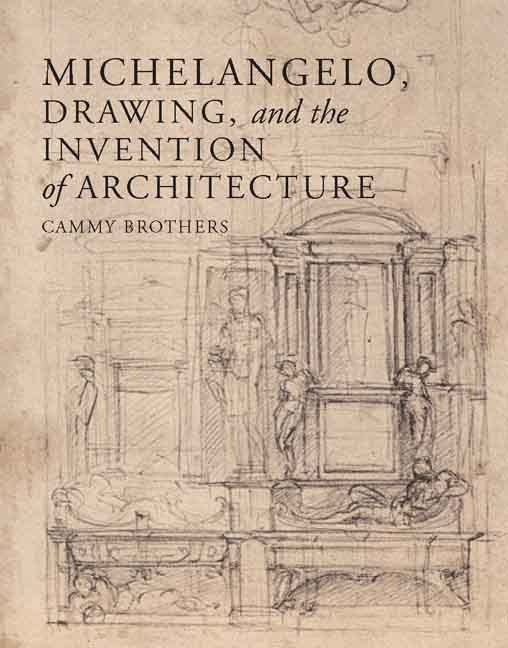

Michelangelo, drawing, and the invention of architecture / Cammy Brothers. txt
New Haven ; London : Yale University Press , 2008Descripción: xi, 259 p. ill. (some col.) 29 cmTipo de contenido:- text
- unmediaded
- volume
- 9780300124897
- 720.92 22
- NA2707.B78 B76 2007
| Imagen de cubierta | Tipo de ítem | Biblioteca actual | Biblioteca de origen | Colección | Ubicación en estantería | Signatura topográfica | Materiales especificados | Info Vol | URL | Copia número | Estado | Notas | Fecha de vencimiento | Código de barras | Reserva de ítems | Prioridad de la cola de reserva de ejemplar | Reservas para cursos | |
|---|---|---|---|---|---|---|---|---|---|---|---|---|---|---|---|---|---|---|
| Libro | CARIBET Biblioteca Arquitectura Colección General CARIBET | General NA2707.B78 B76 2008 (Navegar estantería(Abre debajo)) | 1 | Disponible | 91000000014951 |
Descripciones mejoradas de Syndetics:
In this engaging and handsome book, Cammy Brothers takes an unusual approach to Michelangelo's architectural designs, arguing that they are best understood in terms of his experience as a painter and sculptor. Unlike previous studies, which have focused on the built projects and considered the drawings only insofar as they illuminate those buildings, this book analyses his designs as an independent source of insight into the mechanisms of Michelangelo's imagination. Brothers gives equal weight to the unbuilt designs, and suggests that some of Michelangelo's most radical ideas remained on paper.
Brothers explores the idea of drawing as a mode of thinking, using its evidence to reconstruct the process by which Michelangelo arrived at new ideas. By turning the flexibility and fluidity of his figurative drawing methods to the subject of architecture, Michelangelo demonstrated how it could match the expressive possibilities of painting and sculpture.
Includes bibliographical references (p. 233-247) and indexes.
Drawing, memory and invention -- Architecture, education, and the antique -- The figure and the frame -- Architecture as subject.
Reseñas proporcionadas por Syndetics
Library Journal Review
As the definitive mannerist architect, Michelangelo challenged conventions of form, space, order, and scale. Brothers (architecture, Univ. of Virginia) presents the possibility that Michelangelo may have been among the first to conceive of drawing as a means to architectural design. Appropriately, she begins with an analysis of the artist's drawing techniques and their incorporation into the Sistine Chapel ceiling figures, reminding us that painter-architects were more the norm than the exception. The particular contribution here, however, lies in Brothers's analysis of the most celebrated of Michelangelo's architectural work, the Laurentian Library vestibule, which links the upper cloister and the reading room at San Lorenzo in Florence. For this, architecture becomes the subject, no longer subordinate to sculpture, no longer framing the human figure. Each detail of the space is described in relation to the architect's drawing skills and innate sense of architectural composition. Although not as well illustrated as Giulio Carlo Argan and Bruno Contardi's Michelangelo: Architect and far narrower in its perspective, this book will substantially deepen larger collections on architecture of the late Renaissance.--Paul Glassman, Felician Coll. Lib., Lodi, NJ (c) Copyright 2010. Library Journals LLC, a wholly owned subsidiary of Media Source, Inc. No redistribution permitted.CHOICE Review
That Michelangelo's architecture evolved from his sculpture is generally acknowledged. With unprecedented precision and thoroughness, Brothers (Univ. of Virginia), the author of this beautiful volume with 275 aptly chosen illustrations, explains exactly how. She reads the artist's drawings as traces of his explorative thinking--tentative, vacillating, and at times serendipitous--by inspecting closely the strokes and markings, no less than the chosen medium, from one sheet to another. She observes first that in his figural drawings, in particular for the Sistine Ceiling (chapter 1), Michelangelo isolates parts into abstract forms as he does elements of classical architecture in his copies from the pages of the Codex Coner, largely by his mentor, Giuliano da Sangallo (chapter 2). She then demonstrates how in his projects for San Lorenzo (the facade and the Medici Chapel), the figure progressively merges with the frame (chapter 3), and how ultimately in the Laurentian Library architectural components become figural subjects (chapter 4). In this vicissitudinous process of creative invention, solidly built on conventional precedents, the author finds a parallel in the poetry of Petrarch and Ariosto. This is a refreshing contribution to Renaissance studies, and to Michelangelo scholarship in particular. Summing Up: Recommended. Lower-level undergraduates and above; general readers. T. K. Kitao emerita, Swarthmore CollegeNotas de autor provistas por Syndetics
Cammy Brothers is associate professor of architecture at the University of Virginia.