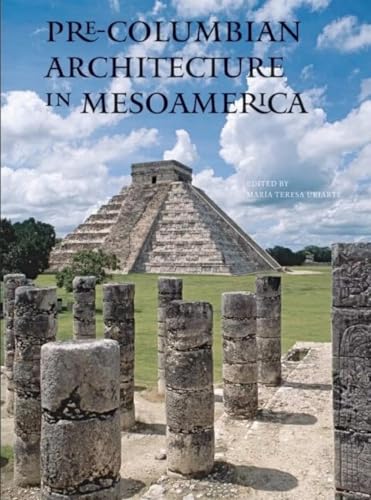
Pre-Columbian architecture in Mesoamerica edited by Maria Teresa Uriarte ; with contributions by Claudia Brittenham ; translted from spanish by Tanya Huntington. txt
United States of AmericaNew YorkLondonItalyAbbeville Press Publishers2010Edición: First editionDescripción: 335 p. ill.; photo; maps. 33 cmTipo de contenido:
An authoritative and magnificently illustrated survey of Mesoamerican architecture from pre-Olmec times to the Spanish conquest.
Pre-Columbian Architecture in Mesoamerica is destined to become a standard reference for the serious student and an intellectual delight for the interested amateur. This authoritative yet accessible study begins with an overview of the aesthetics, meanings, functions, and techniques of Mesoamerican architecture, and then proceeds to survey the historical development of the builder's art in each of the region's cultural areas. As readers travel from the the Maya heartland of Guatemala and the Yucatan to the Aztec stronghold of the Valley of Mexico, and all the way to the northern hinterlands of Mesoamerica, they will gain an appreciation of both the unity and the diversity of the region's architecture. The concluding chapter is devoted to the descriptions of architecture that have survived in Mayan and Aztec texts; it includes a unique and valuable glossary of the relevant glyphs.
The main text is illustrated with color photographs of the spectacular remains of pyramids, palaces, and plazas, while a scholarly appendix presents maps, plans, and drawings of the most important sites and structures.
Include index.
Includes bibliographical references.
Tabla de contenidos provista por Syndetics
Preface
1 Architecture as Art
2 Architecture and Its Hidden Messages
3 The Function and Techniques of Architecture
4 Pre-Olmec and Olmec Architecture
5 The Development of Architecture in the Central High Plains
6 Architecture in the West: Its Originality and Its Integration with the Mesoamerican Panorama
7 Northern Mexico: Architecture in the Landscape
8 Central Veracruz
9 Pre-Hispanic Architecture in the Huastec Region
10 The Architecture of Oaxaca
11 Mayan Architecture
12 Architecture in Mayan and Nahuatl Texts
Technical Illustrations
Notes
Bibliography
Index
Extracto provisto por Syndetics
Excerpt from Pre-Columbian Architecture in Mesoamerica PREFACE María Teresa Uriarte Publishing a book has a lot in common with gardening. First you plant the seed of an idea, and then you work to make it sprout and grow. At last, the mature plant bears fruit when the reader holds the finished product in his or her hands. So it was with this volume. The authors discussed their ideas at length, in numerous meetings. From the outset, we knew we wanted a new and different plant, one that did not repeat what had already been said about Pre-Columbian architecture. We agreed that this architecture should be considered in terms of its artistic values, and explored from an interdisciplinary perspective: architecture, urban studies, and art history would form the axis around which the contributions of archaeology, linguistics, and even astronomy would revolve. This approach was suggested in part by Beatriz De La Fuente, who in the course of preparing a previous volume on Pre-Columbian sculpture had realized the need for a study of Mesoamerican architecture that viewed it as art. Our book's theoretical groundwork is presented in the first three chapters. In chapter one, Antonio Toca and I discuss what we consider to be the aesthetic qualities of architecture; in chapter two, we investigate the meanings that emerge from architecture's relation to people, its surroundings, and the cosmos; and in chapter three, we analyze Mesoamerican construction techniques. Jesús Galindo uses his expertise as an astronomer to illustrate ancient buildings' connections to celestial objects and the calendar, which reveal the Mesoamerican preoccupation with the measurement of time. While the following chapters, which survey individual regions, are more conventionally organized, we still attempt to offer the reader novel analyses and hypotheses that permit different ways of looking at buildings. We explore the fundamental structural elements that Mesoamerican cultures, from the Olmecs to the Aztecs, used to create harmonious architectural environments of which people were an integral part. In the innovative final chapter, Erik Velásquez presents his research on language and writing and their relationship to architecture. This book is an invitation for the reader to learn about people who are different from him or her, but also similar, and to visit the places where they lived and went about their daily business. These were men and women like anybody else, and nobody else, typical yet also unique in their customs and beliefs, their myths and rituals, which they made into a tangible reality through their buildings and urban spaces. Ii is an invitation to envision, and envision oneself in, ancient cities that can be as close or as distant as we choose. The authors have brought together words and images that will take the receptive reader on a journey beyond our contemporary time and space. Thank you for coming along. Excerpted from Pre-Columbian Architecture in Mesoamerica All rights reserved by the original copyright owners. Excerpts are provided for display purposes only and may not be reproduced, reprinted or distributed without the written permission of the publisher.
Reseñas proporcionadas por Syndetics
Library Journal Review
This is one of the most beautiful books ever published on Mesoamerican architecture; it's extensively illustrated, scholarly, completely footnoted, and well organized, and it presents ample maps, glossaries, and indexes. Uriarte (researcher, Instituto de Investigaciones Estéticas, Universidad Autónoma de México) collects essays by 11 established scholars-mainly Central Americans-from leading institutions such as Yale University. Each author addresses a separate topic involving specific regions, isolated cultures, monumental buildings, technical features, imaged writings, linear drawings, and even cities located between Panama and the United States. The wealth of the material is enormous (pyramids, sculptures, paintings, murals, epigraphs, columns, and pavements in addition to specific buildings and cities) and the analyses are clear.VERDICTThis book belongs in any fully stocked art or architecture library, but its 13- height makes it oversized. The coverage and the illustrations are breathtaking; fans of this type of architecture will be overjoyed.-Peter S. Kaufman, formerly with Boston Architectural Coll. (c) Copyright 2010. Library Journals LLC, a wholly owned subsidiary of Media Source, Inc. No redistribution permitted.
CHOICE Review
This is an ambitious survey of one of the great architectural traditions of the ancient world. Written by notable archaeologists and art historians, the book opens with three thematic chapters addressing aesthetics, technology, function, and meaning, including dramatic astronomical alignments of buildings for which Mesoamerica is renowned. Following this are eight regionally focused essays surveying the architecture of such well-known groups as the Olmec, Maya, Teotihuacan, and Aztec, and also those less well known in northern and western Mexico. Seeing all of this material in one volume is a rare pleasure. This book was originally published in Spanish, and unfortunately the prose suffers at times from awkward translation. Touching briefly on most topics, the essays are introductory and generalized. What is lacking in depth, however, is compensated for in expansive coverage, as the book discusses and illustrates no fewer than 89 archaeological sites. An interesting final chapter amasses hieroglyphic texts and symbols referring to architectural elements (e.g., lintel, stair, and ball court) found in classic Maya and colonial Aztec writing. The book's oversized format and generous illustrations provide a satisfying way for the novice to begin to explore Mesoamerican architecture. Summing Up: Highly recommended. Lower- and upper-division undergraduates; general readers. A. J. Stone University of Wisconsin-Milwaukee
Notas de autor provistas por Syndetics
María Teresa Uriarte is a researcher at the Instituto de Investigaciones Estéticas of the Universidad Autónoma de México.
Pre-Columbian architecture in Mesoamerica
APA
Uriarte M. T., Brittenham C., . (2010). Pre-Columbian architecture in Mesoamerica. United States of America: Abbeville Press Publishers.
Chicago
Uriarte María Teresa, Brittenham Claudia, . 2010. Pre-Columbian architecture in Mesoamerica. United States of America: Abbeville Press Publishers.
Harvard
Uriarte M. T., Brittenham C., . (2010). Pre-Columbian architecture in Mesoamerica. United States of America: Abbeville Press Publishers.
MLA
Uriarte María Teresa, Brittenham Claudia, . Pre-Columbian architecture in Mesoamerica. United States of America: Abbeville Press Publishers. 2010.