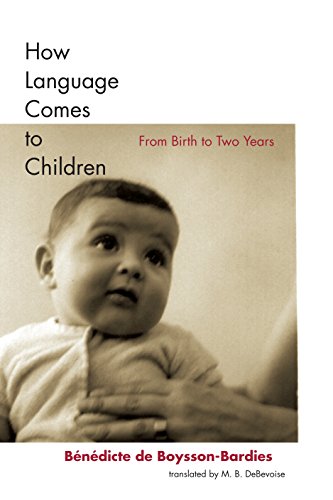

How language comes to children from birth to two years Bénédicte de Boysson-Bardies ; translated by M.B. DeBevoise.
Idioma: Inglés Lenguaje original: Francés Detalles de publicación: Cambridge, Mass. MIT Press c1999.Descripción: xiv, 274 p. 23 cmISBN:- 0262024535 (alk. paper)
- 401/.93 21
- P118 .B65413 1999
| Imagen de cubierta | Tipo de ítem | Biblioteca actual | Biblioteca de origen | Colección | Ubicación en estantería | Signatura topográfica | Materiales especificados | Info Vol | URL | Copia número | Estado | Notas | Fecha de vencimiento | Código de barras | Reserva de ítems | Prioridad de la cola de reserva de ejemplar | Reservas para cursos | |
|---|---|---|---|---|---|---|---|---|---|---|---|---|---|---|---|---|---|---|
| Libro | Biblioteca de Mayagüez Colección General mb | P118 .B65413 1999 (Navegar estantería(Abre debajo)) | Disponible | 50000002087202 |
Descripciones mejoradas de Syndetics:
This text presents a broad picture of language development from foetal development to the toddler years, and examines a range of questions: how do newborns recognize elements of speech?; how do they distinguish them from non-speech sounds?; how do they organize and analyze them?; how do they ultimately come to understand and reproduce these sounds?; and how does the ability to communicate through language emerge in children? The author also addresses questions of particular interest to parents, such as whether one should speak to children in a special way to facilitate language learning and whether there is cause to worry when a 20-month-old child does not yet speak. A feature of the book is the author's research and dialogue with her many young subjects.
"A Bradford book."
Includes bibliographical references (p. [238]-257) and index.
Tabla de contenidos provista por Syndetics
- Translator's Note(p. xi)
- Acknowledgments(p. xiii)
- Introduction(p. 1)
- The Gift of Language(p. 2)
- A Complex Gift(p. 2)
- The Gift of Evolution(p. 4)
- The Gift of Speech and the Child(p. 5)
- The Question of Modularity(p. 7)
- An Interactive Learning System(p. 8)
- Speech and Communication(p. 9)
- From Infans to Child(p. 10)
- 1 The Infant Does Not Talk, But ...(p. 13)
- The Newborn Child: A Stranger(p. 13)
- Speech Is Not the Infant's Language(p. 15)
- A Competent Newborn(p. 18)
- The Infant Is Prepared Before Birth(p. 22)
- The Talents of Infants(p. 26)
- What's in a Name?(p. 28)
- Organization of the Brain for Language(p. 29)
- 2 The Emergence of Speech(p. 37)
- Vocal Expressions of the First Months(p. 37)
- Quick Studies of Their Native Language(p. 40)
- Babbling(p. 45)
- What Do Children Say Between Seven and Ten Months?(p. 46)
- What Do Children Say Between Ten and Twelve Months?(p. 49)
- Wherein the Babbling of Babes Is Subjected to the Seriousness of Scientists(p. 51)
- Do French Babies Babble in French and Yoruba Babies in Yoruba?(p. 56)
- They Begin Speaking Their Language Without an Accent(p. 64)
- Babbling in Sign Language(p. 68)
- 3 The Communicative Universe of the Baby(p. 71)
- Communication and Expression(p. 71)
- Looking(p. 73)
- Reciprocal Behaviors(p. 74)
- Turn-Taking(p. 76)
- Expression of Emotion(p. 77)
- Sharing Information About the Outside World(p. 79)
- Motherese(p. 81)
- Baby Talk(p. 84)
- Cultures and Modes of Talking to Babies(p. 85)
- Critical Periods(p. 91)
- 4 Discovering the Meaning of Words: Nine to Seventeen Months(p. 95)
- Dividing Up and Assembling(p. 95)
- The Infant in Action(p. 100)
- Putting Together the Pieces of the Puzzle(p. 101)
- The Problem of Small Pieces(p. 106)
- Recognizing and Understanding(p. 109)
- Finding the Same Object Again(p. 111)
- Recognizing Familiar Words(p. 113)
- The Mental Representation of Words(p. 115)
- Understanding Words(p. 119)
- 5 The First Lexical Steps: Eleven to Eighteen Months(p. 127)
- The Words for Saying It(p. 127)
- The World and the Baby(p. 129)
- Is the Baby a Physicist?(p. 130)
- Objects and Words(p. 133)
- First Words(p. 136)
- Trials and Errors(p. 141)
- Two Lexicons?(p. 145)
- Building the First Vocabulary(p. 146)
- 6 To Each Baby His Own Style(p. 149)
- All the Same and All Different(p. 149)
- Emilie, Sean, and Timmy: The Minimalist Strategy(p. 152)
- Simon, Leo, and Marie: The Charms of Conversation(p. 158)
- Charles, Noel, and Others: The Middle Way(p. 168)
- Henri: Stepping Back to Move Forward(p. 171)
- They Are the Ones Who Choose(p. 174)
- 7 Languages, Cultures, and Children(p. 177)
- Language and Socialization(p. 177)
- Cultural Milieus and First Words(p. 179)
- Subjects of Conversation of French, American, Swedish, and Japanese Children(p. 182)
- The Hedonism of French Babies(p. 184)
- The Pragmatism and Sociability of American Children(p. 185)
- The Taste for Action of Swedish Children(p. 186)
- The Aesthetic Sense of Japanese Babies(p. 186)
- But All the Children of the World(p. 188)
- 8 Speech Becomes Language: Eighteen to Twenty-Four Months(p. 189)
- A New Step(p. 189)
- The Explosion of the Lexicon(p. 190)
- The Discovery of Phonology(p. 191)
- The Modification of Cerebral Responses(p. 194)
- First Sentences(p. 198)
- The First Sentences of French Children(p. 202)
- Conclusion(p. 211)
- Appendix A The Principal Stages in the Development of Speech from Before Birth to Two Years(p. 217)
- Appendix B International Phonetic Alphabet(p. 221)
- Notes(p. 225)
- Glossary(p. 227)
- Bibliography(p. 239)
- Index(p. 259)