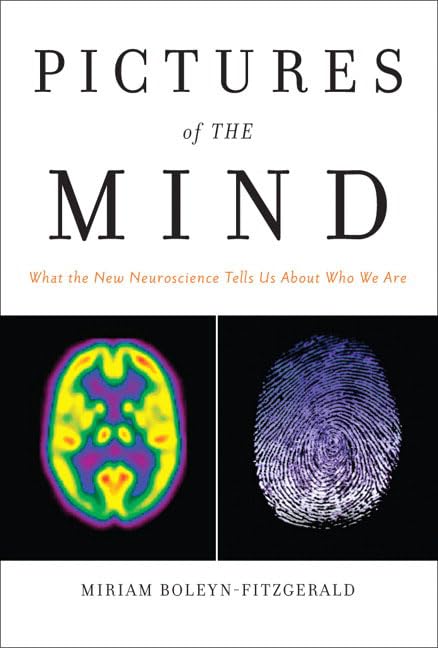

Pictures of the mind what the new neuroscience tells us about who we are Miriam Boleyn-Fitzgerald.
Detalles de publicación: Upper Saddle River, New Jersey FT Press c2010.Descripción: xiv, 177 pages, [16] pages of plates colored illustrations 24 centimetersISBN:- 9780137155163 (hc : alk. paper)
- 0137155166
- 616.8 22
- RC341 .B65 2010
| Imagen de cubierta | Tipo de ítem | Biblioteca actual | Biblioteca de origen | Colección | Ubicación en estantería | Signatura topográfica | Materiales especificados | Info Vol | URL | Copia número | Estado | Notas | Fecha de vencimiento | Código de barras | Reserva de ítems | Prioridad de la cola de reserva de ejemplar | Reservas para cursos | |
|---|---|---|---|---|---|---|---|---|---|---|---|---|---|---|---|---|---|---|
| Libro | Biblioteca de Mayagüez Colección General mb | RC341 .B65 2010 (Navegar estantería(Abre debajo)) | Disponible | 50000003244828 |
Descripciones mejoradas de Syndetics:
Neuroscientists once believed your brain was essentially "locked down" by adulthood. No new cells. No major changes. If you grew up depressed, angry, sad, aggressive, or nasty, you'd be that way for life. And, as you grew older, there'd be nowhere to go but down, as disease, age, or injury wiped out precious, irreplaceable brain cells. But over the past five, ten, twenty years, all that's changed. Using fMRI and PET scanning technology, neuroscientists can now look deep inside the human brain and they've discovered that it's amazingly flexible, resilient, and plastic.
Pictures of the Mind: What the New Neuroscience Tells Us About Who We Are shows you what they've discovered and what it means to all of us. Through author Miriam Boleyn-Fitzgerald's masterfully written narrative and use stunning imagery, you'll watch human brains healing, growing, and adapting to challenges. You'll gain powerful new insights into the interplay between environment and genetics, begin understanding how people can influence their own intellectual abilities and emotional makeup, and understand the latest stunning discoveries about coma and "locked-in" syndrome. You'll learn about the tantalizing discoveries that may lead to cures for traumatic brain injury, stroke, emotional disorders, PTSD, drug addiction, chronic pain, maybe even Alzheimer's. Boleyn-Fitzgerald shows how these discoveries are transforming our very understanding of the "self", from an essentially static entity to one that can learn and change throughout life and even master the art of happiness.Life, death, and the middle ground -- The good, the bad, and the ugly : powerful emotions and our power to work with them -- Happiness on the brain -- Cooling the flame : pictures of addiction, chronic pain, and recovery -- Landscape -- Where does morality live, and when is it home? -- The making and breaking of memories -- Where am "I"? experiences of self, other, and neither.
Includes bibliographical references and index.
Extracto provisto por Syndetics
Reseñas proporcionadas por Syndetics
Publishers Weekly Review
Over the past decade, a revolution in medical imaging has allowed researchers to scan the brain of subjects in situ, while setting their minds to an assigned task. Functional magnetic resonance imaging (fMRI) and positron emission tomography (PET) are revealing, among other discoveries, that the brain of some apparently vegetative patients can be active; the brain's ability to heal and grow well beyond what was previously believed; and the various centers of different behaviors and skills. Physicist and science writer Boleyn-Fitzgerald addresses brain injury, addiction, memory, meditation, and more with summaries of recent research, cogent explanations of what scientists are learning, and plentiful references. Fascinatingly, she illustrates how "[k]notty questions about morality, blame, and punishment provide abundant raw material for brain researchers," who can assess, for instance, "whether ¿normal' brains are wired for altruism and cooperation." Boleyn-Fitzgerald writes in a clear voice, making scientific data engaging and accessible for anyone with an interest in the study of neurology, mindfulness, or behavior. (Feb.) Copyright 2010 Reed Business Information.Notas de autor provistas por Syndetics
For 15 years, Miriam Boleyn-Fitzgerald has published on a wide range of scientific topics geared to curious readers of all backgrounds. She believes in taking the boring out of "technical" so that we might all have ready access to knowledge that can help us lead happier, healthier, more fulfilling lives.
With a degree in physics from Swarthmore College, Ms. Boleyn-Fitzgerald is a former recipient of the Thomas J. Watson Fellowship and the Ida M. Green Award for graduate studies in Science, Technology, and Society at the Massachusetts Institute of Technology. She has worked as a staff writer for President Clinton's Advisory Committee on Human Radiation Experiments and as an analyst for the Natural Resources Defense Council and the Union of Concerned Scientists. Ms. Boleyn-Fitzgerald lives and writes in Appleton, Wisconsin, with her husband Patrick and their son Aidan.