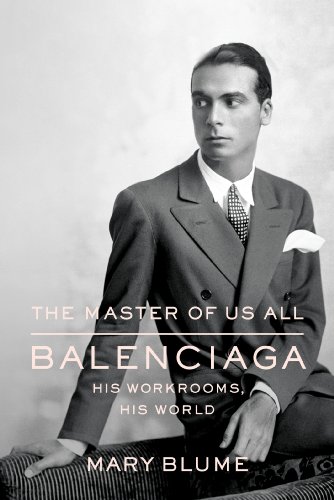

The master of us all Balenciaga, his workrooms, his world Mary Blume.
Detalles de publicación: New York Farrar, Straus and Giroux ©2013.Edición: First editionDescripción: 228 pages illustrations (some color) 22 cm Tipo de medio:- 9780374298739 (hardback)
- 746.9/2092 B 23
- TT505.B28 B59 2013
| Imagen de cubierta | Tipo de ítem | Biblioteca actual | Biblioteca de origen | Colección | Ubicación en estantería | Signatura topográfica | Materiales especificados | Info Vol | URL | Copia número | Estado | Notas | Fecha de vencimiento | Código de barras | Reserva de ítems | Prioridad de la cola de reserva de ejemplar | Reservas para cursos | |
|---|---|---|---|---|---|---|---|---|---|---|---|---|---|---|---|---|---|---|
| Libro | Biblioteca Encarnación Valdés Colección General bev | 746.92092 B6586m (Navegar estantería(Abre debajo)) | Disponible | 80000002552787 |
Descripciones mejoradas de Syndetics:
When Cristobal Balenciaga died in 1972, the news hit the front page of The New York Times. One of the most innovative and admired figures in the history of haute couture, Balenciaga was, said Schiaparelli, the only designer who dares do what he likes. He was, said Christian Dior,the master of us all. But despite his extraordinary impact, Balenciaga was a man hidden from view. Unlike today's celebrity designers, he saw to it that little was known about him, to the point that some French journalists wondered if he existed at all. Even his most notable and devoted clients - Marlene Dietrich, Barbara Hutton, a clutch of Rothschilds - never met him. But one woman knew Balenciaga very well indeed. The first person he hired when he opened his Paris house (then furnished with only a table and a stool) was Florette Chelot, who became his top vendeuse-as much an adviser as a saleswoman. She witnessed the spectacular success of his first collection, and they worked closely for more than thirty years, until 1968, when Balenciaga abruptly closed his house without telling any of his staff. Youth-oriented fashion was taking over, Paris was in upheaval, and the elder statesman wanted no part of it. In The Master of Us All, Mary Blume tells the remarkable story of the man and his house through the eyes of the woman who knew him best. Intimate and revealing, this is an unprecedented portrait of a designer whose vision transformed an industry but whose story has never been told until now.
"A sparkling life of the monumental fashion designer Cristóbal Balenciaga When Cristóbal Balenciaga died in 1972, the news hit the front page of The New York Times. One of the most innovative and admired figures in the history of haute couture, Balenciaga said that he was the only designer who dared to do as he liked. He was, said Christian Dior, "the master of us all." But despite his extraordinary impact, he was a man hidden from view. Unlike today's celebrity designers, he saw to it that little was known about him, to the point that some French journalists wondered if he existed at all. Even his most notable and devoted clients never met him. But one woman knew Balenciaga better than anyone else. The first person he hired when he opened his Paris house, furnished with only a table and a chair, Florette Chelot became his top vendeuse--as much an adviser as a saleswoman. She witnessed the spectacular success of his first collection, and they worked closely for thirty years--until 1968, when Balenciaga abruptly closed his house without telling any of his staff. Youth-oriented fashion was taking over, Paris was in upheaval, and the elder statesman wanted no part of it. In The Master of Us All, Mary Blume tells the remarkable story of the man and his house through the eyes of the woman who knew him best. Intimate and revealing, this is an unprecedented portrait of a designer whose vision transformed an industry, but whose story has never been told until now"-- Provided by publisher.
"The sparkling life of the monumental fashion designer Cristobal Balenciaga. A biography"-- Provided by publisher.
Includes bibliographical references.