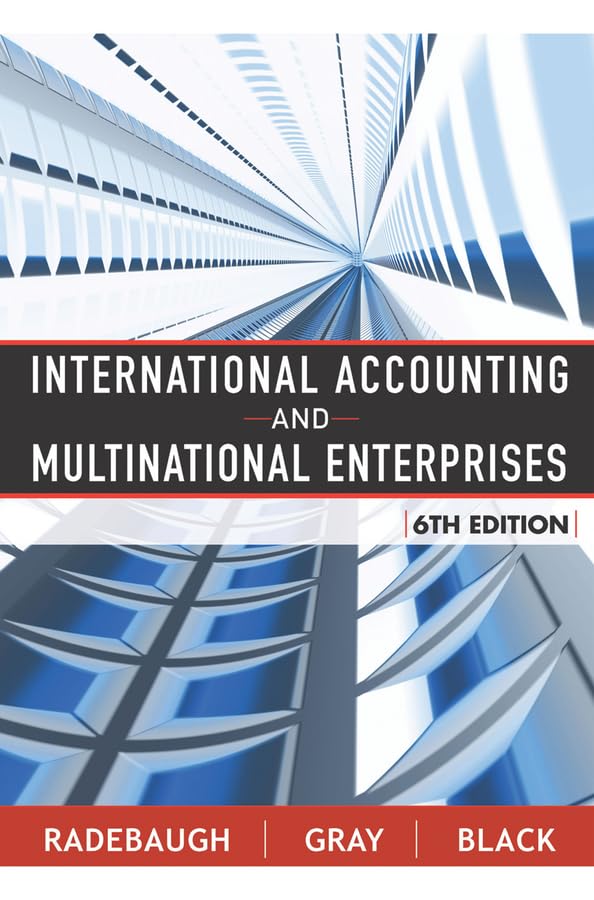

International accounting and multinational enterprises Lee H. Radebaugh, Sidney J. Gray, Ervin L. Black .
Detalles de publicación: New York John Wiley & Sons c2006.Edición: 6th edDescripción: xiv, 506 p. ill. 26 cmISBN:- 9780471652694
- 657/.96 20
- HF5686.I56 A76 2006
| Imagen de cubierta | Tipo de ítem | Biblioteca actual | Biblioteca de origen | Colección | Ubicación en estantería | Signatura topográfica | Materiales especificados | Info Vol | URL | Copia número | Estado | Notas | Fecha de vencimiento | Código de barras | Reserva de ítems | Prioridad de la cola de reserva de ejemplar | Reservas para cursos | |
|---|---|---|---|---|---|---|---|---|---|---|---|---|---|---|---|---|---|---|
| Libro | Biblioteca de Mayagüez Colección General mb | HF5686 .I56 A76 2006 (Navegar estantería(Abre debajo)) | Disponible | 50000003208898 |
Descripciones mejoradas de Syndetics:
Make informed decisions in today's dynamic international business environments
International accounting has never been so exciting. Not only is the pace of international business, finance, and investment rapidly increasing, but we are also moving closer than ever before toward a convergence of accounting standards worldwide.
Updated and revised to keep pace with these changes, this Sixth Edition of Radebaugh, Gray, and Black's International Accounting and Multinational Enterprises focuses on international business strategies and how accounting applies to these strategies. You'll learn how to use financial and accounting information across borders, and make more informed decisions in an increasingly complex international business environment. The authors also explain the key factors, including cultural differences, that influence accounting standards and practices in different countries, and how those factors impact the harmonization of standards worldwide.
New to This Edition:
* New coauthor, Ervin L. Black of Brigham Young University.
* Updated coverage on corporate governance, Sarbanes-Oxley, the Public Company Accounting Oversight Board (PCAOB), and how these forces affect U.S.-based multinationals, as well as companies in other countries.
* Increased coverage of the efforts of the International Accounting Standards Board (IASB) to establish a uniform set of International Financial Reporting Standards (IRFS) worldwide and its interface with different national standard setters, especially the FASB. Special attention is given to the experience of the European Union and Australia in adopting IFRS in 2005.
* A web-based International Accounting Practice Problem, which helps students see how to apply IFRS to a set of transactions.
* Brief, user-oriented examples called Strategic Decision Points at the beginning of each chapter.
* Expanded end-of-chapter material, including more discussion questions and exercises.
* New cases (two per chapter) on the web.
* Accounting for foreign exchange is now covered in two chapters. One chapter focuses on accounting issues, and the other chapter, which is new, focuses on foreign exchange risk management.
adq 11/2011
Includes bibliographical references and indexes.
Tabla de contenidos provista por Syndetics
- Chapter 1 International Accounting and International Business(p. 1)
- Introduction(p. 1)
- The International Development of the Accounting Discipline(p. 2)
- National Differences in Accounting Systems(p. 5)
- The Evolution and Significance of International Business(p. 6)
- Forms of International Involvement(p. 9)
- Environmental Influences on Accounting(p. 15)
- Major Development Factors(p. 18)
- Accountability and Multinational Enterprises(p. 24)
- Accounting Aspects of International Business(p. 25)
- The Field of International Accounting(p. 26)
- Summary(p. 29)
- Chapter 2 International Accounting Patterns, Culture and Development(p. 34)
- Introduction(p. 34)
- Purposes of International Classification(p. 35)
- Classification of Accounting and Reporting Systems(p. 35)
- Cultural Influences on Accounting Systems(p. 41)
- Culture, Societal Values, and Accounting(p. 42)
- International Pressures for Accounting Change(p. 52)
- Summary(p. 54)
- Chapter 3 Comparative International Financial Accounting I(p. 60)
- Introduction(p. 60)
- Anglo-American Accounting(p. 62)
- Nordic Accounting(p. 65)
- Germanic Accounting(p. 67)
- Latin Accounting(p. 70)
- Asian Accounting(p. 72)
- Summary(p. 74)
- Chapter 4 Comparative International Financial Accounting II(p. 79)
- Introduction(p. 79)
- Anglo-American Accounting(p. 82)
- Latin Accounting(p. 83)
- Asian Accounting(p. 85)
- Eastern European Accounting(p. 88)
- Summary(p. 91)
- Chapter 5 International Financial Statement Analysis(p. 95)
- Introduction(p. 95)
- International Accounting Differences and Financial Statement Analysis(p. 96)
- Major Differences in Accounting Principles Around the World(p. 99)
- The Impact of U.S.-U.K. Accounting Differences: A Quantitative Analysis(p. 103)
- A Global Perspective on Earnings Measurement(p. 106)
- A Comparative Global Analysis(p. 108)
- International Accounting Differences and the Stock Market(p. 109)
- Factors Influencing Measurement Differences(p. 109)
- Global Accounting Convergence(p. 110)
- Summary(p. 110)
- Chapter 6 International Transparency and Disclosure(p. 124)
- Introduction(p. 124)
- The Meaning of Transparency(p. 125)
- Disclosure in Corporate Reports(p. 126)
- International Disclosure Regulation(p. 135)
- Corporate Reporting Trends(p. 139)
- Corporate Review Information(p. 139)
- Operations Review(p. 143)
- Financial Review(p. 144)
- Frequency and Timeliness of Reporting(p. 145)
- Growing Pressures for Transparency(p. 145)
- Summary(p. 145)
- Chapter 7 International Accounting Standards and Global Convergence(p. 151)
- Introduction(p. 151)
- Governments(p. 153)
- Trade Unions and Employees(p. 167)
- Investors(p. 169)
- Bankers and Lenders(p. 171)
- Accountants and Auditors(p. 171)
- The International Harmonization and Disclosure Debate(p. 182)
- Summary(p. 183)
- Chapter 8 International Business Combinations, Goodwill, and Intangibles(p. 189)
- Introduction(p. 190)
- Consolidated Financial Statements(p. 190)
- Funds and Cash Flow Statements(p. 197)
- Joint Venture Accounting(p. 199)
- Goodwill and Intangibles(p. 200)
- Goodwill(p. 202)
- Brands, Trademarks, Patents, and Related Intangibles(p. 209)
- Research and Development(p. 213)
- Summary(p. 216)
- Chapter 9 International Segment Reporting(p. 223)
- Introduction(p. 223)
- Users and Uses of Segment Information(p. 224)
- The Benefits of Segment Reporting(p. 225)
- The Costs of Segment Reporting(p. 226)
- International Financial Reporting Standards(p. 227)
- Regulations Around the World(p. 228)
- Segment Reporting Problems(p. 231)
- The Dual-Yardstick Proposal(p. 234)
- Summary(p. 241)
- Chapter 10 Accounting for Foreign Currency(p. 246)
- Introduction(p. 246)
- Basics In Foreign Exchange(p. 247)
- Foreign Currency Transactions(p. 250)
- Translation of Foreign Currency Financial Statements(p. 254)
- Translation Methodologies: An Overview(p. 255)
- International Accounting Standards(p. 257)
- Historical Development in the United States(p. 257)
- Convergence(p. 274)
- Summary(p. 274)
- Chapter 11 International Accounting for Price Changes(p. 284)
- Introduction(p. 284)
- Impact of Inflation on the Corporation(p. 285)
- Accounting Measurement Alternatives(p. 286)
- International Financial Reporting Standards(p. 289)
- Comparative National Regulation and Practice(p. 291)
- Problems and Prospects(p. 298)
- Summary(p. 299)
- Chapter 12 Corporate Governance and Control of Global Operations(p. 303)
- Introduction(p. 303)
- Global Strategic Issues(p. 304)
- Informal and Subtle Mechanisms(p. 308)
- Organizational Structure(p. 308)
- Corporate Governance(p. 313)
- International Importance of Governance(p. 316)
- Studies on International Corporate Governance Practices(p. 317)
- Cross National Differences in Corporate Governance(p. 322)
- Internal Controls(p. 326)
- The Role of Information Technology in MNEs(p. 328)
- Firm Strategy, Structure, and the Accounting Function(p. 332)
- Summary(p. 334)
- Chapter 13 Managing Foreign Exchange Exposure(p. 342)
- Introduction(p. 342)
- Foreign Exchange(p. 343)
- Types of Hedging Exposure(p. 353)
- Hedging Strategies(p. 356)
- Accounting for Foreign Currency Derivatives(p. 360)
- Use of Derivatives to Hedge a Net Investment(p. 369)
- Disclosure of Derivative Financial Instruments(p. 369)
- Summary(p. 371)
- Chapter 14 International Budgeting and Performance Evaluation(p. 380)
- Introduction(p. 380)
- The Strategic Control Process(p. 381)
- Empirical Studies of Differences in Management Accounting and Control Practices Across Nations(p. 382)
- Challenges of Control in the Global Firm(p. 390)
- Intracorporate Transfer Pricing(p. 397)
- Performance Evaluation Issues(p. 403)
- Economic Value Added(p. 405)
- The Balanced Scorecard(p. 407)
- Summary(p. 409)
- Chapter 15 International Auditing Issues(p. 420)
- Introduction(p. 420)
- The Accounting and Auditing Profession(p. 421)
- Global Audit Services and the International Auditing Challenge(p. 422)
- Audit Challenges: Local Business Practices and Customs(p. 424)
- Audit Challenges: Currency, Language, and Law(p. 425)
- Audit Challenges: Distance and Organization for Providing Audit Services(p. 425)
- Audit Challenges: Audit Impediments from International Diversity, Availability, and Training of Auditors(p. 427)
- Global Accounting Firms(p. 430)
- Audit Standards(p. 434)
- Summary(p. 455)
- Chapter 16 International Taxation Issues(p. 464)
- Introduction(p. 464)
- Direct Taxes(p. 465)
- Indirect Taxes(p. 468)
- The Avoidance of Double Taxation of Foreign Source Income(p. 469)
- U.S. Taxation of Foreign Source Income(p. 471)
- Tax Effects of Foreign Exchange Gains and Losses(p. 475)
- Tax Incentives(p. 477)
- Tax Dimensions of Expatriates(p. 478)
- Intracorporate Transfer Pricing(p. 479)
- Tax Planning in the International Environment(p. 482)
- Summary(p. 483)
- Name and Company Index(p. 489)
- Subject Index(p. 493)
Notas de autor provistas por Syndetics
Lee Radebaugh, Ph.D., is the Director of the School of Accountancy and Information Systems and KPMG Professor of Accounting at Brigham Young University. In addition, he is the Executive Director of the BYU Center for International Business Education and Research (CIBER). Professor Radebaugh is co-author of International Business Environments and Operations and International Accounting and Multinational Enterprises, and is the co-author of seven books on Canada-U.S. trade and investment relations. In 1998 he was named the "Outstanding International Educator" of the International Section of the American Accounting Association, and "International Person of the Year" by the World Trade Association of Utah.Sidney J. Gray, Ph.D., is Professor of International Business and Head of the School of International Business in the Faculty of Commerce and Economics at the University of New South Wales. He is also foundation Co-Director of the Australian Centre for International Business(a collaborative venture with the University of Melbourne). Professor gray has published in many leading journals around the world, and is the author/co-author of a number of books, including International Accounting and Multinational Enterprises and Financial Accounting: A Global Approach. In 1994 he as named "Outstanding International Accounting Educator" by the American Accounting Association.