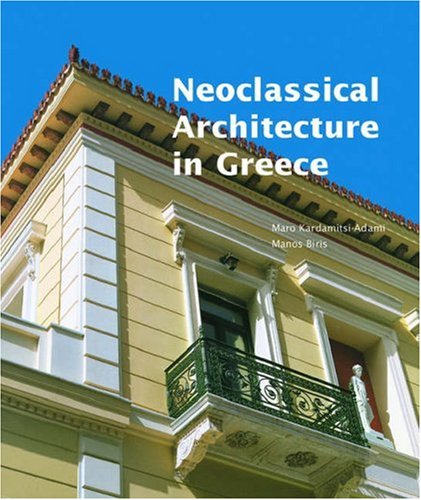

Neoclassical architecture in Greece : Manos Biris, Maro Kardamitsi-Adami ; [David Hardy, translator]. txt
Idioma: Español Los Angeles : Getty Publications, 2009Descripción: 312 p. ill. (chiefly col.) ; plans ; 30 cmTipo de contenido:- text
- unmediaded
- volume
- 9780892367757
- 720/.9495/09034 22
- NA1097 B5713 2004
| Imagen de cubierta | Tipo de ítem | Biblioteca actual | Biblioteca de origen | Colección | Ubicación en estantería | Signatura topográfica | Materiales especificados | Info Vol | URL | Copia número | Estado | Notas | Fecha de vencimiento | Código de barras | Reserva de ítems | Prioridad de la cola de reserva de ejemplar | Reservas para cursos | |
|---|---|---|---|---|---|---|---|---|---|---|---|---|---|---|---|---|---|---|
| Libro Col. General CARIBET | CARIBET Biblioteca Arquitectura Colección General CARIBET | General NA1097 B5713 2004 (Navegar estantería(Abre debajo)) | 1 | Disponible | 91000000022012 |
Descripciones mejoradas de Syndetics:
The establishment of the Modern Greek state in the late 1820s, after four centuries of Ottoman rule, marks a crucial advance in the long history of the Greek nation. Inspired by their new sense of nationalism, the Greeks turned to their own rich architectural heritage - the physical ruins of whose glories stood all around them - for inspiration in building the towns and cities of the new Greek state. The development of this Neoclassical architecture in Greece had distant roots in the Enlightenment and the climate of Western humanism - including a predilection for the ancient world that pervaded eighteenth-century European thought.
Includes index.
Includes bibliographical references (p. 305-307) and index.
Acknowledgements 10 --
Introduction 13 --
The Models, The Reappraisal of Antiquity, The Urban Character, Classical Order as a Means of Expression 15 --
Tradition and Western Influences, Transmutations of the Classical, Ideological and Aesthetic Openings 27 --
The new Greek state, The imposition of planning under Kapodistrias 51 --
Athens the capital, Reconstructing the city, The Consolidation of Monumentality 69 --
The Zenith of Athenian Classicism, Urban Society Matures, Public Buildings, Athenian Residences 133 --
The Unredeemed Territories, The Period of Modernization, Epiros, Central and Nortern Greece, The Islands 171 --
Mass Classicism, The Late Nineteenth Century Aesthetic, The Work of Ernst Ziller, Decentralized Classicism, The Symbolism of style, The Byzantine Revival 211 --
The Transition to Modernism, The Centers That Received the New Styles Between Academism and Greekness 261 --
Epilogue 297 --
Bibliography 305 --
Index 308 --
Sources of Illustrations 312 --
Abbreviations 312 --
"Nineteenth-century urban architecture in Greece took European classicism as its starting point - but the style was cultivated and developed in the shadow of its incomparable models, the Classical monuments on the Acropolis." "The outcome was unique. The Neoclassical architecture formulated in Athens, the reborn Greek capital, displayed exceptional quality and lasting application." "In addition to Athens, many cities and towns throughout Greece followed the same architectural trend, expressed in the form of either Neoclassicism or late historicism. The urban landscape that emerged in Greece through the early twentieth century includes buildings that are remarkable both architecturally and artistically. Today, they attract an intense and growing interest." --