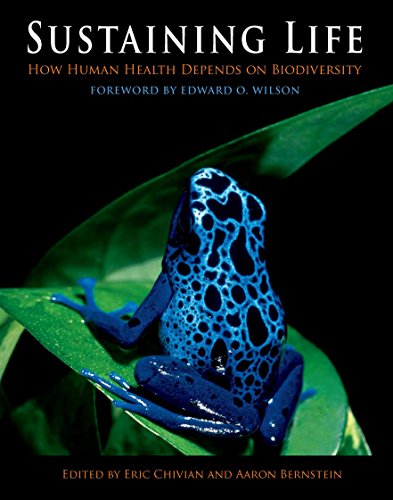
Imagen de portada de Amazon
Imagen de Amazon.com
Imagen de cubierta Syndetics
Portada de Syndetics
Imagen de OpenLibrary

Sustaining life how human health depends on biodiversity edited by Eric Chivian and Aaron Bernstein ; foreword by Edward O. Wilson ; prologue by Kofi Annan.

Colaborador(es): Detalles de publicación: Oxford New York Oxford University Press 2008.Descripción: xxiii, 542 p. ill. (chiefly col.), col. maps 29 cmISBN:
  • 9780195175097 (cloth : alk. paper)
  • 0195175093 (cloth : alk. paper)
Tema(s): Clasificación CDD:
  • 333.9516 S9649 22
Clasificación LoC:
  • QH541.15.B56 S96 2008
Recursos en línea:
Contenidos:
What is biodiversity? -- How is biodiversity threatened by human activity? -- Ecosystem services -- Medicines from nature -- Biodiversity and biomedical research -- Threatened groups of organisms valuable to medicine -- Ecosystem disturbance, biodiversity loss, and human infectious disease -- Biodiversity and food production -- Genetically modified foods and organic farming -- What individuals can do to help conserve biodiversity -- Treaties, conventions, and intergovernmental organizations for the conservation of biodiversity -- Nongovernmental organizations working to conserve biodiversity.
Valoración
    Valoración media: 0.0 (0 votos)
Existencias
Imagen de cubierta Tipo de ítem Biblioteca actual Biblioteca de origen Colección Ubicación en estantería Signatura topográfica Materiales especificados Info Vol URL Copia número Estado Notas Fecha de vencimiento Código de barras Reserva de ítems Prioridad de la cola de reserva de ejemplar Reservas para cursos
Libro Biblioteca Encarnación Valdés Colección General bev 333.9516 S9649 (Navegar estantería(Abre debajo)) Disponible 80000002432519
Total de reservas: 0

Descripciones mejoradas de Syndetics:

The Earth's biodiversity-the rich variety of life on our planet-is disappearing at an alarming rate. And while many books have focused on the expected ecological consequences, or on the aesthetic, ethical, sociological, or economic dimensions of this loss, Sustaining Life is the first book to examine the full range of potential threats that diminishing biodiversity poses to human health. Edited and written by Harvard Medical School physicians Eric Chivian and Aaron Bernstein, along with more than 100 leading scientists who contributed to writing and reviewing the book, Sustaining Life presents a comprehensive--and sobering--view of how human medicines, biomedical research, the emergence and spread of infectious diseases, and the production of food, both on land and in the oceans, depend on biodiversity. The book's ten chapters cover everything from what biodiversity is and how human activity threatens it to how we as individuals can help conserve the world's richly varied biota. Seven groups of organisms, some of the most endangered on Earth, provide detailed case studies to illustrate the contributions they have already made to human medicine, and those they are expected to make if we do not drive them to extinction. Drawing on the latest research, but written in language a general reader can easily follow, Sustaining Life argues that we can no longer see ourselves as separate from the natural world, nor assume that we will not be harmed by its alteration. Our health, as the authors so vividly show, depends on the health of other species and on the vitality of natural ecosystems. With a foreword by E.O. Wilson and a prologue by Kofi Annan, and more than 200 poignant color illustrations, Sustaining Life contributes essential perspective to the debate over how humans affect biodiversity and a compelling demonstration of the human health costs.

Includes bibliographical references (p. 445-514) and index.

"Secretariat of the Convention on Biological Diversity; United Nations Development Programme; United Nations Environment Programme; IUCN--The World Conservation Union."

What is biodiversity? -- How is biodiversity threatened by human activity? -- Ecosystem services -- Medicines from nature -- Biodiversity and biomedical research -- Threatened groups of organisms valuable to medicine -- Ecosystem disturbance, biodiversity loss, and human infectious disease -- Biodiversity and food production -- Genetically modified foods and organic farming -- What individuals can do to help conserve biodiversity -- Treaties, conventions, and intergovernmental organizations for the conservation of biodiversity -- Nongovernmental organizations working to conserve biodiversity.

Tabla de contenidos provista por Syndetics

  • Foreword
  • Prologue
  • 1 What is Biodiversity?
  • 2 How is Biodiversity Threatened by Human Activity?
  • 3 Ecosystem Services
  • 4 Medicines from Nature
  • 5 Biodiversity and Biomedical Research
  • 6 Threatened Groups of Organisms Valuable to Medicine
  • 7 Ecosystem Disturbance, Biodiversity Loss, and Human Infectious Disease
  • 8 Biodiversity and Food Production
  • 9 Genetically Modified Foods and Organic Farming
  • 10 What Individuals Can Do to Help Conserve Biodiversity
  • Appendix A Co-sponsors
  • Appnedix B Treaties, Conventions, and Intergovernmental Organizations
  • Appendix C Non-Governmental Organizations

Reseñas proporcionadas por Syndetics

Library Journal Review

This unique work, edited by two Harvard Medical School physicians, explores the symbiotic relationship among the planet's species and how animals, insects, and plants on land and water have provided enormous health benefits through the natural products they produce. Our quest for natural products to treat and cure diseases is dependent upon this biodiversity of flora and fauna for the long term. Alterations that result in pollution, habitat destruction, climate change, exploitation, radiation, war, and conflict threaten the survival of many of the organisms that have been so vital to human health. The editors illustrate this relationship by focusing on amphibians, bears, primates, gymnosperms, cone snails, sharks, and horseshoe crabs whose contributions to human well-being are critical and the tragedy that would ensue if these organisms disappeared. They offer strategies to change the way we eat, farm, travel, live, work, and use energy to sustain the ecological complexity that allows all species to thrive. A powerhouse of information on a topic that concerns us all. Highly recommended.--Irwin Weintraub, Brooklyn Coll. Lib., NY (c) Copyright 2010. Library Journals LLC, a wholly owned subsidiary of Media Source, Inc. No redistribution permitted.

Publishers Weekly Review

In 1992, the Center for Health and the Global Environment at Harvard Medical School agreed to coordinate a massive, international scientific effort under the direction of Nobel Peace Prize-winning scientist and author Chivian (Critical Condition: Human Health and the Environment) to catalog "what was known about how other species contribute to human health." The result of that extraordinary collaboration, involving more than 100 contributors, is this thorough volume, an invaluable resource for policy makers and a fascinating exploration for general readers of their hyper-connected biosphere. Species diversity, it turns out, acts as a kind of insurance policy for humans, by buffering stresses to the environment. The "mosaic of ecosystems" provide "services" (food, timber, air and water purification, waste decomposition, climate regulation) necessary for life that, due to their complexity and scale, are almost impossible to substitute. Naturally, the system is robust but vulnerable: the vultures of southern Asia, for instance, are threatened with extinction because their natural diet--carrion--has been poisoned with medicine routinely prescribed for livestock and humans. Another "service" contributed by the ecosystem is the highly useful E. coli bacteria, used in biomedical research to develop new medications and provide insight into Alzheimer's and other diseases. This book represents a landmark addition to our understanding of our ecological heritage, and the importance of preserving it. 175 color illus. (June) Copyright 2008 Reed Business Information.

CHOICE Review

This in-depth review of the latest scientific literature on how human medicines, biomedical research, the emergence and spread of infectious diseases, and the production of food all depend on biodiversity grew out of the 1992 Earth Summit in Rio de Janeiro. Edited/written by two Harvard Medical School physicians, the work includes contributions from more than 100 authors and reviewers worldwide. The focal point, as noted by Edward O. Wilson in the foreword, is "that humanity, having evolved as part of the web of life, remains enmeshed within it." Each of the ten chapters begins with a cogent quotation and ends with a concise summary and suggested readings. Chapter 1, "What Is Biodiversity," provides an overview of the world's biodiversity. It is followed by well-written chapters on the threats to biodiversity and biodiversity's contributions to medical and biomedical research, with a sharp focus on seven threatened groups of organisms (e.g., amphibians, primates, gymnosperms), which are valuable to medicine. The final chapter shows how individuals can help conserve biodiversity. Excellent color photographs, maps, and diagrams accompany a highly readable, low-jargon-laden text. Ends with additional references and a thorough index. Summing Up: Highly recommended. All readership levels. E. J. Kormondy chancellor-emeritus, University of Hawaii at Hilo

Booklist Review

A collaborative survey of biodiversity issues written and/or reviewed for accuracy by more than 100 scientists, this volume is motivated by its UN sponsors' sense of the world populace's indifference to the consequences of environmental degradation. Conceiving that implicating human health with the health of other species may enlist its concern, the authors collectively warn that present extinction rates are abnormally high. Seven categories of endangered species stand in as portents of the dire effects to ecosystems when extinction occurs. One chapter's discussion about the pharmaceutical value of species in the wild warns of irreparable impairment of medical discovery whenever a species expires. Such unaccounted benefits of biodiversity amount to this volume's major theme: the free ecosystem services, such as cleanliness and fecundity, furnished to watersheds and soils. Criticizing modern, industrial-scale marine fishing and agricultural practices, this volume holds forth organic farming as a viable alternative and offers readers an action list of things to do and organizations to join. Abundantly illustrated, this is a valuable, urgent resource suited to any general-interest library.--Taylor, Gilbert Copyright 2008 Booklist

Notas de autor provistas por Syndetics

Eric Chivian, M.D., is the Director of the Center for Health and the Global Environment at Harvard Medical School. He shared the 1985 Nobel Peace Prize. He is the lead editor and author of Last Aid: The Medical Dimensions of Nuclear War and Critical Condition: Human Health and the Environment. Aaron Bernstein, M.D., is a Research Associate at the Center for Health and the Global Environment at Harvard Medical School, and pediatrician at Children's Hospital Boston, an affiliate of Harvard Medical School.
Compartir
logopucpr-y-vive

Contáctanos

¡Queremos saber de ti!

Tel. 787.841.2000 Ext. 1801

bibliotecavaldes@pucpr.edu

⁣Búscanos en las redes

© 2026 Desarrollado por Ignite Online • All Rights Reserved • Powered by Koha.