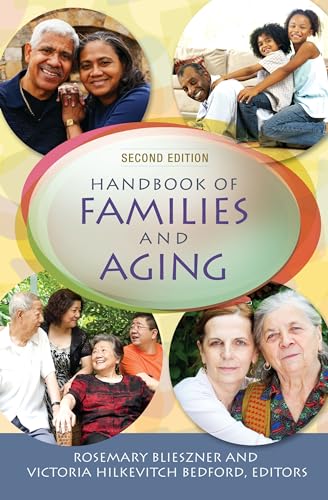

Handbook of families and aging Rosemary Blieszner and Victoria Hilkevitch Bedford, editors.
Detalles de publicación: Santa Barbara, Calif. Praeger c2012.Edición: 2nd edDescripción: x, 616 p. ill. 25 cmISBN:- 9780313381737 (hbk. : alk. paper)
- 9781440828638 (pbk.)
- 9780313381744 (ebook)
- 305.26 H2361 2012 23
- HQ1061 .H3353 2012
| Imagen de cubierta | Tipo de ítem | Biblioteca actual | Biblioteca de origen | Colección | Ubicación en estantería | Signatura topográfica | Materiales especificados | Info Vol | URL | Copia número | Estado | Notas | Fecha de vencimiento | Código de barras | Reserva de ítems | Prioridad de la cola de reserva de ejemplar | Reservas para cursos | |
|---|---|---|---|---|---|---|---|---|---|---|---|---|---|---|---|---|---|---|
| Referencia | Biblioteca Encarnación Valdés Sala de Referencia bev | 305.26 H2361 2012 (Navegar estantería(Abre debajo)) | Disponible | 80000002488420 |
Descripciones mejoradas de Syndetics:
This comprehensive reference in family gerontology reviews and critiques the recent theoretical, empirical, and methodological literature; identifies future research directions; and makes recommendations for gerontology professionals.
This book is both an updated version of and a complement to the original Handbook of Families and Aging . The many additions include the most recent demographic changes on aging families, new theoretical formulations, innovative research methods, recent legal issues, and death and bereavement, as well as new material on the relationships themselves--sibling, partnered, and intergenerational relationships, for example. Among the brand-new topics in this edition are step-family relationships, aging families and immigration, aging families and 21st-century technology, and peripheral family ties.
Unlike the more cursory summaries found in textbooks, the essays within Handbook of Families and Aging, Second Edition provide thoughtful, in-depth coverage of each topic. No other book provides such a comprehensive and timely overview of theory and research on family relationships, the contexts of family life, and major turning points in late-life families. Nevertheless, the contents are written to be engaging and accessible to a broad audience, including advanced undergraduate students, graduate students, researchers, and gerontology practitioners. Serious lay readers will also find this book highly informative about contemporary family issues.
Rev. ed. of: Handbook of aging and the family. 1995.
Includes bibliographical references and index.
Tabla de contenidos provista por Syndetics
- Acknowledgments(p. ix)
- Part I Background
- 1 The Family Context of Aging(p. 3)
- 2 Demographic Trends and Later Life Families in the 21st Century(p. 9)
- 3 Theoretical Directions for Studying Family Ties and Aging(p. 35)
- 4 Innovative Research Methods for Family Gerontology(p. 61)
- Part II Family Relationships
- 5 Marriage and Other Partnered Relationships in Middle and Late Adulthood(p. 91)
- 6 Sibling Relationships from Midlife to Old Age(p. 125)
- 7 Aging Parents and Adult Children: Determinants of Relationship Quality(p. 153)
- 8 Grandparenthood: Grandchild and Great-Grandchild Relationships(p. 183)
- 9 Relationships in Older Stepfamilies(p. 213)
- 10 The Importance of Discretionary and Fictive Kin Relationships for Older Adults(p. 243)
- Part III Contexts of Family Life
- 11 Intersectionality and Aging Families(p. 263)
- 12 Ethnic and Cultural Diversity in Aging Families: Implications for Resource Allocation and Weil-Being across Generations(p. 287)
- 13 Older Rural Adults and Their Families(p. 309)
- 14 Aging Families and Immigration(p. 337)
- 15 U.S. Old Age Policy and Families(p. 363)
- 16 Legal Issues in Aging Families(p. 387)
- 17 Elder Abuse in Aging Families(p. 409)
- 18 Family Gerontechnology: An Emergent Agenda for Research, Policy, and Practice(p. 431)
- Part IV Turning Points in Family Life
- 19 Families and Retirement(p. 461)
- 20 Divorce and Widowhood in Later Life(p. 489)
- 21 Family Caregiving in Later Life: Shifting Paradigms(p. 515)
- 22 Turning Points in Later Life: Grief and Bereavement(p. 543)
- Part V Future Research
- 23 New Directions for Family Gerontology: Where Do We Go from Here?(p. 567)
- About the Editors and Contributors(p. 581)
- Index(p. 593)
Reseñas proporcionadas por Syndetics
CHOICE Review
Aging is challenging everyone, individually and collectively. This collection of well-researched essays (1st ed., CH, Nov'95, 33-1842), some with international comparisons, summarizes a massive amount of data and analysis. Each essay focuses on a specific topic; they include demographics, marriage or partners, stepfamilies, aging parents and adult children, grief, and ethnic and class diversity. Articles distill basic information and current research findings, and identify where significant gaps remain. Some, such as the public policy article that effectively presents existing programs, are more successful than others. Readers are asked to consider underlying assumptions: who is family? As people marry at older ages, divorce more frequently, and have fewer children, siblings, extended family members, and friends assume more responsibility. The authors repeatedly demonstrate that many statuses, such as those of grandparents or widow(er)s, involve multiple relationships and warrant examination. With so many living longer, demands for home health care escalate while funds are being cut; about 29 percent of Americans serve as unpaid caregivers. More case studies, especially of successful programs rather than summaries of subfields, might improve the work. An effective reference source. Summing Up: Recommended. Targeted to professionals and advanced students in related fields. S. D. Borchert emerita, Lake Erie CollegeNotas de autor provistas por Syndetics
Rosemary Blieszner , PhD, is alumni distinguished professor of human development and associate director of the Center for Gerontology at Virginia Polytechnic Institute and State University, Blacksburg.
Victoria Hilkevitch Bedford , PhD, is professor emerita at the University of Indianapolis, School of Psychological Sciences, Indianapolis, IN.