Imagen de portada de Amazon
Imagen de Amazon.com
Imagen de cubierta Syndetics
Portada de Syndetics
Imagen de OpenLibrary

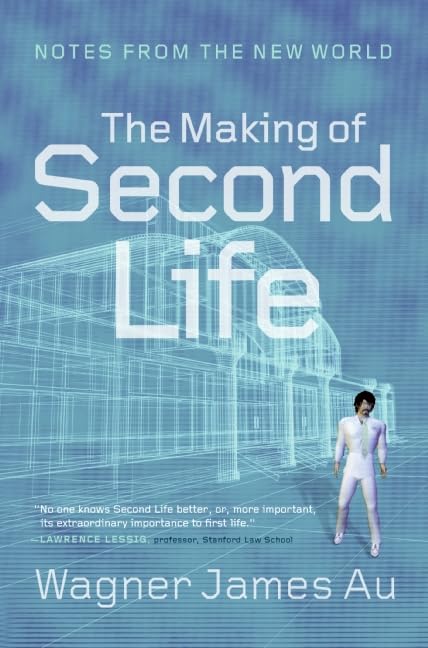
The making of Second Life notes from the new world Wagner James Au.

Por: Detalles de publicación: New York Collins c2008.Edición: 1st edDescripción: xxii, 274 pages 24 cmISBN:
  • 9780061353208
  • 0061353205
Tema(s): Clasificación CDD:
  • 794.8 A8876m 22
Clasificación LoC:
  • GV1469.25.S425 A9 2008
Contenidos:
Introduction : old world to new world : a brief history of the metaverse -- Touching knowledge : from virtual reality to real company -- Imagining the Net in 3-D : shunting the datastream into rivers and sky -- The engines of creation : the alchemy of user-created content -- The unwisdom of crowds : object lessons in online-world social engineering -- Self-made mankind : identity and role-playing with the digital generation -- Making love : romance and desire, digitized for your protection -- Building walls, defending territory : border disputes and culture clashing in war's shadow -- Burning down the house : democracy as a business model -- Avatar as entrepreneur : from content creator to revenue generator -- Investing in utopia : a rough explorer's guidefor corporations and organizations in the metaverse -- Law is code : crime and punishment in the Net's 3-D future -- Building a better world : research, education, and activism in an online world -- Convergence : an internet-to-online world road map for the next decade.
Valoración
    Valoración media: 0.0 (0 votos)
Existencias
Imagen de cubierta Tipo de ítem Biblioteca actual Biblioteca de origen Colección Ubicación en estantería Signatura topográfica Materiales especificados Info Vol URL Copia número Estado Notas Fecha de vencimiento Código de barras Reserva de ítems Prioridad de la cola de reserva de ejemplar Reservas para cursos
Libro Biblioteca Encarnación Valdés Colección General bev 794.8 A8876m (Navegar estantería(Abre debajo)) Disponible 80000002459231
Total de reservas: 0

Descripciones mejoradas de Syndetics:

The wholly virtual world known as Second Life has attracted more than a million active users, millions of dollars, and created its own--very real--economy.

The Making of Second Life is the behind-the-scenes story of the Web 2.0 revolution's most improbable enterprise: the creation of a virtual 3-D world with its own industries, culture, and social systems. Now the toast of the Internet economy, and the subject of countless news articles, profiles, and television shows, Second Life is usually known for the wealth of real-world companies (Reuters, Pontiac, IBM) that have created "virtual offices" within it, and the number of users ("avatars") who have become wealthy through their user-created content.

What sets Second Life apart from other online worlds, and what has made it such a success (one million-plus monthly users and growing) is its simple user-centered philosophy. Instead of attempting to control the activities of those who enter it, the creators of Second Life turned them loose: users (also known as Residents) own the rights to the intellectual content they create in-world, and the in-world currency of Linden Dollars is freely exchangeable for U.S. currency. Residents have responded by generating millions of dollars of economic activity through their in-world designs and purchases--currently, the Second Life economy averages more than one million U.S. dollars in transactions every day, while dozens of real-world companies and projects have evolved and developed around content originated in Second Life.

Wagner James Au explores the long, implausible road behind that success, and looks at the road ahead, where many believe that user-created worlds like Second Life will become the Net's next generation and the fulcrum for a revolution in the way we shop, work, and interact. Au's story is narrated from both within the corporate offices of Linden Lab, Second Life's creator, and from within Second Life itself, revealing all the fascinating, outrageous, brilliant, and aggravating personalities who make Second Life a very real place­--and an illuminating mirror on the real (physical) world. Au writes about the wars they fought (sometimes literally), the transformations they underwent, the empires of land and commerce they developed, and above all, the collaborative creativity that makes their society an imperfect utopia, better in some ways than the one beyond their computer screens.

Includes index.

Introduction : old world to new world : a brief history of the metaverse -- Touching knowledge : from virtual reality to real company -- Imagining the Net in 3-D : shunting the datastream into rivers and sky -- The engines of creation : the alchemy of user-created content -- The unwisdom of crowds : object lessons in online-world social engineering -- Self-made mankind : identity and role-playing with the digital generation -- Making love : romance and desire, digitized for your protection -- Building walls, defending territory : border disputes and culture clashing in war's shadow -- Burning down the house : democracy as a business model -- Avatar as entrepreneur : from content creator to revenue generator -- Investing in utopia : a rough explorer's guidefor corporations and organizations in the metaverse -- Law is code : crime and punishment in the Net's 3-D future -- Building a better world : research, education, and activism in an online world -- Convergence : an internet-to-online world road map for the next decade.

Extracto provisto por Syndetics

The Making of Second Life Notes from the New World Chapter One Touching Knowledge From Virtual Reality to Real Company If Second Life becomes an integral part of the Internet's next evolutionary stage, it's still quite possible that few will remember Linden Lab, the company that nurtured it in the early years. (Ask people who came of age in the twenty-first century if they remember Netscape, creator of the first commercial Web browser; expect blank stares.) Building the metaverse wasn't even the company's main goal when it began operations in 1999, in a warehouse on Linden Street, a narrow alley in San Francisco's Hayes Valley. Like many parts of the city during the Internet's first boom times, the street teetered between gentrification and drug-addled squalor. On one end of Linden were upscale restaurants serving the arrogant young mandarins of dot-com excess; on the other was an unattended parking lot with a clientele who often slept in their cars. Linden Lab's immediate neighbors were wholly appropriate for the world that would eventually emerge from their servers: a dubiously grungy auto body garage and a fetish boutique. Into this unlikeliest of spaces came Philip Rosedale, clutching the keys to his shabby new office. He'd just left his position as chief technology officer of Real Networks--then the Net's audio streaming software of choice--and plowed a million dollars of his own money to build . . . well, at the start, that part wasn't exactly clear. Born in 1968, Philip Rosedale is tall and lanky, with a triathlete's build and the cheeky, boyish good looks usually associated with Hollywood teen idols. (To rib him on that front, some of his waggish employees once cut out a photo of Rosedale from a magazine profile, glued it into a collage of teeny-bopper stars from the eighties, then tacked the mess to the bulletin board at the company's front entrance. For months afterward, visitors to Linden Lab would get their first glimpse of the CEO as a disembodied head floating amid a montage of Mark Hamill, Michael J. Fox, and Emilio Estevez.) Rosedale has light-colored eyes, and during his rhetorical crescendos (which are frequent), they go wide with a kind of wonder that gives anything he's saying an aura of the inevitable or the evangelical, or both. He is prone to flights of gratuitous cosmology, though it's clear he sees these as directly related to the day-to-day of running his company. Then again, it sometimes seems like conversational judo to dodge oncoming practical questions by flipping them into the stratosphere. (A Second Life subscriber once asked him where Linden Lab was going as a corporation, and Rosedale answered by first talking about the birth and expansion of the entire universe.) Whether it's everyday chat or a bout of ontology, however, Rosedale's honorific of choice is generally "dude." He spent his earliest years in Maryland, the oldest son of a U.S. Navy carrier pilot who later retired to become an architect and an English major who left her teaching position to raise Philip and his three siblings. "For a little while, because there was no good public school," Rosedale recalls, "I went to a born-again Baptist school, no kidding, in trailers, in single-wides, in Hollywood, Maryland. And it was so interesting because they just . . . preached fire and brimstone, and it was crazy, and it scared the crap out of me." For a time, it turned him into a pint-sized proselytizer. "So I would go around and ask people, 'Have you been born again?' So I think that actually helped me critically examine the world around me in a really profound way . . . I [later] realized, this is driven by people, this is not driven by some fundamental truth . . . But it left me with a kind of appreciation of deep thoughts and meaningful things. I just think I kind of had to take that and make my own some sense of it at some point." Traditional religion discarded, something still kept him yearning to visualize the absolute. "I can remember standing in the backyard near the woodpile," Rosedale recalls. "Looking into the woods, I can remember thinking, 'Why am I here, and how am I different from everybody else? What am I here to do? What is my purpose here?' But I don't think I thought it in a real religious sense . . . I always had this strong [sense of], 'I want to change the world somehow.'" Thinking back on it now, Rosedale wonders if this was the ultimate origin of Second Life, when he began feeling about for a goal that would match that insight. His experiences with computing would turn that sense of wonder in a practical direction. As an early teen, he read about a single-cell simulation conceived by theoretician Stephen Wolfram, intended to demonstrate how complexity could emerge from nature if a cell reproduced through very simple rules. Rosedale got Wolfram's simulation working to his satisfaction in 1982 on an Apple computer owned by his aunt and uncle in Santa Barbara. Starting with a single pixel, the Wolfram program quickly transformed the monitor into a starburst of activity. "You can see the pattern evolving," Rosedale recounts, "so when you get something growing, it's like a little Christmas tree going down the screen. So I looked at that, and I [thought], 'Oh my god, you can simulate . . . anything.'" That intuition was enforced a couple of years later, when he and a friend tinkered with a Windows program that displayed Mandelbrot sets, mathematical constructs that seem, at a distance, to be a single crystal form but as you keep magnifying, reveal layers of thriving intricacy. Once again, he saw the richness and variety of life, simulated through an elegant flourish of code. Unlike most computer programmers, whose creativity is entirely consumed by the digital, Rosedale maintained a loop into the real world; he had a yen to tinker and reshape it. As a kid he wanted his bedroom door to slide up and down, like in Star Trek, so he got out some tools and made it so. Which is why his parents came home one day to discover that he'd not only taken his door off its hinges but had gone up into the attic, cut a deep groove through the ceiling, and attached it to a pulley system, instead. The Making of Second Life Notes from the New World . Copyright © by Wagner Au. Reprinted by permission of HarperCollins Publishers, Inc. All rights reserved. Available now wherever books are sold. Excerpted from The Making of Second Life: Notes from the New World by Wagner James Au, Wagner J. Au All rights reserved by the original copyright owners. Excerpts are provided for display purposes only and may not be reproduced, reprinted or distributed without the written permission of the publisher.

Reseñas proporcionadas por Syndetics

Library Journal Review

Linden Labs gave Au, a highly accomplished technology journalist, the opportunity to describe the growth, from launch, of its highly popular virtual 3-D product Second Life. Second Life is appropriately named because individuals can create "avatars," also called "residents," to interact with others and enhance this universe through their own user-generated content. Avatars engage in many humanlike behaviors, such as communication, sexual relations, and wealth attainment. Second Life even has its own currency, Linden Dollars, which is convertible into U.S. dollars. Au has drawn on his own extensive Second Life experience, including online interviews with avatars and offline interviews with the persons behind them. He presents a comprehensive account that shows why Second Life may be the next great frontier and why it is so appealing to individuals and enterprises worldwide. Au also discusses the interaction between real life and this online world, the many ethical and policymaking issues Linden Labs has encountered, and the future of Second Life. This intriguing work is suitable for both public and academic libraries.-Caroline Geck, Kean Univ., Union, NJ (c) Copyright 2010. Library Journals LLC, a wholly owned subsidiary of Media Source, Inc. No redistribution permitted.

Publishers Weekly Review

For those unfamiliar with the hype or the ridicule, Second Life is a "massively multi-user online world," a vast simulation created by ordinary loggers-in using 3-D graphic-design tools from the site's proprietor, Linden Labs. Posing as animated "avatars," "Residents" ramble or fly through the videoscape; they socialize with other avatars, create art, have sex, build cities, open shops and nightclubs, spend Linden Dollars (redeemable for real dollars) and fight wars, all while seated at their computer screens. Au, a journalist who chronicled the site as Linden Labs' reporter-avatar, visits the usual dot-com-saga touchstones. There's the shoestring startup by eccentric geeks; the pilgrimage to Burning Man; the bloviating visionary founder, Philip Rosedale ("I'm passionate about Second Life because there doesn't need to be a God"); the marketing gobbledygook about "Leverag[ing] Metaverse Brands." Au celebrates Second Life as a seedbed for unfettered cybercapitalism, a liberating outlet for the masses' pentup creativity and a "lucid dream" that erases the virtual-real divide. Alas, in his telling, Second Life's ongoing fantasia--"the monkey now perched on the wing screamed 'DIEEEE' as he strafed a well-armed babe in a bikini"--feels very much like a recounted dream: creative, certainly, but rather tedious and patently irrelevant. (Mar.) (c) Copyright PWxyz, LLC. All rights reserved

CHOICE Review

One of the most popular virtual worlds today, Second Life in not a game but rather an online world created by Linden Labs. Linden Labs invited Au, a freelance writer, to chronicle the development of Second Life from the inside as the avatar Hamlet Linden. Au in turn created the blog New World Notes to capture his insights about the development, growth, and future of Second Life. Au opens the present title with an excellent history of Linden Labs and Second Life, placing the development of Second Life within the context of the development of the Internet, online gaming environments, and Web 2.0 technologies. In the chapters that follow, the author provides a taste of what Second Life is to its users: a world of user-created content with its own economy, social stereotypes, rules, and agendas. Of particular interest is a chapter about the entrance of major corporations into Second Life; here Au highlights how major corporations are beginning to realize that knowing the culture of Second Life is crucial to success within it. Summing Up: Recommended. Upper-division undergraduates through faculty. A. Hollister State University of New York at Cortland

Booklist Review

Au, who has written feature articles for the Los Angeles Times and online magazines such as Salon, acted as the embedded journalist during the first three years of the ever popular online world Second Life. As opposed to other virtual realities, such as The Simms, the residents of Second Life have the full power to cocreate themselves and the environment in which they live, building entire cities that morph continuously as members expand on each other's work. The epitome of Web 2.0, where users take an active role in creating content, Second Life has all the features of real life and more: money, real estate, bars and other hangouts, deeply developed personal relationships, even a quirky version of sex. Possibilities are only restrained by the imagination. Au charts the course of the evolution of Second Life from an idea in its creators' minds to the megahit that it is today, with many surprising revelations on the possibilities that unfold within this virtual reality.--Siegfried, David Copyright 2008 Booklist
Compartir
logopucpr-y-vive

Contáctanos

¡Queremos saber de ti!

Tel. 787.841.2000 Ext. 1801

bibliotecavaldes@pucpr.edu

⁣Búscanos en las redes

© 2026 Desarrollado por Ignite Online • All Rights Reserved • Powered by Koha.