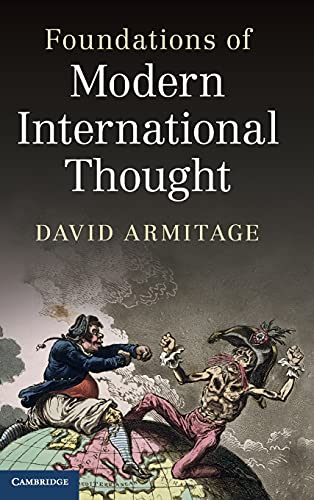

Foundations of modern international thought David Armitage.
Detalles de publicación: Cambridge New York Cambridge University Press 2012.Descripción: xii, 300 pages 23 cmISBN:- 9780521807074 (hbk.)
- 9780521001694 (pbk.)
- 327.101 A732f 23
- JZ1305 .A75 2012
| Imagen de cubierta | Tipo de ítem | Biblioteca actual | Biblioteca de origen | Colección | Ubicación en estantería | Signatura topográfica | Materiales especificados | Info Vol | URL | Copia número | Estado | Notas | Fecha de vencimiento | Código de barras | Reserva de ítems | Prioridad de la cola de reserva de ejemplar | Reservas para cursos | |
|---|---|---|---|---|---|---|---|---|---|---|---|---|---|---|---|---|---|---|
| Libro | Biblioteca Encarnación Valdés Colección General bev | 327.101 A732f (Navegar estantería(Abre debajo)) | Disponible | 80000002480203 |
Descripciones mejoradas de Syndetics:
Between the early seventeenth and mid-nineteenth centuries, major European political thinkers first began to look outside their national borders and envisage a world of competitive, equal sovereign states inhabiting an international sphere that ultimately encompassed the whole globe. In this insightful and wide-ranging work, David Armitage - one of the world's leading historians of political thought - traces the genesis of this international turn in intellectual history. Foundations of Modern International Thought combines important methodological essays, which consider the genealogy of globalisation and the parallel histories of empires and oceans, with fresh considerations of leading figures such as Hobbes, Locke, Burke and Bentham in the history of international thought. The culmination of more than a decade's reflection and research on these issues, this book restores the often overlooked international dimensions to intellectual history and recovers the intellectual dimensions of international history.
"Between the early seventeenth and mid-nineteenth centuries, major European political thinkers first began to look outside their national borders and envisage a world of competitive, equal sovereign states inhabiting an international sphere that ultimately encompassed the whole globe. In this insightful and wide-ranging work, David Armitage - one of the world's leading historians of political thought - traces the genesis of this international turn in intellectual history. Foundations of Modern International Thought combines important methodological essays, which consider the genealogy of globalisation and the parallel histories of empires and oceans, with fresh considerations of leading figures such as Hobbes, Locke, Burke and Bentham in the history of international thought. The culmination of more than a decade's reflection and research on these issues, this book restores the often overlooked international dimensions to intellectual history and recovers the intellectual dimensions of international history"-- Provided by publisher.
Machine generated contents note: Introduction: rethinking the foundations of modern international thought; Part I. Historiographical Foundations: 1. The international turn in intellectual history; 2. Is there a pre-history of globalisation?; 3. The elephant and the whale: empires and oceans in world history; Part II. Seventeenth-Century Foundations: Hobbes and Locke: 4. Hobbes and the foundations of modern international thought; 5. John Locke's international thought; 6. John Locke, Carolina and the Two Treatises of Government; 7. John Locke: theorist of empire?; Part III. Eighteenth-Century Foundations: 8. Parliament and international law in eighteenth-century Britain; 9. Edmund Burke and Reason of State; 10. Globalising Jeremy Bentham; Part IV. Building on the Foundations: Making States since 1776: 11. The Declaration of Independence and international law; 12. Declarations of independence, 1776-2012.
Tabla de contenidos provista por Syndetics
- Introduction: rethinking the foundations of modern international thought
- Part I Historiographical Foundations
- 1 The international turn in intellectual history
- 2 Is there a pre-history of globalisation?
- 3 The elephant and the whale: empires and oceans in world history
- Part II Seventeenth-Century Foundations: Hobbes and Locke
- 4 Hobbes and the foundations of modern international thought
- 5 John Locke's international thought
- 6 John Locke, Carolina and the Two Treatises of Government
- 7 John Locke: theorist of empire?
- Part III Eighteenth-Century Foundations
- 8 Parliament and international law in eighteenth-century Britain
- 9 Edmund Burke and Reason of State
- 10 Globalising Jeremy Bentham
- Part IV Building on the Foundations: Making States since 1776
- 11 The Declaration of Independence and international law
- 12 Declarations of independence, 1776âÇô2012