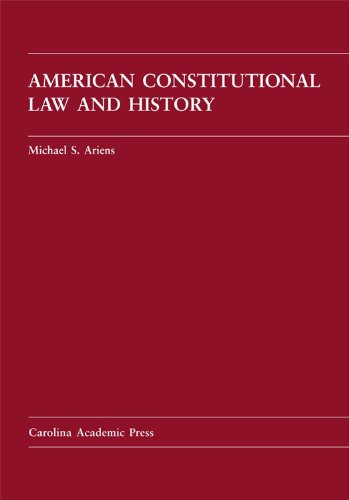

American constitutional law and history Michael S. Ariens, professor of law, St. Mary's University School of Law.
Detalles de publicación: Durham, North Carolina Carolina Academic Press [2012]Descripción: lxxxv, 948 pages 26 cmISBN:- 9781611630985
- 1611630983
- 342.73029 22
- KF 4550 .A759 2012
| Imagen de cubierta | Tipo de ítem | Biblioteca actual | Biblioteca de origen | Colección | Ubicación en estantería | Signatura topográfica | Materiales especificados | Info Vol | URL | Copia número | Estado | Notas | Fecha de vencimiento | Código de barras | Reserva de ítems | Prioridad de la cola de reserva de ejemplar | Reservas para cursos | |
|---|---|---|---|---|---|---|---|---|---|---|---|---|---|---|---|---|---|---|
| Libro | Biblioteca de Derecho Mons. Fremiot Torres Oliver Colección General biblioteca derecho | KF 4550 .A759 2012 (Navegar estantería(Abre debajo)) | Disponible | 70000000894636 |
Descripciones mejoradas de Syndetics:
To access the 2015 supplement, click here .
Written for first-year constitutional law students, American Constitutional Law and History has four goals: First, it gives students an understanding of constitutional law doctrine, as well as the unstable nature of that doctrine. Second, it introduces students to the recurring types of accepted justifications by the members of the Court for the exercise of judicial review, the duty, in John Marshall's famous words, "to say what the law is." Third, the book provides students with a sense of how constitutional decision making has changed in different historical periods, and how those changes have affected the present Court's understanding of the Constitution. Finally, American Constitutional Law and History shows students how to name and use regularly recurring forms of legal argument, such as analogical reasoning, syllogisms, re-framing by varying the level of generality, and a group of arguments characterized as "rhetorical" arguments such as the slippery slope and famous dead person (appeal to authority) arguments.
Includes bibliographical references (pages 911-922) and index.