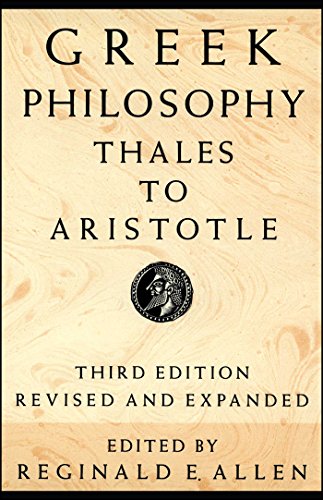
Imagen de portada de Amazon
Imagen de Amazon.com
Imagen de cubierta Syndetics
Portada de Syndetics
Imagen de OpenLibrary

Greek philosophy Thales to Aristotle Reginald E. Allen.

Colaborador(es): Series Readings in the history of philosophyDetalles de publicación: New York Free Press Toronto Maxwell Macmillan Canada New York Maxwell Macmillan International c1991.Edición: 3rd ed., rev. and expandedDescripción: p. cmISBN:
  • 0029004950 (pbk.)
Tema(s): Clasificación CDD:
  • 180 20
Clasificación LoC:
  • B171 .G74 1991
Valoración
    Valoración media: 0.0 (0 votos)
Existencias
Imagen de cubierta Tipo de ítem Biblioteca actual Biblioteca de origen Colección Ubicación en estantería Signatura topográfica Materiales especificados Info Vol URL Copia número Estado Notas Fecha de vencimiento Código de barras Reserva de ítems Prioridad de la cola de reserva de ejemplar Reservas para cursos
Libro Biblioteca Encarnación Valdés Colección General bev 180 G793 (Navegar estantería(Abre debajo)) Disponible 80000000340151
Total de reservas: 0

Descripciones mejoradas de Syndetics:

Widely praised for its accessibility and its concentration on the metaphysical issues that are most central to the history of Greek philosophy, Greek Philosophy: Thales to Aristotle offers a valuable introduction to the works of the Presocratics, Plato, and Aristotle.
For the Third Edition, Professor Allen has provided new translations of Socrates' speech in the Symposium and of the first five chapters of Aristotle's Categories, as well as new selections bearing on Aristotle's Theory of Infinity, Continuity, and Discreteness. The book also contains a general introduction which sets forth Professor Allen's distinctive and now widely accepted interpretation of the development of Greek philosophy and science, along with selective bibliography, and lists of suggested readings.

920108

Includes bibliographical references and index.

Tabla de contenidos provista por Syndetics

  • Preface To The Third Edition
  • Introduction
  • Presocratic Philosophy
  • I The Sources
  • II The Milesians
  • III Pythagoras and Pythagoreanism
  • IV Heraclitus
  • V The Eleatics
  • VI The Pluralists Plato
  • VII Euthyphro
  • VIII Apology
  • IX Crito
  • X Meno
  • XI The Speech of Socrates in the Symposium(in part)
  • XII Phaedo(in part)
  • XIII Republic(in part)
  • XIV Phaedrus(in part)
  • XV Parmenides(in part)
  • XVI Timaeus(in part)
  • XVII Categories(in part)
  • XVIII On the Soul(in part)
  • XIX Metaphysics(in part)
  • XX Nicomachean Ethics(in part)
  • XXI Politics(in part)
  • XXII Physics(in part)
  • Bibliography
  • Index

Extracto provisto por Syndetics

Chapter I THE SOURCES No work of the Presocratics has come down in its entirety. We possess fragments preserved by later authors, and testimony. The major sources are as follows: A. Philosophers (i) Plato gives useful information about his predecessors. Since he himself was not a historian of philosophy, his remarks must be treated with caution. (ii) Aristotle surveyed his predecessors' testimony on the philosophical problems with which he himself was concerned. The Presocratics are thus made parties to his argument, not left to speak for themselves, and this often introduces a cast into his interpretation. Nevertheless, he was not without a sense of history, and his work is, and will remain a major source of knowledge. (iii) The Stoics' method of interpretation was syncretistic: they undertook to show that their predecessors agreed with Stoic doctrine, and with each other. (iv) Sceptics, such as Sextus Empiricus, were concerned to exhibit the contradictions of earlier philosophy, but preserved valuable fragments. (v) The Neo-Platonists, especially Proclus, Alexander, and Simplicius, commented on Plato and Aristotle; with the library of the Academy at their disposal, they too preserved many fragments. B. The Doxographical Tradition Theophrastus, Aristotle's successor in the Lyceum, continued the Peripatetic interest in history. As part of the encyclopedia of knowledge projected by the school, Theophrastus wrote On the Opinions of the Physical Philosophers, parts of which have come down to us. He consulted the original texts of the Presocratics, but his historical judgment was much influenced by Aristotle. Theophrastus' work became the standard authority in the ancient world. The doxographers are those who derive their material, directly or indirectly, from the Opinions (doxai). The main sources in the doxographical tradition are Diogenes Laertius (probably third century A.D.), Plutarch (first-second century A.D.), and John Stobeaus (fifth century A.D.). Copyright © 1966, 1985, 1991 by Reginald E. Allen Excerpted from Greek Philosophy: Thales to Aristotle All rights reserved by the original copyright owners. Excerpts are provided for display purposes only and may not be reproduced, reprinted or distributed without the written permission of the publisher.

Notas de autor provistas por Syndetics

Reginald E. Allen is professor of classics and philosophy at Northwestern University. He is the author of Plato's Parmenides: Translation and Analysis, Socrates and Legal Obligation, and Plato's Symposium.
Compartir
logopucpr-y-vive

Contáctanos

¡Queremos saber de ti!

Tel. 787.841.2000 Ext. 1801

bibliotecavaldes@pucpr.edu

⁣Búscanos en las redes

© 2026 Desarrollado por Ignite Online • All Rights Reserved • Powered by Koha.