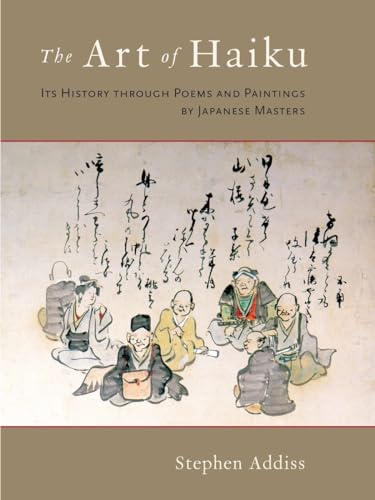

The art of haiku its history through poems and paintings by Japanese masters Stephen Addiss.
Detalles de publicación: Boston Shambhala 2012.Edición: 1st edDescripción: xi, 338 p., [32] p. of plates ill. (some col.) 24 cmISBN:- 9781590308868 (hardcover : acid-free paper)
- 809.1/41 23
- PL729 .A34 2012
| Imagen de cubierta | Tipo de ítem | Biblioteca actual | Biblioteca de origen | Colección | Ubicación en estantería | Signatura topográfica | Materiales especificados | Info Vol | URL | Copia número | Estado | Notas | Fecha de vencimiento | Código de barras | Reserva de ítems | Prioridad de la cola de reserva de ejemplar | Reservas para cursos | |
|---|---|---|---|---|---|---|---|---|---|---|---|---|---|---|---|---|---|---|
| Libro | Biblioteca Encarnación Valdés Colección General bev | 809.141 A2272a 2012 (Navegar estantería(Abre debajo)) | Disponible | 80000002486754 |
Descripciones mejoradas de Syndetics:
Its History through Poems and Paintings by Japanese Masters
In this in-depth look at the history of haiku and haiku paintings, one of the foremost experts on the art form offers a fascinating discussion on the development of the poetic form, concentrating on the great haiku poets like Basho, Buson, and Issa, but also moving into the twentieth century with poets like Santoka. While much has been written about haiku as a poetic form, haiku paintings, called haiga , are less widely discussed. Historically, all the leading masters created paintings, or at least calligraphy, with their haiku. The interaction of text and image adds another dimension to the already popular form of haiku, and is especially interesting since the two are so closely interwoven. This thorough history of haiku offers a clear view of the art of haiku and haiku paintings, and is presented with a wealth of examples of poems and paintings.
Includes bibliographical references (p.326-333) and index.
Background: the tanka (waka) tradition -- Renga, hokku, haikai, and haiga -- Bash? -- Followers of bash? -- Senryu and zen -- Buson -- Issa and the early nineteenth century -- Shiki and the modern age.