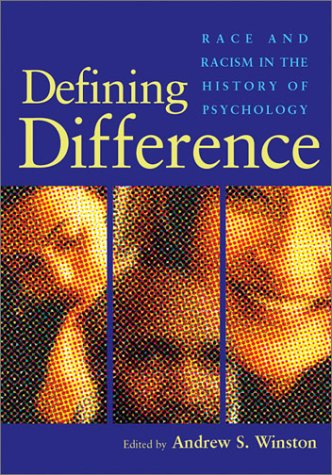

Defining difference race and racism in the history of psychology edited by Andrew S. Winston.
Detalles de publicación: Washington, DC American Psychological Association c2004.Descripción: xi, 303 p. 26 cmISBN:- 1591470277 (alk. paper)
- 155.8209 D3138 21
- BF76.45 .D44 2004
| Imagen de cubierta | Tipo de ítem | Biblioteca actual | Biblioteca de origen | Colección | Ubicación en estantería | Signatura topográfica | Materiales especificados | Info Vol | URL | Copia número | Estado | Notas | Fecha de vencimiento | Código de barras | Reserva de ítems | Prioridad de la cola de reserva de ejemplar | Reservas para cursos | |
|---|---|---|---|---|---|---|---|---|---|---|---|---|---|---|---|---|---|---|
| Libro | Biblioteca Encarnación Valdés Colección General bev | 155.8209 D3138 (Navegar estantería(Abre debajo)) | Disponible | 80000002257338 |
Descripciones mejoradas de Syndetics:
This text brings together scholarship on the history of psychology and race. Throughout the history of the field, psychological discourse has been shaped by social concerns, and its discourse on race is no exception. Psychologists have promoted and fought against racism and a nuanced historical account requires analysis of both dimensions. The contributors seek to understand the relationship between the changes in the field and broader social change by mapping the changing discourse for defining difference through race. ideas of race in the work of 19th-century and 20th-century psychologists; psychological discourse on topics such as mixed-race people; political uses of racial research; changes in textbook presentations of race and intelligence; and international perspectives on psychology and race. The contibutors also examine the prominence and persistence of American research on racial differences in intelligence as well as the work of Kenneth Clark and Horace Mann Bond in combatting racism in science and society. This volume aims to increase readers' understanding of the link between racial studies and social attitudes in our time, and aims to provide a comprehensive examination of that link through history.
Includes bibliographical references and indexes.
Tabla de contenidos provista por Syndetics
- Contributors(p. ix)
- Acknowledgments(p. xi)
- Introduction: Histories of Psychology and Race(p. 3)
- I. Foundations of Psychology and Race Before 1900(p. 19)
- Chapter 1. Type and Essence: Prologue to the History of Psychology and Race(p. 21)
- Chapter 2. The Concept of Race in the Life and Thought of Francis Galton(p. 49)
- II. Psychology, Science, and "Race Mixing"(p. 77)
- Chapter 3. The Historical Problematization of "Mixed Race" in Psychological and Human-Scientific Discourses(p. 79)
- Chapter 4. "Inharmoniously Adapted to Each Other": Science and Racial Crosses(p. 109)
- III. Cultural Contexts and 20th-Century Psychology(p. 135)
- Chapter 5. "It's an American Thing": The "Race" and Intelligence Controversy From a British Perspective(p. 137)
- Chapter 6. Race and Psychology in South Africa(p. 171)
- Chapter 7. Constructing Difference: Heredity, Intelligence, and Race in Textbooks, 1930-1970(p. 199)
- IV. Confronting Racism(p. 231)
- Chapter 8. Antiracist Work in the Desegregation Era: The Scientific Activism of Kenneth Bancroft Clark(p. 233)
- Chapter 9. "Racially Stuffed Shirts and Other Enemies of Mankind": Horace Mann Bond's Parody of Segregationist Psychology in the 1950s(p. 261)
- Author Index(p. 285)
- Subject Index(p. 293)
- About the Editor(p. 303)
Reseñas proporcionadas por Syndetics
CHOICE Review
In nine well-documented essays, a group of talented and respected scholars explore the definitions of race and racial difference as they have been used in psychological discourse, with emphasis on the social and professional contexts within which psychologists have conducted studies and drawn conclusions. From the late 19th century, the conceptualization of race and theories and practice have shifted from viewing race as a fundamental, essentialist concept to considering "race" in less certain terms. Throughout this history, psychological research and theory have involved both racist and antiracist dimensions. The topics of heredity, intelligence testing, and "race mixing" are considered from perspectives that developed in North America, Europe, and South Africa. Included also are detailed analyses of the work of persons who played key roles in "defining difference" up to 1970, including Francis Galton, Kenneth Bancroft Clark, and Horace Mann Bond. This well-edited work adds to understanding major issues that psychology, both as science and as profession, confronted in the 20th century. It also demonstrates the relatedness of psychological research and the sociocultural milieu in which research is conducted. ^BSumming Up: Recommended. Upper-division undergraduates through faculty; general readers. E. Scarborough emerita, Indiana University South BendNotas de autor provistas por Syndetics
Andrew S. Winston, PhD, is a professor of psychology at the University of Guelph in Guelph, Ontario, CanadaBethany Butzer, BA, Department of Psychology, University of Western Ontario, Canada
Raymond E. Fancher, PhD, Department of Psychology, York University, Toronto, Ontario, Canada
Mark D. Ferris, MLIS, Toronto, Ontario, Canada
Don Foster, PhD, Department of Psychology, University of Cape Town, Rondebosch, Republic of South Africa
John P. Jackson, Jr., PhD, Department of Communication, University of Colorado, Boulder
Johann Louw, PhD, Department of Psychology, University of Cape Town, Rondebosch, Republic of South Africa
Layli Phillips, PhD, Women's Studies Institute, Georgia State University, Atlanta
Graham Richards, DLitt, Department of Psychology, Staffordshire University, Stoke-on-Trent, Staffordshire, England
Thomas Teo, PhD, Department of Psychology, York University, Toronto, Ontario, Canada
William H. Tucker, PhD, Department of Psychology, Rutgers University -- Camden, NJ
Fredric Weizmann, PhD, Department of Psychology, York University, Toronto, Ontario, Canada
Andrew S. Winston, PhD, Department of Psychology, University of Guelph, Ontario, Canada