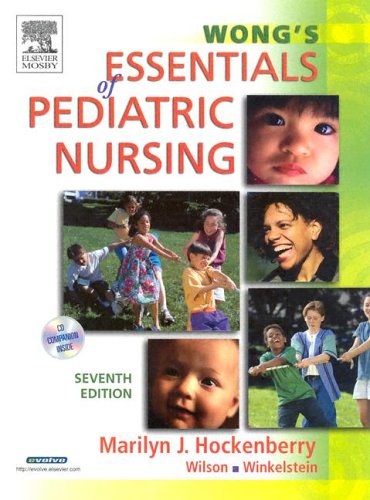

Wong's essentials of pediatric nursing Marilyn J. Hockenberry.
Detalles de publicación: St. Louis, Mo. Elsevier Mosby 2005.Edición: 7th edDescripción: xxxi, 1307 p. ill. 29 cmISBN:- 0323025935
- Essentials of pediatric nursing
- 618.9200231 H6856w7 22
| Imagen de cubierta | Tipo de ítem | Biblioteca actual | Biblioteca de origen | Colección | Ubicación en estantería | Signatura topográfica | Materiales especificados | Info Vol | URL | Copia número | Estado | Notas | Fecha de vencimiento | Código de barras | Reserva de ítems | Prioridad de la cola de reserva de ejemplar | Reservas para cursos | |
|---|---|---|---|---|---|---|---|---|---|---|---|---|---|---|---|---|---|---|
| Disco | Biblioteca Encarnación Valdés Colección General bev | 618.9200231 H6856w7 (Navegar estantería(Abre debajo)) | Disponible | CD | 80000002250564 | |||||||||||||
| Libro | Biblioteca Encarnación Valdés Colección General bev | 618.9200231 H6856w7 (Navegar estantería(Abre debajo)) | Disponible | 80000002250556 |
Descripciones mejoradas de Syndetics:
From its superior illustrations and striking full-color design to its abundant special features, it's easy to see why it's been the #1 pediatric nursing text for over 20 years. It provides readers with the essential information they need to deliver safe and accurate care. Divided into two logical parts, the first half of the book focuses on child development and health promotion by age group and lays the foundation for the second half of the book which addresses specific health problems organized by body systems. Text focuses on the family throughout by emphasizing the role and influence of the family in health and illness Utilizes the nursing process format to present nursing care for major diseases and disorders. Guidelines boxes throughout the text provide step-by-step instructions for performing specific skills or procedures Emergency Treatment boxes provide quick reference in critical situations Nursing Care Plans incorporate patient- and family-centered goals and include rationales for nursing interventions Family Home Care boxes highlight important information to better prepare families to cope with their child¡¦s care in special situations Disorder sections provide detailed presentations of pathophysiology Community Focus boxes emphasize community issues and provide additional resources for guidance on caring for children outside the clinical setting Cultural Awareness boxes highlight ways in which variations in beliefs and practices affect child care Atraumatic Care boxes provide guidance for administering nursing care with minimal pain or stress to the child, family, and nurse Evidence-Based Practice boxes throughout the text focus students¡¦ attention on application of both research and critical thought processes to support and guide the outcomes of nursing care Nursing Alerts and Nursing Tips are highlighted throughout the text to provide the reader with either critical information (Alerts) or helpful hints (Tips) CD companion features critical thinking questions, case studies, nursing care plans, assessment tools, new NCLEX"¥ examination-style review questions, and skills Critical Thinking Exercises encourage self-evaluation about clinical judgements Ethical Case Studies provide realistic learning experiences The most current information on immunizations to keep readers up-to-date Appendix with Spanish-English translations includes words and phrases commonly used in nurse-parent interactions A chapter on Chronic Illness, Disability, and End-of-Life Care provides the necessary content for quality nursing care at the end of life
ESTE LIBRO INCLUYE UN DISCO
Tabla de contenidos provista por Syndetics
- Unit 1 Children, Their Families, and the Nurse
- 1 Perspectives of Pediatric Nursing(p. 1)
- 2 Community-Based Nursing Care of the Child and Family(p. 22)
- 3 Family Influences on Child Health Promotion(p. 30)
- 4 Social, Cultural, and Religious Influences on Child Health Promotion(p. 55)
- 5 Developmental Influences on Child Health Promotion(p. 79)
- Unit 2 Assessment of the Child and Family
- 6 Communication and Health Assessment of the Child and Family(p. 104)
- 7 Physical and Developmental Assessment of the Child(p. 131)
- Unit 3 The Newborn
- 8 Health Promotion of the Newborn and Family(p. 175)
- 9 Health Problems of Newborns(p. 222)
- Unit 4 Infancy
- 10 Health Promotion of the Infant and Family(p. 307)
- 11 Health Problems of Infants(p. 359)
- Unit 5 Early Childhood
- 12 Health Promotion of the Toddler and Family(p. 389)
- 13 Health Promotion of the Preschooler and Family(p. 416)
- 14 Health Problems of Toddlers and Preschoolers(p. 433)
- Unit 6 Middle Childhood and Adolescence
- 15 Health Promotion of the School-Age Child and Family(p. 472)
- 16 Health Promotion of the Adolescent and Family(p. 493)
- 17 Health Problems of School-Age Children and Adolescents(p. 516)
- Unit 7 The Child and Family With Special Needs
- 18 Chronic Illness, Disability, or End-of-Life Care for the Child and Family(p. 549)
- 19 Impact of Cognitive or Sensory Impairment on the Child and Family(p. 589)
- 20 Family-Centered Home Care(p. 622)
- Unit 8 Impact of Hospitalization on the Child and Family
- 21 Family-Centered Care of the Child During Illness and Hospitalization(p. 637)
- 22 Pediatric Variations of Nursing Interventions(p. 706)
- Unit 9 The Child With Problems Related to the Transfer of Oxygen and Nutrients
- 23 The Child With Respiratory Dysfunction(p. 787)
- 24 The Child With Gastrointestinal Dysfunction(p. 839)
- Unit 10 The Child With Problems Related to the Production and Circulation of Blood
- 25 The Child With Cardiovascular Dysfunction(p. 890)
- 26 The Child With Hematologic or Immunologic Dysfunction(p. 938)
- Unit 11 The Child With a Disturbance of Regulatory Mechanisms
- 27 The Child With Genitourinary Dysfunction(p. 984)
- 28 The Child With Cerebral Dysfunction(p. 1011)
- 29 The Child With Endocrine Dysfunction(p. 1063)
- 30 The Child With Integumentary Dysfunction(p. 1095)
- Unit 12 The Child With a Problem That Interferes With Physical Mobility
- 31 The Child With Musculoskeletal or Articular Dysfunction(p. 1147)
- 32 The Child With Neuromuscular or Muscular Dysfunction(p. 1187)
- Appendixes
- A Family Assessment(p. 1215)
- B Patterns of Inheritance(p. 1217)
- C Developmental/Sensory Assessment(p. 1219)
- D Growth Measurements(p. 1225)
- E Common Laboratory Tests(p. 1245)
- F Dietary Reference Intakes: Recommended Dietary Allowances (RDA) and Adequate Intake (Al)(p. 1254)
- G NANDA International-Approved Nursing Diagnoses 2003-2004(p. 1258)
- H Translations of Wong-Baker FACES Pain Rating Scale(p. 1259)
- I Spanish-English Translations(p. 1262)