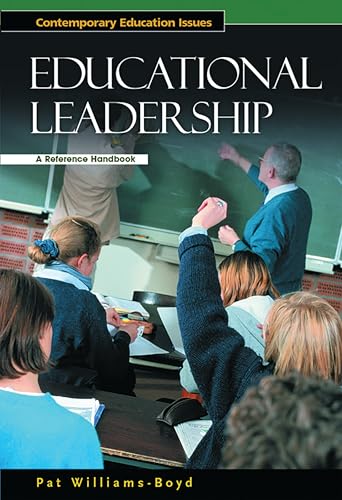

Educational leadership a reference handbook Pat Williams.
Series Contemporary education issuesDetalles de publicación: California ABC-CLIO 2002.Descripción: xv, 341 p. 24 cmISBN:- 157607353X
- LB2805 .W517 2002
| Imagen de cubierta | Tipo de ítem | Biblioteca actual | Biblioteca de origen | Colección | Ubicación en estantería | Signatura topográfica | Materiales especificados | Info Vol | URL | Copia número | Estado | Notas | Fecha de vencimiento | Código de barras | Reserva de ítems | Prioridad de la cola de reserva de ejemplar | Reservas para cursos | |
|---|---|---|---|---|---|---|---|---|---|---|---|---|---|---|---|---|---|---|
| Libro | Biblioteca de Mayagüez Colección General mb | LB2805 .W517 2002 (Navegar estantería(Abre debajo)) | Disponible | 50000002177409 |
Descripciones mejoradas de Syndetics:
An objective discussion of educational leadership from both inside and outside the school system, focusing on ethical issues, dominant models, and today's unprecedented commitment to community involvement.
During the last decade of the 20th century, the United States entered a new era of educational leadership. The seat of educational authority shifted from the district office to the individual school, from the principal-as-manager to the stakeholders: students, teachers, families, community members, school boards, politicians, and corporate and philanthropic foundations.
In Educational Leadership , educator Pat Williams-Boyd traces these changes from their roots in the 19th century to the present day. She shows readers what leadership looks like when it is distributed throughout a community and explains how collaborative relationships can be forged. She also examines techniques for effective leadership during the hazardous process of school reform and presents a critical discussion of 20 leading school reform models.
Includes bibliographical references and index.
Tabla de contenidos provista por Syndetics
- Series Editor's Preface(p. xi)
- Preface(p. xiii)
- Acknowledgments(p. xv)
- Chapter 1 Overview(p. 1)
- Constructing the Past: Where We've Been(p. 1)
- Comparing the Corporate and the Educational(p. 3)
- Setting Twenty-First-Century Educational Leadership in Context: Where We Are(p. 4)
- Defining New Era Leadership(p. 5)
- Contrasting New Era Leadership with Previous Experience: Where We're Going(p. 6)
- Educational Leaders--Leaders in Education: Who Is Leading?(p. 7)
- An Example of Heightened Partnership(p. 8)
- Practice Level(p. 9)
- Students(p. 9)
- The Family: Parents/Guardians as Partner-Leaders(p. 18)
- Teachers(p. 28)
- School-Level Administrative Leadership(p. 35)
- Systems-Level Leadership(p. 51)
- Superintendents(p. 51)
- Local School Board(p. 62)
- Professional-Level Leadership(p. 74)
- Professional Developers(p. 74)
- Researchers(p. 76)
- Policy Level(p. 78)
- State Level(p. 78)
- Governor(p. 79)
- State Legislature(p. 82)
- State Education Agencies (SEAs)(p. 83)
- State Board of Education(p. 84)
- Chief State School Officer (CSSO)(p. 85)
- State Department of Education(p. 87)
- Federal Level(p. 89)
- United States Department of Education(p. 93)
- Congress(p. 94)
- Summary(p. 95)
- References(p. 96)
- Chapter 2 Chronology: Shifting Perspectives--Involvement, Ownership, and the Business of Community Building(p. 103)
- References(p. 115)
- Chapter 3 Shifting Styles, Changing Metaphors: The Art of Creating Effective Leadership(p. 117)
- Leadership Styles: Mobilizing for Improvement(p. 118)
- Roles Leaders Assume(p. 132)
- Technical Leadership(p. 132)
- Leader as Manager(p. 132)
- Tasks of Leader-Managers(p. 137)
- Leader as Problem Solver(p. 149)
- Leader as Decision Maker(p. 152)
- Nontechnical Educational Leadership(p. 158)
- Leader as Instructional Leader(p. 158)
- Leaders as Facilitators(p. 164)
- Leaders as Stewards, or Transcendent Leadership(p. 169)
- What Are the Critical Issues Educational Leaders Confront?(p. 173)
- What Is Considered to Be Effective, and How Is Effectiveness Measured?(p. 177)
- Conclusion(p. 190)
- References(p. 191)
- Chapter 4 The Community of Leaders and Learners(p. 199)
- Schools as Communities(p. 199)
- Community of Ideas and Responsibility(p. 203)
- Core Values(p. 214)
- Conclusion(p. 222)
- References(p. 223)
- Chapter 5 Competing Models: Leaders Initiating Change(p. 227)
- National Reform Models(p. 234)
- Systemic or Comprehensive Reform Models(p. 234)
- Curricular Models(p. 248)
- Instructional Model(p. 253)
- Foundations and Corporations(p. 254)
- References(p. 263)
- Chapter 6 Directory of Organizations, Institutes, Associations, Government Agencies, and Leadership Academies(p. 267)
- Organizations(p. 267)
- Training(p. 277)
- Leadership Academies and Institutes(p. 279)
- State and National Initiatives of Note(p. 281)
- Associations(p. 284)
- Student Leadership(p. 291)
- Groups That Address the Family in a Leadership Role(p. 292)
- Chapter 7 Selected Print and Nonprint Resources(p. 297)
- Selected Print Resources(p. 297)
- Books(p. 297)
- Authors of Note(p. 301)
- Selected Articles(p. 302)
- Research Reports(p. 304)
- Policy Brief(p. 307)
- Selected Nonprint Resources(p. 307)
- World Wide Web Sites(p. 307)
- Databases(p. 313)
- Videotapes(p. 315)
- Audiotapes(p. 316)
- Index(p. 319)
- About the Author(p. 341)