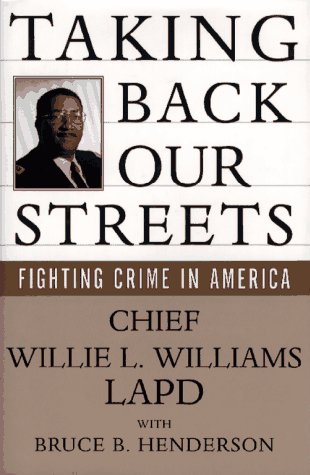
Imagen de portada de Amazon
Imagen de Amazon.com
Imagen de cubierta Syndetics
Portada de Syndetics
Imagen de OpenLibrary

Taking back our streets fighting crime in America Willie L. Williams with Bruce B. Henderson.

Por: Colaborador(es): Detalles de publicación: New York, NY Scribner c1996.Descripción: 287 p. ill. 25 cmISBN:
  • 0684802775
Tema(s): Clasificación CDD:
  • 363.2/092 B 20
Clasificación LoC:
  • HV7911.W494 A3 1996
Valoración
    Valoración media: 0.0 (0 votos)
Existencias
Imagen de cubierta Tipo de ítem Biblioteca actual Biblioteca de origen Colección Ubicación en estantería Signatura topográfica Materiales especificados Info Vol URL Copia número Estado Notas Fecha de vencimiento Código de barras Reserva de ítems Prioridad de la cola de reserva de ejemplar Reservas para cursos
Libro Biblioteca Encarnación Valdés Colección General bev 363.2092 W728t (Navegar estantería(Abre debajo)) Disponible 80000001914814
Total de reservas: 0

Descripciones mejoradas de Syndetics:

Williams took over the position as Chief of the Los Angeles Police Department after the Rodney King trial, coming from Philadelphia where he witnessed the devastating bombing of the MOVE headquarters as a young police officer. In this professional biography he discusses some of his most public cases, including those of Heidi Fleiss and O.J. Simpson, but more interestingly he describes his theories on community policing and how he implemented his ideas in both Philadelphia and Los Angeles. He offers practical advice on how individual citizens can organize and help police "take back their streets." Annotation c. by Book News, Inc., Portland, Or.

"A Lisa Drew book."

Includes index.

Reseñas proporcionadas por Syndetics

Library Journal Review

That Los Angeles police chief Williams is upbeat shines through everything he has to say about his four years' tenure in L.A., his service before that in Philadelphia, and the country's prospects for fighting urban crime. Only a hopeful, positive, and competent person would sign on for a police department and a city wracked by the Rodney King trial riots and the exodus of elected officials from the city. Even as Williams was uplifting and retraining his demoralized police and giving the public renewed confidence in them, his department has faced a whole series of new traumas: the second King trial and its threat of riot; the Reginald Denny trial; the earthquake; the Michael Jackson child molestation probe; the Heidi Fleiss prostitution case; and the O.J. Simpson trial. Williams is the very model of a modern policeman. He is African American but considers himself "blue" first; he talks and listens to his officers; he believes in community policing, conceptualizing police work in the framework of the larger community, talking and listening there, too, and relying in turn on the community for support. The final chapter is a shopping list of what communities can do "to take back their streets." Recommended for popular and academic criminal justice collections. [Previewed in Prepub Alert, LJ 12/95.]‘Janice Dunham, John Jay Coll. Lib., New York (c) Copyright 2010. Library Journals LLC, a wholly owned subsidiary of Media Source, Inc. No redistribution permitted.

Publishers Weekly Review

In 1992, Williams, then head of the Philadelphia Police Department, was about to become Chief of Police in L.A. when the riots following the Rodney King verdict erupted. How he helped to steer the LAPD on a new course is the subject of the first half of this book, written with Henderson, coauthor of The Sea Will Tell. In essence. Williams's philosophy was to eradicate the military-style, us-versus-them bunker attitude that had characterized the department for decades and to introduce community policing. This involved both paying attention to citizens' concerns and explaining why his officers could not always do what the public wanted. He also began an aggressive campaign to recruit more minorities and women. In the latter sections, Williams gives details on how community policing is taking hold in L.A. and how other cities and towns can adopt it. A book that might have been self-serving instead makes a solid contribution to educating us about problems facing law enforcement officers. Reform of the LAPD is ongoing, according to Williams, a process likely to take 10-12 years. (Apr.) (c) Copyright PWxyz, LLC. All rights reserved

Booklist Review

The L.A. Police Department may be the most famous in the U.S. because of the recent rash of high-profile crimes: the Rodney King beating; the 1992 riots; the Hollywood madame and Michael Jackson pederasty cases; and the matter of O. J. Simpson. Williams became L.A.'s police chief mere weeks after the riots, with a mandate to restore morale in the ranks and confidence in the police throughout the city. With Henderson's writing help, he tells what he has done and is doing to accomplish those objectives, along the way relaying his philosophy of policing, his ideas about kinds of crime that plague the whole nation (he's for gun control, against drug legalization), and a smidgen of autobiography. Williams believes in community policing--putting more uniforms on the street, soliciting citizens' cooperation in addressing problems, hearing actual complaints and dealing with them directly. For Williams, who as a black man has known discrimination personally, community policing also means building a police corps that reflects the populace it serves, through affirmative action (he has already greatly increased the number of women in LAPD blue) and by not tolerating the bigotry of a Mark Fuhrman in the force. You may not think a cop talking about the applied theory rather than the nitty-gritty of his work could be engrossing, but in this case, you'd be wrong. (Reviewed Feb. 15, 1996)0684802775Ray Olson
Compartir
logopucpr-y-vive

Contáctanos

¡Queremos saber de ti!

Tel. 787.841.2000 Ext. 1801

bibliotecavaldes@pucpr.edu

⁣Búscanos en las redes

© 2026 Desarrollado por Ignite Online • All Rights Reserved • Powered by Koha.