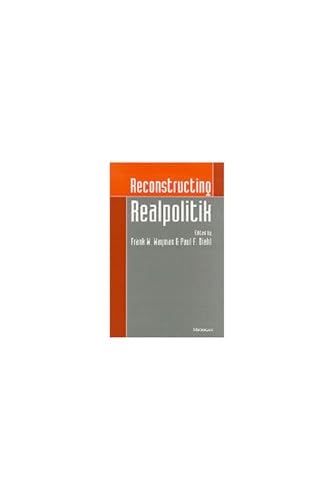

Reconstructing realpolitik edited by Frank W. Wayman and Paul F. Diehl.
Detalles de publicación: Ann Arbor University of Michigan Press c1994.Descripción: 293 pISBN:- 0472103555 (alk. paper)
- 047208268X (pbk. : alk. paper)
- 327.1/01 20
- JX1391 .R43 1994
| Imagen de cubierta | Tipo de ítem | Biblioteca actual | Biblioteca de origen | Colección | Ubicación en estantería | Signatura topográfica | Materiales especificados | Info Vol | URL | Copia número | Estado | Notas | Fecha de vencimiento | Código de barras | Reserva de ítems | Prioridad de la cola de reserva de ejemplar | Reservas para cursos | |
|---|---|---|---|---|---|---|---|---|---|---|---|---|---|---|---|---|---|---|
| Libro | Biblioteca Encarnación Valdés Colección General bev | 327.101 R311 (Navegar estantería(Abre debajo)) | Disponible | 80000001747404 |
Descripciones mejoradas de Syndetics:
Reconstructing Realpolitik assesses what there is of value in the realpolitik approach to understanding world politics, what must be amended ordiscarded, and what might be needed to replace the classic model. Calling realpolitik, or realism, a "cluster of models, assumptions, hunches, hypotheses, and parameter estimates" united only by their common focus on power, the editors challenged their contributors to test elements of the realpolitik model with empirical evidence and to suggest how the model might be revised to make it square with the evidence. The result is a wealth of original, rigorously tested, data-based findings that advance our understanding of this basic paradigm.The coverage is unusually comprehensive: chapters address the onset, escalation, and expansion phases of conflict; different conflict phenomena, such as economic sanctions, interventions, crisis bargaining, and decolonization, besides the more traditional concerns of military disputes, are examined; and the cases represent a variety of different spatial and temporal domains. In the end, Reconstructing Realpolitik shows that realpolitik factors and insights help to explain and predict a variety of international conflict phenomena while at the same time offen producing incorrect or exaggerated results. While realism remains a valuable proposition, it is clear that it fails to encompass several key factors that influence state behavior.Contributors include Robert A. Baumann, Bruce Bueno de Mesaquita, Gary Goertz, Athanasios Hristoulas, Paul Huth, Patrick James, Daniel M. Jones, Charles W. Kegley, Jr., David Lalman, Russell J. Leng, Frederic S. Pearson, Jeffrey J. Pickering, Brian M. Pollins, and Gregory A. Raymond.
Includes bibliographical references and index.