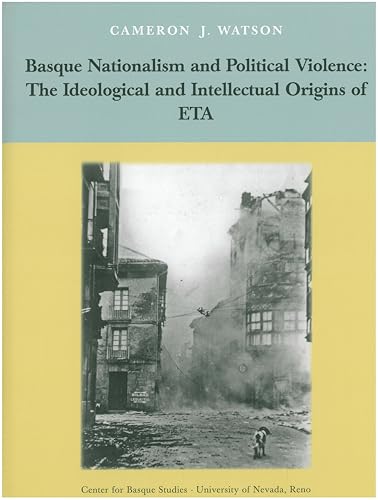

Basque nationalism and political violence the ideological and intellectual origins of ETA by Cameron J. Watson.
Series Occasional papers series ; no. 14Detalles de publicación: Reno, Nev. Center for Basque Studies, University of Nevada, Reno 2007.Descripción: 330 p. ill. 25 cmISBN:- 9781877802751 (hardcover)
- 1877802751 (hardcover)
- 303.60946/609045 22
- HN590.P275 W37 2007
| Imagen de cubierta | Tipo de ítem | Biblioteca actual | Biblioteca de origen | Colección | Ubicación en estantería | Signatura topográfica | Materiales especificados | Info Vol | URL | Copia número | Estado | Notas | Fecha de vencimiento | Código de barras | Reserva de ítems | Prioridad de la cola de reserva de ejemplar | Reservas para cursos | |
|---|---|---|---|---|---|---|---|---|---|---|---|---|---|---|---|---|---|---|
| Libro | Biblioteca Encarnación Valdés Colección General bev | 303.60946 W3371b (Navegar estantería(Abre debajo)) | Disponible | 80000002346909 |
Descripciones mejoradas de Syndetics:
This work seeks to interrogate the relationship between ideas and action through a historical account of how images of violence and warfare pervaded the discourse of Basque nationalism--principally through the parameters of the hegemonic Partido Nacionalista Vasco (PNV or Basque Nationalist Party)--from its foundation in the 1890s through the mid-twentieth century. Ultimately, it argues that a culture of political violence emerged within the Basque nationalist movement that eventually resulted in the creation of ETA (Euskadi ta Askatasuna, Basque Country and Freedom) in 1959. However, the undertone of violent struggle in substate Basque nationalism was itself a response to the aggressive statist nationalism of Spain, a country whose problematic transition to modernity in the nineteenth and twentieth centuries engendered multiple forms of social, political, and structural violence within its own borders and beyond. The work views Basque political violence, then, as the contemporary manifestation of a past cultural experience, based on a problematic dialogue with the emergence of modern Spain. Yet it does not limit its explanation of ETA's emergence to the Spanish context alone. Rather, it emphasizes the transnational context in which nationalist movements emerge and develop. Specifically, in the Basque case, and at varying times, the national struggles of Cuba, Morocco, and Ireland were extremely influential. Moreover, the immediate origins of ETA were strongly influenced by post-World War II intellectual currents, from existentialism to the liberating theories of anticolonial nationalist movements.
Includes bibliographical references and index.
Introduction: Culture, history, and identity -- Overlapping identities in Spain and the Basque country -- Sabino de Arana y Goiri and the emergence of Basque nationalism -- Core images in the emergence of Basque nationalism -- The age of dissent : Basque nationalism, 1903-23 -- Core images in Basque nationalism, 1916-23 -- An opportunity missed? Basque nationalism during the second Spanish republic, 1930-36 -- Basque war stories -- Franco and the Basque country 1937-51 -- From EKIN to ETA : the new struggle? -- Cultural representation and political violence : the creative legacy of EKIN -- Conclusion: Past imperfect : the historical and cultural dimensions of Basque political violence before ETA.
Tabla de contenidos provista por Syndetics
- Acknowledgments(p. 11)
- Introduction: Culture, History, and Identity(p. 15)
- Chapter 1 Overlapping Identities in Spain and the Basque Country(p. 29)
- Chapter 2 Sabino de Arana y Goiri and the Emergence of Basque Nationalism(p. 49)
- Chapter 3 Core Images in the Emergence of Basque Nationalism(p. 73)
- Chapter 4 The Age of Dissent: Basque Nationalism, 1903-23(p. 91)
- Chapter 5 Core Images in Basque Nationalism, 1916-23: The Saint, the Prophet, the Peasant, and the Warrior(p. 111)
- Chapter 6 An Opportunity Missed? Basque Nationalism, 1930-36(p. 127)
- Chapter 7 Basque War Stories(p. 145)
- Chapter 8 Franco and the Basque Country 1937-51(p. 167)
- Chapter 9 From Ekin to ETA: The New Struggle?(p. 185)
- Chapter 10 Cultural Representation and Political Violence: The Creative Legacy of Ekin(p. 201)
- Conclusion: Past Imperfect: The Historical and Cultural Dimensions of Basque Political Violence before ETA(p. 217)
- Notes(p. 225)
- Glossary(p. 281)
- Bibliography(p. 285)
- Index(p. 313)