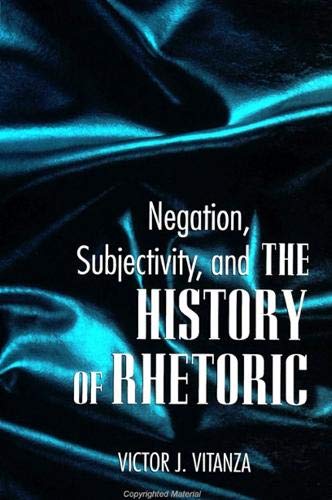
Imagen de portada de Amazon
Imagen de Amazon.com
Imagen de cubierta Syndetics
Portada de Syndetics
Imagen de OpenLibrary

Negation, subjectivity, and the history of rhetoric Victor J. Vitanza.

Por: Detalles de publicación: Albany State University of New York Press 1996.Descripción: xii, 428 pISBN:
  • 0791431231 (alk. paper)
  • 079143124X (pbk. : alk. paper)
Tema(s): Clasificación CDD:
  • 808/.009 20
Clasificación LoC:
  • PN183 .V58 1996
Valoración
    Valoración media: 0.0 (0 votos)
Existencias
Imagen de cubierta Tipo de ítem Biblioteca actual Biblioteca de origen Colección Ubicación en estantería Signatura topográfica Materiales especificados Info Vol URL Copia número Estado Notas Fecha de vencimiento Código de barras Reserva de ítems Prioridad de la cola de reserva de ejemplar Reservas para cursos
Libro Biblioteca Encarnación Valdés Colección General bev 808.009 V837n (Navegar estantería(Abre debajo)) Disponible 80000001908980
Total de reservas: 0

Descripciones mejoradas de Syndetics:

Vitanza introduces his book with the questions: "What Do I Want, Wanting to Write This ('our') Book? What Do I Want, Wanting You to Read This ('our') Book?" Thereafter, in a series of chapters and excursions and as schizographer of rhetorics (erotics), he interrogates three recent, influential historians of Sophists (Edward Schiappa, John Poulakos, and Susan Jarratt), and how these historians as well as others represent Sophists and, in particular, Isocrates and Gorgias under the sign of the negative. Vitanza concludes--rather rebegins in a sophistic-performative excursus--with a prelude to future (anterior) histories of rhetorics. Vitanza asks: "What will have been anti-Oedipalizedized (de-negated) hysteries of rhetorics? What will have they looked like, sounded, read like? Or to ask affirmatively, what, then, will have libidinalized-hysteries of rhetorics looked, sounded, read like?"

Includes bibliographical references and index.

Reseñas proporcionadas por Syndetics

CHOICE Review

In answering the question "What is it to write histories of rhetoric?" this volume follows Vitanza's edited volume Writing Histories of Rhetoric (CH, Dec'94) and further opens the door to the vastness of historiography. In postmodern fashion Vitanza readies the field by pointing out the rubble of what is already there and what is not, and thus attempts to write a prelude to future histories of rhetoric. A Dionysian tour de force, it cuts and pastes the English language to include in its discussion subjectivity and negative dialectic, aesthetics and politics, Lyotard and Derrida, Isocrates and Gorgias, and current historians of the Sophists--among a myriad of concepts, philosophers, and rhetoricians. The goal is to take the reader to "the idea of the dispersion of power in various accounts" and to those rhetors of a new Third Sophistic finding ways of rethinking power. The notion that women should write their "own past and destiny," their own "rhetorical feminisms" set within this male writing, confronts the danger line that Vitanza challenges, a line of "necessary confusion," with its one and two at the edge of many. If it is necessary to erect a "tower of Babel" occasionally, this is such a structure for the history of rhetoric. For upper-division undergraduates, graduate students, and faculty. T. B. Dykeman Fairfield University

Notas de autor provistas por Syndetics

Victor J. Vitanza is Associate Professor of English at the University of Texas at Arlington. He is the editor of two books, PRE/TEXT: The First Decade and Writing Histories of Rhetoric .
Compartir
logopucpr-y-vive

Contáctanos

¡Queremos saber de ti!

Tel. 787.841.2000 Ext. 1801

bibliotecavaldes@pucpr.edu

⁣Búscanos en las redes

© 2026 Desarrollado por Ignite Online • All Rights Reserved • Powered by Koha.