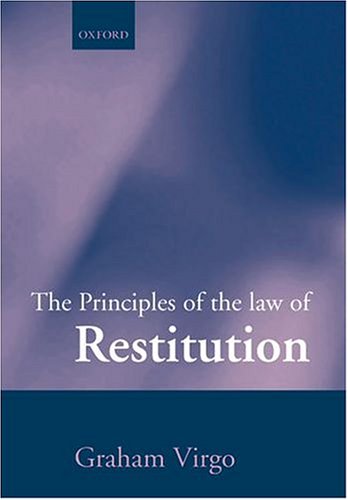

Principles of the law of restitution Graham Virgo.
Detalles de publicación: Oxford Oxford University Press 1999.Descripción: 800 p. 25 cmISBN:- 019876376X
- KD 1924 .V67 1999
| Imagen de cubierta | Tipo de ítem | Biblioteca actual | Biblioteca de origen | Colección | Ubicación en estantería | Signatura topográfica | Materiales especificados | Info Vol | URL | Copia número | Estado | Notas | Fecha de vencimiento | Código de barras | Reserva de ítems | Prioridad de la cola de reserva de ejemplar | Reservas para cursos | |
|---|---|---|---|---|---|---|---|---|---|---|---|---|---|---|---|---|---|---|
| Libro | Biblioteca de Derecho Mons. Fremiot Torres Oliver Colección General biblioteca derecho | KD 1924 .V67 1999 (Navegar estantería(Abre debajo)) | Disponible | 70000000636105 |
Descripciones mejoradas de Syndetics:
This new textbook outlines the general principles of the rapidly developing subject of the Law of Restitution. Restitution is concerned with the reversing of unjust enrichment and was recently recognized as a discrete body of law by the House of Lords although restitutionary principles have in fact been evolving for over 200 years. Rather than taking the traditional approach which assumes that restitutionary remedies will be awarded against a defendant only where it can be shown that the defendant has been unjustly enriched at the expense of the plaintiff.The book asserts that the law of restitution is simply concerned with the question of when restitutionary remedies may be awarded, that is remedies which are assessed by reference to a benefit obtained by the defendant. But in determining whether restitutionary remedies are available it is necessary to identify the causes of the action which triggers them. There are three such causes of action, namely the reversal of the defendants unjust enrichment, the commission of a wrong by the defendant, and the vindication of the defendants property rights. The state of the law is examined through analyses of the statutory provisions and key cases demonstrating the way the law is used to resolve a wide variety of legal problems. The very different views of academics as to the nature and ambit of the subject are also identified. This book should be invaluable to students on restitution courses at every level.
Includes bibliographical references.
Tabla de contenidos provista por Syndetics
- Preface(p. vii)
- Part I The Fundamental Principles(p. 1)
- 1 The Essence of Restitution(p. 3)
- 2 Themes and Controversies(p. 37)
- Part II Unjust Enrichment(p. 47)
- 3 The Principle of Unjust Enrichment(p. 49)
- 4 Enrichment(p. 58)
- 5 At the Expense of the Plaintiff(p. 105)
- Part III The Grounds of Restitution for the Purpose of Establishing Unjust Enrichment(p. 117)
- 6 Principles Underlying the Recognition of Grounds of Restitution(p. 119)
- 7 Ignorance(p. 128)
- 8 Mistake(p. 134)
- 9 Compulsion(p. 188)
- 10 Exploitation(p. 248)
- 11 Necessity(p. 300)
- 12 Failure of Consideration(p. 323)
- 13 Incapacity(p. 409)
- 14 Restitution from Public Authorities(p. 422)
- Part IV Restitution for Wrongs(p. 443)
- 15 General Principles(p. 445)
- 16 Restitution for Torts(p. 473)
- 17 Restitution for Breach of Contract(p. 498)
- 18 Restitution for Equitable Wrongdoing(p. 518)
- 19 Criminal Offences(p. 556)
- Part V Proprietary Restitutionary Claims(p. 589)
- 20 Establishing Proprietary Restitutionary Claims(p. 591)
- 21 Restitutionary Claims and Remedies to Vindicate Property Rights(p. 656)
- 22 The Defence of Bona Fide Purchase(p. 674)
- Part VI The General Defences and Bars to Restitutionary Claims(p. 681)
- 23 Fundamental Principles and General Bars(p. 683)
- 24 Defences Arising from Changes in the Defendant's Circumstances(p. 694)
- 25 Passing on and Mitigation of Loss(p. 733)
- 26 Illegality(p. 740)
- 27 Incapacity(p. 757)
- 28 Limitation Periods and Laches(p. 767)
- Bibliography(p. 779)
- Index(p. 789)