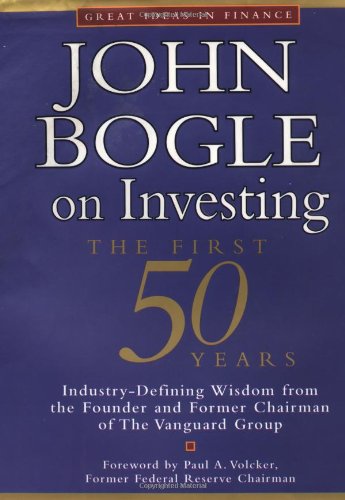

John Bogle on investing the first 50 years by John Bogle.
Detalles de publicación: New York McGraw-Hill c2000.Descripción: xxiv, 455 p. ill. 24 cmISBN:- 0071364382 :
- HG4521 .B575 2000
| Imagen de cubierta | Tipo de ítem | Biblioteca actual | Biblioteca de origen | Colección | Ubicación en estantería | Signatura topográfica | Materiales especificados | Info Vol | URL | Copia número | Estado | Notas | Fecha de vencimiento | Código de barras | Reserva de ítems | Prioridad de la cola de reserva de ejemplar | Reservas para cursos | |
|---|---|---|---|---|---|---|---|---|---|---|---|---|---|---|---|---|---|---|
| Libro | Biblioteca de Mayagüez Colección General mb | HG4521 .B575 2000 (Navegar estantería(Abre debajo)) | Disponible | 50000002123536 |
Descripciones mejoradas de Syndetics:
This work chronicles John Bogle's - the founder and former senior chairman of the Vanguard Group - 50 years in the financial services industry. His university thesis on the role of an investment company is included, along with speeches made by him over the past 40 years. The themes of investing for the long term, the importance of indexing, the critical effect of costs on investment returns, and the importance of diversification, are all covered.
Includes bibliographical references (p. 445-449) and index.
Tabla de contenidos provista por Syndetics
- Foreword(p. ix)
- Introduction(p. xi)
- Preface(p. xv)
- Some Words of Appreciation(p. xxiii)
- Part I Investment Strategies for the Intelligent Investor
- 1 Investing in the New Millennium: The Bagel and the Doughnut(p. 5)
- 2 The Clash of the Cultures in Investing: Complexity vs. Simplicity(p. 17)
- 3 Equity Fund Selection: The Needle or the Haystack?(p. 33)
- 4 Risk and Risk Control in an Era of Confidence (or Is It Greed?)(p. 47)
- 5 Buy Stocks? No Way!(p. 66)
- 6 The Death Rattle of Indexing(p. 82)
- 7 25 Years of Indexing: When Active Managers Win, Who Loses?(p. 98)
- 8 Selecting Equity Mutual Funds(p. 108)
- 9 The Third Mutual Fund Industry(p. 122)
- Part II Taking on the Mutual Fund Industry
- 10 Mutual Funds: The Paradox of Light and Darkness(p. 141)
- 11 Economics 101: For Mutual Fund Investors ... For Mutual Fund Managers(p. 153)
- 12 Honing the Competitive Edge in Mutual Funds(p. 168)
- 13 Creating Shareholder Value: BY Mutual Funds ... or FOR Mutual Fund Shareholders?(p. 180)
- 14 The Silence of the Funds: Mutual Fund Investment Policies and Corporate Governance(p. 196)
- 15 Losing Our Way: Where Are the Independent Directors?(p. 208)
- Part III Economics and Idealism: The Vanguard Experiment
- 16 Vanguard--Child of Fortune(p. 221)
- 17 The Winds of Change: The Vanguard Experiment in Internalized Management(p. 231)
- 18 Deliverance(p. 246)
- 19 The Lengthened Shadow, Economics, and Idealism(p. 260)
- 20 On the Right Side of History(p. 270)
- Part IV Personal Perspectives
- 21 Changing the Mutual Fund Industry: The Hedgehog and the Fox(p. 291)
- 22 The Majesty of Simplicity(p. 307)
- 23 The Things by Which One Measures One's Life(p. 312)
- 24 Telltale Hearts(p. 316)
- 25 Press On Regardless(p. 327)
- Part V The Princeton Thesis
- The Economic Role of the Investment Company(p. 341)
- Index(p. 451)
Reseñas proporcionadas por Syndetics
Library Journal Review
Bogle, founder of the enormous Vanguard family of no-load mutual funds, has long been one of the strongest voices for low-cost mutual funds and shareholder rights. Here, he gathers some of the speeches he has delivered over the past three decades (but most within the last few years). His themes are the failure of the mutual-fund industry to provide adequate returns, the value of index funds, the proper role of funds in corporate governance, the origins of Vanguard, and his own career. He also includes his 1951 Princeton undergraduate thesis on the economic role of mutual funds. Because so many of the speeches are recent, they hold timely information, though there is some repetition of ideas from one to another. This is an important collection by one of the major figures in mutual funds, and it belongs in every library with more than cursory holdings on investing. However, Bogle's other books, Bogle on Mutual Funds (LJ 10/15/93) or Common Sense on Mutual Funds (Wiley, 1999), would be more appropriate for the casual reader.DLawrence R. Maxted, Gannon Univ. Lib., Erie, PA (c) Copyright 2010. Library Journals LLC, a wholly owned subsidiary of Media Source, Inc. No redistribution permitted.Publishers Weekly Review
The author of two classic books, Bogle on Mutual Funds (1993) and Common Sense on Mutual Funds (1999), Bogle has been a strong voice for sensible, efficient, honest financial management throughout his career. In 1951, for his undergraduate economics thesis at Princeton, he wrote the first comprehensive analysis of the modern mutual fund. He then spent 25 years working in the fund industry before founding Vanguard, and another 25 years running that company. This omnibus begins with the 1951 thesis and includes articles and speeches over the next half-century. Unfortunately, 17 of the 26 chapters are speeches from the two years leading up to publication, which are really the same recycled speech with a few introductory paragraphs tailored to the audience. The older material, especially the thesis and a 1975 speech about the founding of Vanguard, will be extremely interesting only to Bogle's biographer and to Ph.D. students writing about the history of the mutual fund industry. General readers will be impressed with Bogle's consistency, though that is hardly adequate reward for 480 pages of mostly dull reading. (Nov.) (c) Copyright PWxyz, LLC. All rights reservedCHOICE Review
John Bogle founded The Vanguard Group, the second largest mutual fund family. This volume, the first in McGraw-Hill's "Great Ideas in Finance" series, contains 25 of his speeches presented to industry groups, investor organizations, college and high school classes, and general audiences from 1971 to 2000, organized in four sections: investment strategy, the mutual fund industry, the history of Vanguard, and personal perspectives. The basic theme--low-cost, long-term investing using index funds--is exceptionally well articulated throughout the first three sections. In the fourth section, readers learn something of Bogle the man from five speeches reflecting on his personal philosophy. A fifth section contains Bogle's 1951 undergraduate thesis, which sets out some of the ideas that led to the formation of Vanguard in 1974. This is not his best book for the novice investor, who will find Bogle's Common Sense on Mutual Funds (1999) a better introduction to investing and mutual funds. His new book is highly recommended for individual investors, investment professionals, and students of the mutual fund industry, lower-division undergraduate and up. D. A. Latzko Pennsylvania State University, York CampusBooklist Review
Bogle made news last year when he unsuccessfully challenged the mandatory retirement policy at Vanguard Group, the mutual funds investment company that he founded in 1974 and that he continued to serve as senior chairman. Bogle has always been well regarded by the press and by Vanguard's 14 million shareholders. He pioneered both no-load and index investment funds and he constantly criticized other companies for their high fees and service charges. The inaugural title in McGraw-Hill's Great Ideas in Finance series, this collection is a fitting tribute to Bogle. It consists of 25 speeches that he made throughout his career. These cover investment strategy, the mutual fund industry, and Bogle's view of human values and the philosophy of investing. Five of the speeches were made before general audiences; one is a high-school commencement address; another discusses organ donation (Bogle is the recipient of a heart transplant). The book concludes with the text of the dissertation Bogle submitted for graduation from Princeton University in 1951; it sets out the ideas that led to the formation of Vanguard nearly a quarter century later. --David RouseNotas de autor provistas por Syndetics
John Clifton Bogle was born in Montclair, New Jersey on May 8, 1929. He received a bachelor's degree in economics from Princeton University in 1951. After graduation, he was hired by the Wellington Fund, a Philadelphia-based fund management company. He was named president of Wellington in 1967. He founded the Vanguard Group of Investment Companies in 1974. In 1976, he founded the Vanguard Index Trust, the first index fund for individual investors. In 1977, he started selling mutual funds directly to investors rather than through brokers, thus eliminating the sales fees. He officially stepped down as chief executive of Vanguard in January 1996 and remained as chairman until the end of 1999.He wrote several books including Bogle on Mutual Funds, Common Sense on Mutual Funds, and The Clash of the Cultures: Investment vs. Speculation. He died from esophageal cancer on January 16, 2019 at the age of 89.
(Bowker Author Biography)