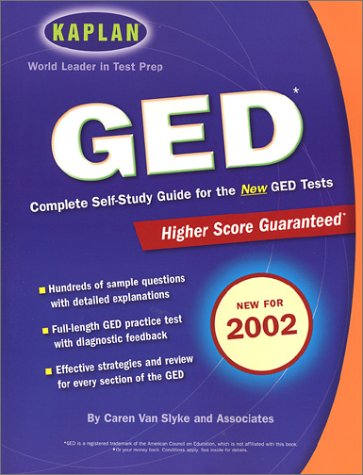
Imagen de portada de Amazon
Imagen de Amazon.com
Imagen de cubierta Syndetics
Portada de Syndetics
Imagen de OpenLibrary

GED by Caren Van Slyke and associates.

Colaborador(es): Detalles de publicación: New York, NY Simon & Schuster c2002.Edición: 5th edDescripción: xvi, 688 p. 28 cmISBN:
  • 0743215559 (pbk.)
Otro título:
  • Kaplan GED
Tema(s): Clasificación CDD:
  • 373.1262 G295 2002 21
Valoración
    Valoración media: 0.0 (0 votos)
Existencias
Imagen de cubierta Tipo de ítem Biblioteca actual Biblioteca de origen Colección Ubicación en estantería Signatura topográfica Materiales especificados Info Vol URL Copia número Estado Notas Fecha de vencimiento Código de barras Reserva de ítems Prioridad de la cola de reserva de ejemplar Reservas para cursos
Referencia Biblioteca Encarnación Valdés Sala de Referencia bev 373.1262 G295 2002 (Navegar estantería(Abre debajo)) Disponible 80000002225673
Total de reservas: 0

Descripciones mejoradas de Syndetics:

Review Strategies Practice Expert Advice Everything you need to score higher on the new GED Tests New! A Practical Guide Designed for Individual Study This comprehensive self-study guide, based on the most up-to-date information on the GED, has been specially created for individuals who want to prepare for the GED on their own. Kaplan's GED guide features targeted subject review, practice questions with detailed explanations and valuable feedback, and proven score-raising strategies. This guide includes: * Essential skills and knowledge needed to pass the new Reading, Writing, Math, Science, and Social Studies Tests * Effective strategies for writing the GED essay * Clear instructions on how to use the Casio fx-260 Calculator -- the actual calculator you will use on the GED Mathematics Test * Easy-to-review key ideas and tips throughout the book, featuring test-taking strategies and important information about the GED * Hundreds of sample questions with answers, detailed explanations, and valuable feedback to help you focus your study * A full-length GED practice test

At head of title: Kaplan.

Extracto provisto por Syndetics

Introduction Learn to Relax and Reduce Test Anxiety Adapted from the Kaplan AdvantageTrademark Stress Management System The countdown has begun. Your date with THE TEST is looming on the horizon. Anxiety is on the rise. The butterflies in your stomach have gone wild. Perhaps you feel as if the last thing you ate has turned into a lead ball. Your thinking is getting cloudy. Maybe you think you won't be ready. Maybe you already know your stuff, but you're going into panic mode already. Don't panic. It is possible to tame that anxiety and stress -- before and during the test. We'll show you how. You won't believe how quickly and easily you can deal with your anxiety. 1. Identify the Source of Your Anxiety In the space provided, jot down anything that you identify as a source of your test-related stress. The idea is to pin down that free-floating anxiety so that you can take control of it. Here are some common examples: * I always freeze up on tests. * I haven't studied math for years. * I have to get my GED to __. * I study like crazy, but nothing seems to stick. Now write down five or six personal "sources of stress." __________________________________________________ __________________________________________________ __________________________________________________ __________________________________________________ __________________________________________________ Take a few minutes to think about what you've just written down. Then, on another sheet of paper, rewrite your ideas in order. Put your biggest sources of anxiety at the top of the list and the lesser items below. As you write the list, you are forming a hierarchy of anxiety producers that bother you the most. Experience shows, as you begin to reduce your stress by taking care of items at the top of the list, you will have gone a long way to relieving your test anxiety, and the problems at the bottom will begin to take care of themselves. Start at the top of the list and develop a strategy to diffuse that source of stress. 2. Identify Your Areas of Strength and Weakness There are five test areas on the GED: reading, writing, math, science, and social studies. Based on this list, write the areas in which you are strongest: __________________________________________________ Now identify the tests that you expect to be most problematic: __________________________________________________ Next, go back to the "strong" list and take two minutes to write why you are strong in those subject areas. __________________________________________________ __________________________________________________ __________________________________________________ __________________________________________________ __________________________________________________ __________________________________________________ __________________________________________________ __________________________________________________ When you have stopped, check how much you wrote in two minutes. Do you think you could have written more? Is it possible that you need to give yourself more credit for what you are good at and what you like to do? You just took an important step toward helping yourself pass the GED. Notice any increased feelings of confidence? Enjoy them. Here's another way to think about what you wrote. Every area of strength and confidence is like a savings account that you can draw on. You can use your strengths to answer difficult problems, maintain confidence, and keep stress at a distance. For example, if you are good at reading but are worried about science, know that a lot of the science questions are based on reading science material that is provided on the test. Or if you like math but are worried about social studies, remember that you will use logical thinking on the Social Studies Test, as well as on the Mathematics Test. 3. Imagine Yourself Succeeding Forcing relaxation is like asking yourself to flap your arms and fly. You can't do it, and every push and prod only gets you more frustrated. Relaxation is something you don't work at. You simply let it happen. Think about it. When was the last time that you tried to force yourself to go to sleep and it worked? First, get yourself into a comfortable sitting position in a quiet setting. Wear loose clothing and take off any glasses. Close your eyes and breathe in a deep, satisfying breath of air. Really fill your lungs until your rib cage is fully expanded and you can't take in any more. Then exhale the air completely. Imagine that you are blowing out a candle with a little puff of air. Do this two or three more times, filling your lungs to the maximum and emptying them totally. Keep your eyes closed comfortably but not tightly. Let your body sink deeper into the chair as you become even more comfortable With your eyes shut, you can notice something very interesting. You're no longer dealing with the worrisome stuff going on in the world outside of you. Now you can concentrate on what happens inside of you. The more you recognize your own physical reactions to stress and anxiety, the more you can do about them. You may not realize it, but you've begun to regain a sense of control. Let images begin to form on the "viewing screens" on the back of your eyelids. You're experiencing visualizations from the place in your mind that makes pictures. Allow the images to come easily and naturally. Imagine yourself in a relaxing situation. Make your picture as detailed as possible, and notice as much as you can. Think about the sights, tastes, and textures associated with this place. See and feel yourself in this place. Stay focused on the images as you sink farther back into your chair. Breathe easily and naturally. You may have the sensations of any stress or tension draining from your muscles and flowing downward and away from you. Take a minute to notice how comfortable you've become. Imagine how much easier it would be if you could take the GED feeling this relaxed. You've coupled the images of a special place with sensations of relaxation and comfort. You've found a way to relax through visualization. Close your eyes again, and remember a real-life situation in which you did well on a test. If you can't come up with one, remember a situation in which you did something (in school or otherwise) that you were really proud of -- a genuine accomplishment. Make the memory as detailed as possible. Remember how confident you felt when you accomplished your goal. Now start thinking about taking the GED Tests. Keep your thoughts and feelings in line with that successful situation. Don't make comparisons between them. Just imagine taking the GED with the same feelings of confidence and relaxed control. This exercise is a great way to bring the test down to earth. You should practice this exercise often, especially when the prospect of taking the GED starts to create anxiety. The more you practice it, the more effective it will be for you. 4. Determine to Overcome Your Weaknesses Let's get back to the list of your weak points on page xii. Take two minutes to expand it, just as you did with your list of strengths. Be honest with yourself without going overboard. It's an accurate appraisal of the test areas that give you trouble. So pick up your pencil, check your clock, and start writing. __________________________________________________ __________________________________________________ __________________________________________________ __________________________________________________ __________________________________________________ __________________________________________________ __________________________________________________ __________________________________________________ How did you do? Were you able to keep writing for the full two minutes? Has making this list helped you become clearer about the specific areas you need to work on? Facing your weak spots gives you some distinct advantages. It helps a lot to realize that the WHOLE test can be broken down into areas of strengths and weaknesses. This allows you to build on your strengths to improve your scores in your strong areas and to focus on spending extra effort on your areas of weakness. Increased exposure to tough material makes it more familiar and less intimidating. Actually, you'll feel better about facing the test because you know that you're actively strengthening your chances of earning a higher overall score on the GED. Take Control Now that you have gotten into the GED mind-set and have practiced relaxing and reducing stress, you have to learn to take control, both in the days just before you take the GED and during the test itself. Quick Tips for the Days Just Before You Take the GED * Ease up as Test Day approaches. The best test takers do less and less as "Test Day" approaches. Taper off on your study schedule and take it easy. You want to be ready, but you also want to be relaxed. Give yourself time off, especially the evening before you take the test. By that time, if you've studied well, everything you need to know has been covered. * Give yourself positive self-talk. Positive self-talk can be extremely liberating and invigorating, especially as the test looms closer. Tell yourself things such as, "I choose to take this test," rather than "I have to" and, "I will do well," rather than "I hope I can pass." Be aware of negative, self-defeating thoughts and images, and immediately counter those you become aware of. Replace them with positive statements that encourage your self-esteem and confidence. * Get your act together sooner rather than later. Have everything (including choice of clothing) laid out in advance. More importantly, be sure you know where the test will be held and the easiest, quickest way to get there. You will get great peace of mind if you know that all the little details -- gas in the car, directions, etc. -- are firmly in control on Test Day. * Go to the testing center a few days in advance. This is very helpful if you are especially anxious. If at all possible, find out what room you will take the test in, and sit in the room. Better still, bring some preparation material with you, and work on it in that room. Familiarity doesn't breed contempt; it generates comfort and confidence. * Don't study on the day before the test. It is best to marshal your physical and psychological resources for twenty-four hours or so. Even racehorses are kept in the pad-dock and treated like princes the day before a race. Keep the upcoming test out of your consciousness: go to a movie, take a hike, or just relax. Don't eat junk food or tons of sugar. And, of course, get plenty of rest the night before the test. Just don't go to bed too early. It's hard to fall asleep earlier than you're used to, and you don't want to lie there thinking about the test. Handling Stress During the Test The biggest stress monster will be Test Day itself. Fear not; there are methods of quelling your stress during the test. * Keep moving forward, instead of getting bogged down with a difficult question. You don't have to get everything right to achieve a passing score. So don't linger on a question that is going nowhere, even after you have spent considerable time on it. Even the most successful test takers temporarily skip difficult material. You should lightly mark the ones that are left unanswered and be sure to come back to them before the test ends. But remember-before the test ends, make sure you leave no question unanswered. * Don't be thrown if other test takers seem to be working more quickly than you. Continue to spend time patiently, but doggedly, thinking through your answers. This is going to lead to higher-quality test taking and better results. Don't mistake activity for a guarantee of correct test taking. * Manage your time. Wear a watch or keep your eye on the clock. If you have a watch, set it at 12:00 at the beginning of each test so that it is easy to check the time. Even though the GED examiner will tell you how long you have for each test, you need to be in charge of your own time management. Easier questions will take you less time, and you need to be able to spend extra time on the more difficult ones. * Keep breathing! Sometimes people forget to breathe when they are taking a test. No kidding! They start holding their breath without realizing it, or they breathe erratically. Improper breathing hurts confidence and accuracy. Just as importantly, it interferes with clear thinking. * Do some quick relaxation exercises during the test. Do some quick isometrics during the test, especially if concentration is wandering or energy is waning. Try this: Put your palms together and press intensely for a few seconds. Concentrate on the tension you feel through your palms, wrists, forearms, and up into your biceps and shoulders. Then quickly release the pressure. Feel the difference as you let go. Focus on the warm relaxation that floods through the muscles. Now you're ready to return to the task. Here's another isometric that will relieve tension in both your neck and eye muscles. Slowly rotate your head from side to side, turning your head and eyes to look as far back over each shoulder as you can. Feel the muscles stretch on one side of your neck as they contract on the other. Repeat five times in each direction. With what you've learned here, you're ready to face the test. This book and your other studies will give you the information you'll need to answer the questions. It's all firmly planted in your mind. You also know how to deal with any excess tension that might come along when you're studying for and when you're taking the GED Tests. You've practiced what you need to control your test anxiety and stress. Study productively, and you'll pass the GED. Good luck! Copyright 2002 Learning Unlimited
Compartir
logopucpr-y-vive

Contáctanos

¡Queremos saber de ti!

Tel. 787.841.2000 Ext. 1801

bibliotecavaldes@pucpr.edu

⁣Búscanos en las redes

© 2026 Desarrollado por Ignite Online • All Rights Reserved • Powered by Koha.