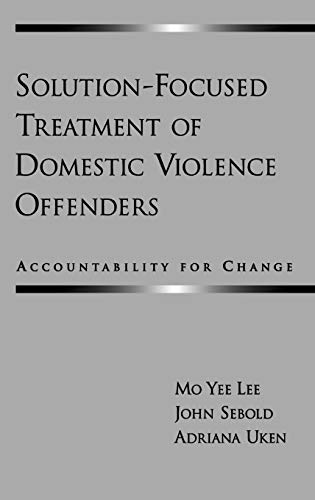

Solution-focused treatment of domestic violence offenders accountability for change Mo Yee Lee, John Sebold, Adriana Uken.
Detalles de publicación: Oxford New York Oxford University Press 2003.Descripción: ix, 255 p. 24 cmISBN:- 0195146778 (hardcover : alk. paper)
- 0195146786 (pbk. : alk. paper)
- 362.829286 L4771s 21
- HV6626 .L44 2003
- 2004 G-400
- WM 55
| Imagen de cubierta | Tipo de ítem | Biblioteca actual | Biblioteca de origen | Colección | Ubicación en estantería | Signatura topográfica | Materiales especificados | Info Vol | URL | Copia número | Estado | Notas | Fecha de vencimiento | Código de barras | Reserva de ítems | Prioridad de la cola de reserva de ejemplar | Reservas para cursos | |
|---|---|---|---|---|---|---|---|---|---|---|---|---|---|---|---|---|---|---|
| Libro | Biblioteca Encarnación Valdés Colección General bev | 362.829286 L4771s (Navegar estantería(Abre debajo)) | Disponible | 80000002294380 |
Descripciones mejoradas de Syndetics:
Every fifteen seconds someone commits a crime of domestic violence in the United States, and most violators will be court-mandated to receive group treatment. Outcome studies of traditional treatment programs (those with confrontational or educational approaches) indicate high rates of dropping out and low effectiveness, lending urgency to the need to find an alternative method. This book describes a cutting-edge treatment approach that creates effective, positive changes in domestic violence offenders.Solution-focused therapy focuses on holding offenders accountable and responsible for building solutions, rather than emphasizing their problems and deficits. By focusing on "solution-talk" instead of "problem-talk," clients are assisted in developing useful goals and solution behaviors that are then amplified, supported, and reinforced through a solution-building process. The book will be of great interest to professionals and graduate students in social work, psychology, and counseling.
Includes bibliographical references (p. 239-248) and index.
Introduction : accountability for solutions -- 2. The solution-focused assessment interview -- 3. Using group rules, assignments, and a team approach -- 4. Developing useful goals -- 5. Utilizing goals in the process of change -- 6. Consolidating change : the "language of success" -- 7. Utilizing group process : the "language of sharing" -- 8. Useful assumptions and tools -- 9. Working with special populations -- 10. Evaluation of the treatment program -- Appendix 1 : theoretical perspectives of domestic violence -- Appendix 2 : group rules -- Appendix 3 : written assignment.
Tabla de contenidos provista por Syndetics
- Foreword(p. v)
- 1 Introduction: Accountability for Solutions(p. 3)
- 2 The Solution-Focused Assessment Interview(p. 18)
- 3 Using Group Rules, Assignments, and a Team Approach(p. 42)
- 4 Developing Useful Goals(p. 54)
- 5 Utilizing Goals in the Process of Change(p. 88)
- 6 Consolidating Change: The "Language of Success"(p. 112)
- 7 Utilizing Group Process: The "Language of Sharing"(p. 122)
- 8 Useful Assumptions and Tools(p. 130)
- 9 Working with Special Populations(p. 149)
- 10 Evaluation of the Treatment Program(p. 182)
- 11 Afterword(p. 219)
- Appendix 1 Theoretical Perspectives of Domestic Violence(p. 229)
- Appendix 2 Group Rules(p. 235)
- Appendix 3 Written Assignment(p. 237)
- References(p. 239)
- Index(p. 249)