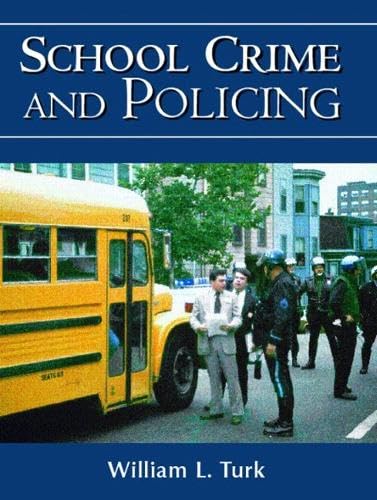
Imagen de portada de Amazon
Imagen de Amazon.com
Imagen de cubierta Syndetics
Portada de Syndetics
Imagen de OpenLibrary

School crime and policing William L. Turk.

Colaborador(es): Detalles de publicación: Upper Saddle River, NJ Pearson c2004.Descripción: xv, 265 p. 24 cmISBN:
  • 0130924911 (pbk.)
Tema(s): Clasificación CDD:
  • 371.782 S3721 21
Clasificación LoC:
  • LB3013.32 .P65 2004
Valoración
    Valoración media: 0.0 (0 votos)
Existencias
Imagen de cubierta Tipo de ítem Biblioteca actual Biblioteca de origen Colección Ubicación en estantería Signatura topográfica Materiales especificados Info Vol URL Copia número Estado Notas Fecha de vencimiento Código de barras Reserva de ítems Prioridad de la cola de reserva de ejemplar Reservas para cursos
Libro Biblioteca Encarnación Valdés Colección General bev 371.782 S3721 (Navegar estantería(Abre debajo)) Disponible 80000002270398
Total de reservas: 0

Descripciones mejoradas de Syndetics:

This one-of-a-kind book opens by exploring the problem of school crime in America today--stating in explicit and understandable terms the exact nature of juvenile and school crime as described in national and state statistics, and examines various methods and techniques for solving the problem. In short, anyone who reads this book will understand the reality of school crime and what to do about it. KEY TOPICS Chapter topics provide an overview of school crime in the U.S., school crime in California and Texas, how to prepare for safe schools, recommended practices for safe schools, the police response to school crime, the classroom teacher¿s and school administrator¿s perspectives on school violence, the appropriate and effective use of security technologies in schools, and school-based prevention programs that work. For public school teachers, administrators, and staff.

Includes bibliographical references.

Tabla de contenidos provista por Syndetics

  • 1 Juvenile Offenders and Victims: 1999 National Report
  • 2 School Crime in the United States: A Brief Analysis of Patterns and Trends
  • 3 School Crime Reporting in California
  • 4 School-Based Violent Crime in Texas
  • 5 Preparing for Safe Schools
  • 6 Recommended Practices for Safe Schools
  • 7 A Police Officer's Response to School Crime: A Cooperative Venture
  • 8 School Violence from the Classroom Teacher's Perspective
  • 9 School Violence from the Administrator's Perspective
  • 10 The Appropriate and Effective Use of Security Technologies in U.S. Schools: A Guide for Schools and Law Enforcement Agencies
  • 11 A Guide to Effective School-Based Prevention Programs: Early Childhood Education and Environmentally Focused Programs
  • 12 A Guide to Effective School-Based Prevention Programs: Individually Focused Programs
  • 13 Policing and School Violence: Perceptions or Reality - Either Way There Will Always Be the Need for Safety

Extracto provisto por Syndetics

School crime has been on the public agenda for almost 30 years. Violent and dangerous acts occur with some regularity at schools across the country and have for some time. The acts were dismissed by citizens and hidden by education officials. School principals were well aware of the fights on school property, the acts of vandalism, and the weapons confiscated every school year. It was an issue that never reached the "identification of a problem" stage. Individual acts of crime and whole school disruptions during the rock and roll era, the civil rights movement, the Vietnam War protests, and the dramatically changing lifestyle in post-WWII America did not seem to, grab our attention.Blackboard JungleandRebel Without a Causecame closer to alerting Americans that something at school had changed. The advent of congressional hearings in 1975 signaled the beginnings of a fairly recent national concern with school crime. My hope is that this book will contribute in some small measure toward a better understanding of the problem of school crime, yet I sincerely hope it also offers some possible solutions. It is no accident that this book-'s content is weighted toward suggested solutions of the problem. Four of the 13 chapters are geared toward an analysis of the problem, while the remaining nine are oriented toward resolution. The first chapter asks the question: Why is there school crime? The answer is because there is juvenile crime. The larger question of why juveniles or adults commit crimes remains to be answered. Scholars, philosophers, theologians, and others have struggled with this conundrum across the ages. The inability of human beings to consistently obey even the simplest of rules seems to be part and parcel of our basic nature. Chapter 1 is designed to give that overview of juvenile crime in present-day America. The authors of Chapters 2 through 4 use published data to describe the status of crime occurring in and around schools in the United States, California, and Texas. By examining an overview of school crime in the United States and then specifically looking at the two largest states, it is hoped the reader will gain a clear perspective of the state of crime in schools at this date. What crimes are being committed? Who are the criminals? Who are the victims? What, exactly, are the dimensions of the problem? The remainder of the book is devoted to working on solutions for the problem identified so conclusively in these first chapters. Chapter 5 addresses the concept of planning for safe schools. Planning is the keystone in the arch of successful safe school management. The very essence of planning is to see opportunities, threats, strengths, and weaknesses. Planning shapes the whole area encompassed by the idea of safe schools. Richard Stephens writes from experience in the field in detail and with conviction. Crime is going to happen in your school; be prepared through proper planning. Dr. Stephens, who has devoted his life's work to safe schools, then follows with best practices for developing safe schools in Chapter 6. He offers concrete suggestions on how to proceed and especially how to cooperate with local police officials to combat school crime. In my view, cooperation with local police authorities is essential for all schools. Their expertise and experience are invaluable to the school system. No school district can, or should, attempt to "go it alone." "Building community partnerships" is not just common sense; it is imperative. Chapter 6's discussion of "campus access and control," "administrative leadership," "school climate," "student behavior, supervision, and management," "staff training," and "student involvement" is rife with guidance for building safety into the school. The School Crime Assessment Survey in Appendix A is invaluable for an accurate inventory of a school's crime-prevention readiness. Following along on the recommendation from t Excerpted from School Crime and Policing by William L. Turk All rights reserved by the original copyright owners. Excerpts are provided for display purposes only and may not be reproduced, reprinted or distributed without the written permission of the publisher.

Notas de autor provistas por Syndetics

William L. Turk, (Ph.D., University of Texas Arlington), is an assistant professor of political science at the University of Texas-Pan American in Edinburg, Texas. He has recently published When Juvenile Crime Comes to School (The Edwin Mellen Press, 1999), an in-depth look at and analysis of school crime in 50 Texas school districts. He has published in academic journals and extensively in private industry press. He is currently working on a book about special districts in Texas.

Compartir
logopucpr-y-vive

Contáctanos

¡Queremos saber de ti!

Tel. 787.841.2000 Ext. 1801

bibliotecavaldes@pucpr.edu

⁣Búscanos en las redes

© 2026 Desarrollado por Ignite Online • All Rights Reserved • Powered by Koha.