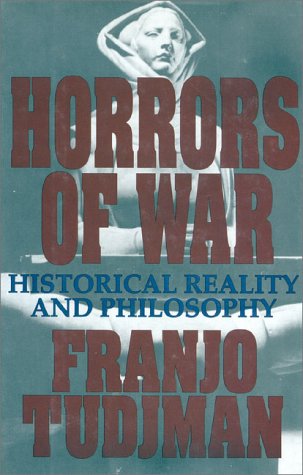

Horrors of war historical reality and philosophy Franjo Tudjman ; translated from Croatian by Katarina Mijatovic.
Idioma: Inglés Lenguaje original: croata Detalles de publicación: New York M. Evans c1996.Edición: Rev. edDescripción: xvi, 480 p. 24 cmISBN:- 0871318385
- DR1539 .T8313 1996
| Imagen de cubierta | Tipo de ítem | Biblioteca actual | Biblioteca de origen | Colección | Ubicación en estantería | Signatura topográfica | Materiales especificados | Info Vol | URL | Copia número | Estado | Notas | Fecha de vencimiento | Código de barras | Reserva de ítems | Prioridad de la cola de reserva de ejemplar | Reservas para cursos | |
|---|---|---|---|---|---|---|---|---|---|---|---|---|---|---|---|---|---|---|
| Libro | Biblioteca Encarnación Valdés Colección General bev | 364.138 T911b I (Navegar estantería(Abre debajo)) | Disponible | 80000001981052 |
Descripciones mejoradas de Syndetics:
In Horrors of War, Tudjman combines his first-hand war-torn Yugoslavian experience with a vast knowledge of history, philosophy and literature to prove that violence and retribution are not new to this world, and unfortunately show no sign of abatement. As part of his review of violence in history, and it's political uses, Tudjman examines the Yugoslav Communist creation of a croation 'black legend', attempting to fix the blame for the world war II crimes of Croatia's Ustasha puppet government on the entire Croation people. In particular, he assesses the nature and scope of the crimes committed by the Ustasha government, particularly at the Jasenovac death camp. He concludes that, although Jasenovac was a cruel and terrible place where tens of thousands were murdered, it does not and cannot justify the delegitimization of the Croatian nation. He chronicles the systematic use by the Yugoslav regime of Jasenovac and the ustasha terror as a tool in it's attempt to eliminate Croatian aspirations towards independence. He brings up the fact that the anti-fascist movement in Croatia was one of the strongest anti-fascist movements not only in Yugoslavia but also in Europe. Franjo Tudjman is the president of the Republic of Croatia and a signer of the Dayton Accords.
"This is a substantially revised version of the book Bespuca povijesne zbiljnosti : rasprava o povijesti i filozofiji zlosilja (Wastelands of historical reality : discussion on history and philosophy of aggressive violence)"--P. ix.
Includes bibliographical references (p. 413-463) and index.