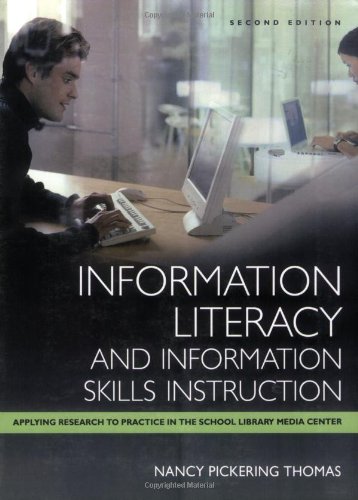

Information literacy and information skills instruction applying research to practice in the school library media center Nancy Pickering Thomas.
Series Library and information problem-solving skills seriesDetalles de publicación: Westport, Conn. Libraries Unlimited c2004.Edición: 2nd edDescripción: xiii, 225 p. 28 cmISBN:- 1591580811 (pbk. : alk. paper)
- Library orientation for school children -- United States
- Information literacy -- Study and teaching (Secondary) -- United States
- Information literacy -- Study and teaching (Elementary) -- United States
- School libraries -- Activity programs -- United States
- Library orientation for high school students -- United States
- 027.62/6 22
- Z711.2 .T496 2004
| Imagen de cubierta | Tipo de ítem | Biblioteca actual | Biblioteca de origen | Colección | Ubicación en estantería | Signatura topográfica | Materiales especificados | Info Vol | URL | Copia número | Estado | Notas | Fecha de vencimiento | Código de barras | Reserva de ítems | Prioridad de la cola de reserva de ejemplar | Reservas para cursos | |
|---|---|---|---|---|---|---|---|---|---|---|---|---|---|---|---|---|---|---|
| Libro | Biblioteca de Mayagüez Colección General mb | Z711.2 .T496 2004 (Navegar estantería(Abre debajo)) | Disponible | 50000003177176 |
Descripciones mejoradas de Syndetics:
In this new edition of her well received and reviewed book, Nancy Pickering Thomas updates and expands on her reviews of the literature concerning learning styles, information skills, literacy skills, technological literacy, and bibliographic instruction. In addition, she discusses current trends, issues, and applications for the research reviewed. Thomas looks at information processing models, instructional diagnostic models, and how to assess the outcomes of information skills instruction. This meticulously researched and logically organized book will be valuable to school library educators as a supplemental text and to practitioners for the discussion given to the application of the research reviewed.
Includes bibliographical references and indexes.
Tabla de contenidos provista por Syndetics
- Acknowledgments(p. x)
- Introduction(p. xi)
- 1 From Personal Assistance to Bibliographic Instruction: The Roots of Information Skills Instruction in Academic and Public Libraries(p. 1)
- Approaches to Service: Origins and Development(p. 1)
- A Taxonomy of Service(p. 2)
- Research versus Information Seeking(p. 4)
- Library Instruction as an Aspect of Service in Academic Libraries(p. 5)
- Knapp's Experiment(p. 9)
- Bibliographic Instruction: The Earlham College Experience(p. 10)
- "Personal Assistance" in Public Libraries and the Library of Congress(p. 12)
- Conclusion(p. 14)
- 2 The Development of School Libraries: From Concept to Reality(p. 15)
- Opening the Door(p. 16)
- Progress toward Centralization of School Collections(p. 19)
- Development of Library Skills Instruction(p. 20)
- The End of an Era(p. 23)
- Demonstrating Value: An Enduring Dilemma(p. 25)
- 3 From Library Skills to Information Skills Instruction: Kuhlthau's Information Search Process (ISP)(p. 27)
- The Source Approach(p. 27)
- The Pathfinder Approach(p. 28)
- Process Models Approach(p. 28)
- Kuhlthau's Studies of the Information Search Process(p. 30)
- Kuhlthau's Levels of Intervention(p. 34)
- Research Based on Kuhlthau's ISP Model(p. 40)
- 4 Process Models for Information Skills Instruction(p. 44)
- Irvings's Study and Information Skills across the Curriculum(p. 45)
- Information Problem Solving: Eisenberg and Berkowitz's Big6 Skills(p. 48)
- Stripling and Pitts's REACTS Model for Term Paper Preparation(p. 50)
- Pappas and Tepe's Pathways to Knowledge(p. 53)
- Joyce and Tallman's I-Search Model(p. 54)
- Flip It! The Handy 5, McKenzie's Research Cycle, and the Atlantic Model: Grassroots Models for Teaching the Research Process(p. 56)
- Conclusion(p. 60)
- 5 Diagnosing Informational and Instructional Needs: Strategies, Theories, and Issues(p. 62)
- Diagnosing Instructional Needs of Diverse Learners: Grover's Model(p. 62)
- Individual Differences: Approaches and Strategies(p. 64)
- Making Sense of Individual Differences: Implications for Student Research and Information Skills Instruction(p. 81)
- Creating Supportive Library Environments(p. 97)
- Media Literacy: An Essential Information Literacy Skill Agenda(p. 99)
- Conclusion(p. 100)
- 6 Current Trends in Research on Information Skills Instruction(p. 103)
- Constructivism(p. 104)
- Effective "Research" Assignments(p. 111)
- "Effective" Assignments from the Student's Point of View(p. 116)
- Authentic Research(p. 117)
- Skills and Competencies for Independent Research in the Library Media Center(p. 119)
- Conclusion(p. 129)
- 7 From Reference Skills to Technological Literacy: The Impact of Electronic and Internet Resources on Information Skills Instruction(p. 132)
- How Students Think About and Use the Internet(p. 133)
- How Technology Changes the Context of Learning(p. 138)
- Technology and Learning: Promise and Possibilities(p. 140)
- Challenges for Students and Library Media Specialists in Using Electronic Resources(p. 141)
- Implications for Instruction and Intervention(p. 149)
- The Library Media Specialist: Instructional and Service Roles(p. 153)
- Teacher-Library Media Specialist Partnerships for Collaboration and Staff Development(p. 155)
- 8 Assessment and Information Skills Instruction(p. 158)
- Educational Assessment: The Standardized Testing Imperative(p. 159)
- Outcomes-Based Education(p. 160)
- New Models for Student Assessment(p. 160)
- Authentic Assessment(p. 161)
- Alternative/Authentic Assessment Models: Difficulties and Disadvantages(p. 163)
- Determining the Value of the School Library(p. 164)
- Traditional Approaches to School Library Evaluation(p. 164)
- Standardized Testing and Higher-Order Thinking(p. 171)
- Outcomes-Based Education: Implications for Library Media Programs(p. 171)
- Relationship of Alternative Assessment Models and the Process Approach Curriculum(p. 172)
- The Library Media Specialist and Alternative Assessment(p. 172)
- Conclusion(p. 173)
- 9 Information Seeking as a Social Encounter(p. 175)
- The Cognitive Approach to Information Seeking and Learning(p. 175)
- Social Aspects of Information-Seeking and Information Skills Instruction(p. 176)
- Interpersonal Interactions in the School Library Context(p. 178)
- Library Encounters as Communicative Action(p. 178)
- Self-Esteem Needs and the Library Media Center(p. 181)
- How We Describe Library Users Matters(p. 181)
- Epilogue(p. 183)
- References(p. 187)
- Author Index(p. 211)
- Subject Index(p. 217)
Notas de autor provistas por Syndetics
NANCY PICKERING THOMAS is Associate Professor, School of Library and Information Management, Emporia State University, Emporia, Kansas.