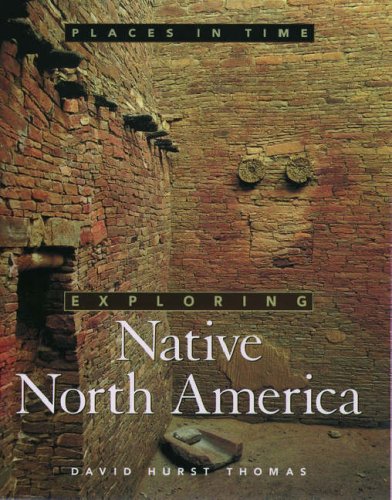

Exploring Native North America David Hurst Thomas.
Series Places in timeDetalles de publicación: Oxford New York Oxford University Press 2000.Descripción: xii, 227 p. ill. (some col.), maps (some col.) 26 cmISBN:- 019511857X (alk. paper)
- 970.01 21
- E77.9 .T5 2000
| Imagen de cubierta | Tipo de ítem | Biblioteca actual | Biblioteca de origen | Colección | Ubicación en estantería | Signatura topográfica | Materiales especificados | Info Vol | URL | Copia número | Estado | Notas | Fecha de vencimiento | Código de barras | Reserva de ítems | Prioridad de la cola de reserva de ejemplar | Reservas para cursos | |
|---|---|---|---|---|---|---|---|---|---|---|---|---|---|---|---|---|---|---|
| Libro | Biblioteca de Mayagüez Colección General mb | E77.9 .T5 2000 (Navegar estantería(Abre debajo)) | Disponible | 50000003188090 |
Descripciones mejoradas de Syndetics:
From the 11,00-year -old Blackwater Draw in New Mexico to the Little Bighorn Battlefield in Wyoming, the archaeological evidence left by Native Americans forms a fascinating legacy. In the third volume in Oxford's acclaimed Places in Time series, David Hurst Thomas guides readers through twenty well-known sites in the United States, Canada, and Mexico. A lively and engaging narrative, as well as photographs, maps, reconstructions, and site plans help tell the story of each site and illuminate the early history of North America. Thomas's introduction provides a brief history of the archaeological research in the region, along with a discussion of its demographic trade and economy, science and technology, and art and religion. Each chapter is devoted to a single site and features a map showing its location, a site plan or reconstruction, a chronological table covering the span of occupation, a history of the site's excavation, a discussion of the principle finds and description of the particular method used by archaeologists. Sites covered include Cape Krusenstern in Alaska, Head-Smashed-In-Buffalo Jump in Canada, Mesa Verde in Arizona, Serpent Mound in Ohio, and Knife River in North Dakota. Thomas also addresses the culture and way of life of the people who lived at each site, their technological achievements, their relationship with the environment, and the spiritual beliefs that motivated them. Gracefully written and based on the most current archaeological scholarship, Exploring Native North America offers a fascinating tour for history buffs, armchair time-travelers, and anyone planning to explore these intriguing sites.
Includes bibliographical references and index.
gccago2008
Extracto provisto por Syndetics
Reseñas proporcionadas por Syndetics
Library Journal Review
Not to be confused with Thomas's Exploring Ancient Native America: An Archaeological Guide (Prentice Hall, 1994), this is the latest entry in Oxford's "Places in Time" series. Following an introduction that echoes many themes found in his Skull Wars: Kennewick Man, Archaeology and the Battle for Native American Identity (LJ 4/1/00), Thomas examines 18 sites, from Blackwater Draw, dating from 9300 to 4000 B.C.E. to the Little Bighorn Battlefield. Many sites are popular tourist attractions, such as the Serpent Mound and Mesa Verde, while others, like Hidden Cave, are included for archaeological significance. The author grudgingly includes the Big Horn Medicine Wheel in Wyoming, though he is extremely concerned about the potential damage caused by large numbers of visitors to a site considered sacred ground by Native Americans. Each chapter focuses on a specific site and includes text written for the lay reader, supplemented by maps, illustration, photographs, suggestions for further reading, and information on how to visit each site. Recommended for the travel sections of public libraries.-John Burch, Hagan Memorial Lib., Williamsburg, KY (c) Copyright 2010. Library Journals LLC, a wholly owned subsidiary of Media Source, Inc. No redistribution permitted.School Library Journal Review
YA-In this thorough but sophisticated book, Thomas presents a detailed archaeological discussion of 18 American Indian cultural sites throughout the United States and Canada. The subjects range from utilitarian sites like Head-Smashed-In Buffalo Jump in Alberta, to sacred places such as Big Horn Medicine Wheel in Wyoming. They likewise span the history of our continent, from locations of specific historic events like the Battle of Little Bighorn in 1876, to areas that define the oldest epochs of North America, such as the Blackwater Draw used from 9300 to 4000 B.C.E. Thomas has consulted with and been supported by a few Native scholars and elders, as well as other academic experts. The book is definitely archaeological in perspective but the author is sensitive to and respectful of the cultures he examines. The preface and introduction include valuable essays on the issues involved in studying such sites, such as appropriate and respectful terminology, cultural ownership of sacred sites, and the problem of tourism vs. preservation. The informative text is enhanced by well-chosen, black-and-white and a few full-color illustrations. An excellent resource for serious students of the subject, but very scholarly.-Sean George, St. Charles Parish Library, Luling, LA (c) Copyright 2010. Library Journals LLC, a wholly owned subsidiary of Media Source, Inc. No redistribution permitted.Booklist Review
Thomas, a professional archaeologist, has written a book that is accessible to a broad readership. He discusses 18 key archaeological sites in North America that reflect significance in the history and culture of American Indians. These are all sites that allow visitors and range from the well known (Mesa Verde in Colorado) to the obscure (Blackwater Draw in New Mexico). Thomas is careful to balance the curiosity of tourist and more serious students of archaeology against the sensitivities of Native Americans, and he advises on the appropriate behavior when visiting sites. He uses the terms Indians and Native Americans interchangeably and explains why; he puts more emphasis on getting the names right for the individual tribes. Thomas examines the linkages between Ice Age humans in the Americas to modern Native Americans, noting the skepticism of Indians toward archaeologists and current conflicts over the right to dig up bones and stones in sacred sites. Well-illustrated and well-researched look at fascinating American cultures. --Vanessa BushNotas de autor provistas por Syndetics
David Hurst Thomas is Curator of Anthropology at The American Museum of Natural History and the author of Archaeology. He lives in West Nyack, New York.