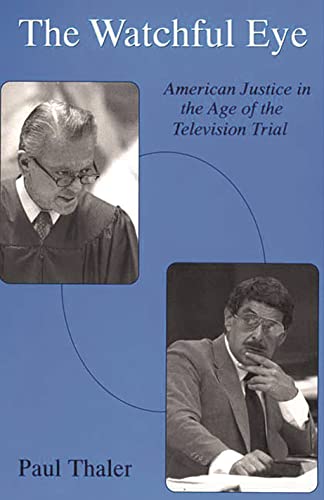

The watchful eye American justice in the age of the television trial Paul Thaler.
Detalles de publicación: Westport, Conn. Praeger 1994.Descripción: xxiii, 239 p. ill. 24 cmISBN:- 0275942155 (alk. paper)
- KF8725 .T47 1994
| Imagen de cubierta | Tipo de ítem | Biblioteca actual | Biblioteca de origen | Colección | Ubicación en estantería | Signatura topográfica | Materiales especificados | Info Vol | URL | Copia número | Estado | Notas | Fecha de vencimiento | Código de barras | Reserva de ítems | Prioridad de la cola de reserva de ejemplar | Reservas para cursos | |
|---|---|---|---|---|---|---|---|---|---|---|---|---|---|---|---|---|---|---|
| Libro | Biblioteca de Derecho Mons. Fremiot Torres Oliver Colección General biblioteca derecho | KF 8725 .T47 1994 (Navegar estantería(Abre debajo)) | Disponible | 70000000467436 |
Descripciones mejoradas de Syndetics:
According to Thaler, the presence of cameras in the courtroom is a pervasive technology that can affect public perceptions of the judicial process, change the behavior and attitudes of trial participants, and ultimately transform the sober process of justice into a media event designed for maximum public exposure. The author has interviewed more than 50 people--prominent journalists, academics, and members of the legal system--and brought together their observations in a fascinating historical and psychological profile of the televised courtroom. Thaler provides a historical overview and theoretical perspective, and discusses the new cable courtroom network and the current and continuing camera debate in New York City. He makes reference to the recent celebrated cases involving Amy Fisher, William Kennedy Smith, and Rodney King, then turns to an in-depth case study of the Joel Steinberg murder trial, including insights from the presiding judge, trial attorneys, witnesses, jurors, and the defendant himself, as well as journalists who covered the trial. The author concludes that the process of justice is slowly being turned into an entertainment vehicle, not unlike the show trials of bygone eras.
Includes bibliographical references (p. [229]-233) and index.
Pt. 1. The age of the television trial -- Pt. 2. The Steinberg trial: a case study.
Tabla de contenidos provista por Syndetics
- Preface
- Introduction: The Faustian Bargain
- The Age of the Television Trial
- The Theater of the Television Trial
- The Early Years The Defendants:
- Police The Electronic Courtroom: The Rise of Court
- TV The Forty-Fifth State
- The Steinberg Trial: A Case Study
- The Beginning
- The Trial
- The Self-Consciousness Factor
- The Hedda Nussbaum Testimony Feedback
- Television's Mirror Mediated Feedback
- The Participant and the Public
- The Steinberg Interview Reflections
- Television and the Steinberg Trial
- Postscript: Gray Endings
- Appendix
- Selected Bibliography
- Index