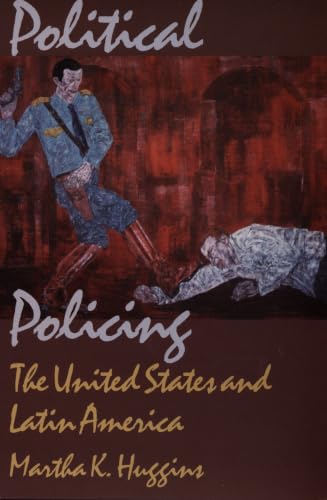

Political policing the United States and Latin America Martha K. Huggins.
Series Ciencias policial ; 2Detalles de publicación: Durham, N.C. Duke University Press 1998.Descripción: xxi, 247 p. 24 cmISBN:- 0822321599 (cloth : alk. paper)
- 0822321726 (pbk alk. paper)
- HV 8160.A2 H84 1998
| Imagen de cubierta | Tipo de ítem | Biblioteca actual | Biblioteca de origen | Colección | Ubicación en estantería | Signatura topográfica | Materiales especificados | Info Vol | URL | Copia número | Estado | Notas | Fecha de vencimiento | Código de barras | Reserva de ítems | Prioridad de la cola de reserva de ejemplar | Reservas para cursos | |
|---|---|---|---|---|---|---|---|---|---|---|---|---|---|---|---|---|---|---|
| Libro | Biblioteca de Derecho Mons. Fremiot Torres Oliver Colección General biblioteca derecho | HV 8160.A2 H84 1998 (Navegar estantería(Abre debajo)) | Disponible | 70000000639729 |
Descripciones mejoradas de Syndetics:
Reconstructing eighty years of history, Political Policing examines the nature and consequences of U.S. police training in Brazil and other Latin American countries. With data from a wide range of primary sources, including previously classified U.S. and Brazilian government documents, Martha K. Huggins uncovers how U.S. strategies to gain political control through police assistance--in the name of hemispheric and national security--has spawned torture, murder, and death squads in Latin America.
After a historical review of policing in the United States and Europe over the past century, Huggins reveals how the United States, in order to protect and strengthen its position in the world system, has used police assistance to establish intelligence and other social control infrastructures in foreign countries. The U.S.-encouraged centralization of Latin American internal security systems, Huggins claims, has led to the militarization of the police and, in turn, to an increase in state-sanctioned violence. Furthermore, Political Policing shows how a domestic police force--when trained by another government--can lose its power over legitimate crime as it becomes a tool for the international interests of the nation that trains it.
Pointing to U.S. responsibility for violations of human rights by foreign security forces, Political Policing will provoke discussion among those interested in international relations, criminal justice, human rights, and the sociology of policing.
Includes bibliographical references (p. [213]-235) and index.
Policing international politics : theory and practice -- "Gunboat" policing : the first twenty-five years -- "Good neighbor" policing -- From policing espionage to sup[p]ressing "communism" : World War II and its aftermath -- Policing containment -- Counterinsurgency policing : internationalization and professionalization -- Policing Brazil's "cleanup," 1964-1968 -- Repression and the Brazilian police -- Fortifying security and privatizing repression : torture and death sqauds in authoritarian devolution, 1969-1970 -- Closing the circle : devolution abroad and at home -- Conclusion : police assistence as a " protection racket".
Reseñas proporcionadas por Syndetics
CHOICE Review
After 1946, the US took steps to contain Soviet expansion in the developing world; police training became a part of that effort, along with general intelligence operations and military assistance. Although Huggins's study includes material on a number of Latin American nations, its primary focus is on Brazil, under strongly anticommunist military rule from 1964 to 1970. Throughout Brazil there were widespread reports of Death Squads linked to the police and to the use of torture against political dissidents. By 1971, criticism in the US of acts of brutality by Brazilian authorities, as well as reports of covert US links to security forces in Uruguay and Guatemala, was growing. In 1974, following CIA involvement in the destabilization of the Chilean government, President Gerald Ford abolished the system of centralized control of overseas police training. Huggins contends, however, that other means were found to continue training, which often resulted in a kind of protection racket aimed at control of the population in Latin America. The central question raised is, "How can a democracy extend police training to a developing nation without assisting various forms of oppression?" Upper-division undergraduates and above. E. H. Moseley; formerly, University of AlabamaNotas de autor provistas por Syndetics
Martha K. Huggins is Roger Thayer Stone Professor of Sociology at Union College in Schenectady, New York. She is the editor of Vigilantism and the State in Modern Latin America .