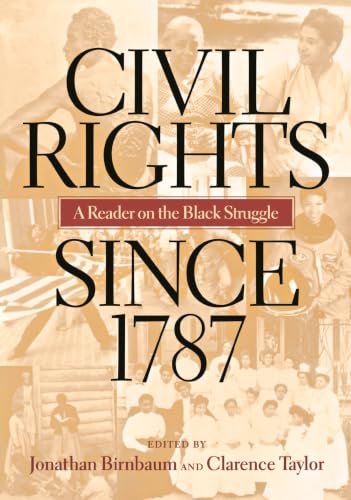

Civil rights since 1787 a reader on the Black struggle edited by Jonathan Birnbaum and Clarence Taylor.
Detalles de publicación: New York New York University Press 1999.Descripción: xxi, 936 p. ill. 25 cmISBN:- 0814782493
- 21 323.1196073 C5822
- E184.6 .C595 1999
| Imagen de cubierta | Tipo de ítem | Biblioteca actual | Biblioteca de origen | Colección | Ubicación en estantería | Signatura topográfica | Materiales especificados | Info Vol | URL | Copia número | Estado | Notas | Fecha de vencimiento | Código de barras | Reserva de ítems | Prioridad de la cola de reserva de ejemplar | Reservas para cursos | |
|---|---|---|---|---|---|---|---|---|---|---|---|---|---|---|---|---|---|---|
| Libro | Biblioteca Encarnación Valdés Colección General bev | 323.1196073 C5822 (Navegar estantería(Abre debajo)) | Disponible | 80000002088741 |
Descripciones mejoradas de Syndetics:
Winner of the 2001 Gustavus Myers Program Book Award.
Traces the black struggle for civil rights back to 1787
Contrary to simple textbook tales, the civil rights movement did not arise spontaneously in 1954 with the landmark Brown v. Board of Education decision. The black struggle for civil rights can be traced back to the arrival of the first Africans, and to their work in the plantations, manufacturies, and homes of the Americas. Civil rights was thus born as labor history.
Civil Rights Since 1787 tells the story of that struggle in its full context, dividing the struggle into six major periods, from slavery to Reconstruction, from segregation to the Second Reconstruction, and from the current backlash to the future prospects for a Third Reconstruction. The "prize" that the movement has sought has often been reduced to a quest for the vote in the South. But all involved in the struggle have always known that the prize is much more than the vote, that the goal is economic as well as political. Further, in distinction from other work, Civil Rights Since 1787 establishes the links between racial repression and the repression of labor and the left, and emphasizes the North as a region of civil rights struggle.
Featuring the voices and philosophies of orators, activists, and politicians, this anthology emphasizes the role of those ignored by history, as well as the part that education and religion have played in the movement. Civil Rights Since 1787 serves up an informative mix of primary documents and secondary analysis and includes the work of such figures as Ella Baker, Mary Frances Berry, Clayborne Carson, Frederick Douglass, W. E. B. DuBois, Eric Foner, Herb Gutman, Fannie Lou Hamer, A. Leon Higginbotham, Darlene Clark Hine, Jesse Jackson, Malcolm X, Martin Luther King, Manning Marable, Nell Painter, Frances Fox Piven and Richard Cloward, A. Philip Randolph, Mary Church Terrell, and Howard Zinn.
Includes bibliographical references and index.
Tabla de contenidos provista por Syndetics
- Acknowledgments(p. xxi)
- Introduction: It Didn't Start in 1954(p. 1)
- Part I Slavery: America's First Compromise
- 1 Introduction: Original Sin(p. 7)
- 2 The International Slave Trade(p. 9)
- 3 Slavery, the Constitution, and the Founding Fathers(p. 16)
- 4 Our Pro-Slavery Constitution(p. 24)
- 5 Slave Religion, Rebellion, and Docility(p. 29)
- 6 1787 Petition for Equal Educational Facilities(p. 35)
- 7 The Abolitionist Movement(p. 36)
- 8 Too Long Have Others Spoken for Us(p. 41)
- 9 Education for Black Women(p. 45)
- 10 Walker's Appeal(p. 47)
- 11 On African Rights and Liberty(p. 50)
- 12 The Liberator: Opening Editorial(p. 53)
- 13 An Address to the Slaves of the United States(p. 55)
- 14 Free Blacks and Suffrage(p. 58)
- 15 Silencing Debate: The Congressional Gag Rule(p. 59)
- 16 Equality before the Law(p. 60)
- 17 Free Blacks and the Fugitive Slave Act(p. 66)
- 18 The Fugitive Slave Law(p. 70)
- 19 What to the Slave Is the Fourth of July?(p. 74)
- 20 Dred Scott v. Sandford (1857)(p. 78)
- 21 Illinois No Longer a Free State(p. 83)
- 22 Literacy, Slavery, and Religion(p. 85)
- 23 Who Freed the Slaves?(p. 90)
- Part II Reconstruction
- 24 Introduction: The Second American Revolution(p. 101)
- 25 The Second American Revolution(p. 103)
- 26 Schools for Freedom(p. 109)
- 27 The Southern Black Church(p. 116)
- 28 Forty Acres and a Mule: Special Field Order No. 15(p. 118)
- 29 A Proposal for Reconstruction(p. 121)
- 30 Woman's Rights(p. 127)
- 31 Woman Suffrage(p. 130)
- 32 Black Women during Reconstruction(p. 131)
- 33 Southern Discomfort(p. 135)
- 34 The Ku Klux Klan Conspiracy(p. 138)
- 35 Black Workers and Republicans in the South(p. 141)
- 36 The Reconstruction Myth(p. 150)
- 37 The Impeachment of President Andrew Johnson(p. 154)
- Part III Segregation
- 38 Introduction: Separate and Unequal(p. 161)
- The Repression of Free Blacks
- 39 Plessy v. Ferguson (1896)(p. 165)
- 40 Newspapers on Plessy v. Ferguson(p. 170)
- 41 How Disenfranchisement Was Accomplished(p. 172)
- 42 Lynching(p. 177)
- 43 The Atlanta Massacre(p. 181)
- 44 The Race War in the North(p. 184)
- 45 Jim Crow and the Limits of Freedom, 1890-1940(p. 190)
- 46 Blacks and the First Red Scare(p. 199)
- 47 The Second Klan(p. 203)
- The Black and Progressive Response
- 48 Black Workers from Reconstruction to the Great Depression(p. 215)
- 49 The Atlanta Address(p. 222)
- 50 Of Mr. Booker T. Washington and Others(p. 226)
- 51 Report of the 1900 Pan-African Conference(p. 232)
- 52 The Niagara Movement Declaration of Principles(p. 234)
- 53 The Task for the Future(p. 238)
- 54 Returning Soldiers(p. 242)
- 55 Lynching a Domestic Question?(p. 244)
- 56 Address to President Wilson(p. 246)
- 57 The Higher Education of Women(p. 249)
- 58 Black Women and the Right to Vote(p. 252)
- 59 Woman Suffrage and the Fifteenth Amendment(p. 260)
- 60 Woman Suffrage and the Negro(p. 262)
- 61 The Great Migration(p. 264)
- 62 Migration and Political Power(p. 267)
- 63 The Objectives of the Universal Negro Improvement Association(p. 268)
- 64 The Garvey Milieu(p. 274)
- 65 The Scottsboro Case(p. 278)
- 66 Women and Lynching(p. 280)
- 67 Blacks and the New Deal(p. 283)
- 68 Mary McLeod Bethune and the Black Cabinet(p. 287)
- 69 Marian Anderson, Eleanor Roosevelt, and the D.A.R.(p. 290)
- 70 Blacks and the CIO(p. 292)
- 71 The Harlem Bus Boycott of 1941(p. 298)
- 72 The March on Washington Movement(p. 303)
- 73 Executive Order 8802: Establishing the FEPC(p. 307)
- 74 The Sharecroppers' Tale(p. 309)
- 75 The "Double V" Campaign(p. 315)
- 76 Nazi and Dixie Nordics(p. 318)
- 77 The Civil Rights Congress(p. 321)
- Part IV The Second Reconstruction
- 78 Introduction: The Modern Civil Rights Movement(p. 327)
- The Legal Strategy
- 79 Charles Hamilton Houston and the NAACP Legal Strategy(p. 333)
- 80 The NAACP and Brown(p. 341)
- 81 Brown v. Board of Education (1954)(p. 349)
- 82 Mississippi Murders(p. 355)
- Labor Days
- 83 Labor, Radicals, and the Civil Rights Movement(p. 363)
- 84 Migration and Electoral Politics(p. 383)
- 85 To Secure These Rights(p. 388)
- 86 Executive Order 9981: Barring Segregation in the Armed Forces(p. 394)
- 87 The Second Red Scare: The Cold War in Black America(p. 396)
- 88 Remembering Jackie Robinson(p. 409)
- 89 Paul Robeson and the House Un-American Activities Committee(p. 412)
- 90 The Highlander School(p. 416)
- 91 If the Negro Wins, Labor Wins(p. 421)
- 92 CORE and the Pacifist Roots of Civil Rights(p. 428)
- The Churches' Hour
- 93 The Baton Rouge Bus Boycott(p. 435)
- 94 Rosa Parks and the Montgomery Bus Boycott(p. 443)
- 95 The Social Organization of Nonviolence(p. 457)
- 96 SCLC and "The Beloved Community"(p. 461)
- 97 On King's Influences and Borrowings(p. 464)
- 98 Women and Community Leadership(p. 467)
- 99 The Student Nonviolent Coordinating Committee(p. 472)
- 100 SNCC Statement of Purpose(p. 474)
- 101 Suppose Not Negroes but Men of Property Were Being Beaten in Mississippi(p. 475)
- 102 Letter from Birmingham City Jail(p. 477)
- 103 Television Address on Civil Rights(p. 490)
- 104 What Really Happened at the March on Washington?(p. 493)
- 105 Which Side Is the Federal Government On?(p. 501)
- 106 I Have a Dream(p. 504)
- 107 Movie Myths about Mississippi Summer(p. 508)
- 108 Freedom Schools(p. 511)
- 109 The Mississippi Freedom Democratic Party(p. 517)
- 110 Testimony before the 1964 DNC Credentials Committee(p. 521)
- 111 Civil Rights and Black Protest Music(p. 524)
- 112 From Protest to Politics(p. 528)
- 113 The Selma Movement and the Voting Rights Act of 1965(p. 539)
- 114 Address on Voting Rights(p. 546)
- Economic Justice: The North Has Problems Too
- 115 Report of the National Advisory Commission on Civil Disorders(p. 553)
- 116 The Watts Uprising(p. 555)
- 117 The Great Society(p. 561)
- 118 The SCLC and Chicago(p. 565)
- 119 Resurrection City and the Poor People's Campaign(p. 574)
- 120 The Welfare Rights Movement(p. 580)
- Black Power
- 121 We Must Have Justice(p. 587)
- 122 The Ballot or the Bullet(p. 589)
- 123 Malcolm and Martin: A Common Solution(p. 604)
- 124 What We Want(p. 611)
- 125 The Black Panther Party Ten-Point Program(p. 615)
- 126 The Black Panther Party(p. 618)
- 127 Women and the Black Panther Party(p. 621)
- 128 Black Power and Labor(p. 624)
- Electoral and Street Politics
- 129 The Nixon Administration and Civil Rights(p. 631)
- 130 The Gary Black Political Convention of 1972(p. 635)
- 131 Police Violence and Riots(p. 641)
- 132 Rodney King, Police Brutality, and Riots(p. 645)
- 133 Black Power in the Age of Jackson(p. 649)
- 134 Race and the Democrats(p. 655)
- 135 Mississippi Abolishes Slavery(p. 659)
- 136 Undercounting Minorities(p. 661)
- 137 The Color of Money(p. 663)
- Discrimination: Ongoing Examples
- 138 The Possessive Investment in Whiteness(p. 669)
- 139 Discrimination and Racism Continue(p. 679)
- 140 Education's "Savage Inequalities"(p. 684)
- 141 Shopping While Black(p. 688)
- 142 Environmental Racism(p. 692)
- Affirmative Action
- 143 Affirmative Action and History(p. 697)
- 144 The Great White Myth(p. 700)
- 145 How the Press Frames Affirmative Action(p. 702)
- 146 Position Paper on Affirmative Action(p. 708)
- Part V Backlash Redux
- 147 Introduction: Redemption II(p. 717)
- The Roots of Backlash
- 148 The Southern Manifesto(p. 721)
- 149 George Wallace and the Roots of Modern Republicanism(p. 725)
- 150 Segregation Forever(p. 731)
- 151 The Southern Strategy(p. 735)
- 152 The Nixon That Black Folks Knew(p. 742)
- 153 The FBI, COINTELPRO, and the Repression of Civil Rights(p. 745)
- 154 The Urban Fiscal Crisis and the Rebirth of Conservatism(p. 753)
- 155 Boston's Battle over Busing(p. 759)
- Backlash
- 156 The Tax Revolt(p. 779)
- 157 Campus Racism and the Reagan Budget Cuts(p. 780)
- 158 The War against the Poor(p. 785)
- 159 David Duke and the Southern Strategy(p. 792)
- 160 The Civil Rights Act of 1991(p. 794)
- 161 How "Welfare" Became a Dirty Word(p. 798)
- 162 Lazy Lies about Welfare(p. 803)
- 163 Race and the "New Democrats"(p. 805)
- 164 Defunding the Congressional Black Caucus(p. 817)
- 165 Vouchers, the Right, and the Race Card(p. 819)
- 166 The Prison Industrial Complex(p. 823)
- 167 Felony Disenfranchisement(p. 829)
- 168 Chain Gang Blues(p. 831)
- 169 Breaking Thurgood Marshall's Promise(p. 836)
- Part VI Toward a Third Reconstruction
- 170 Introduction: Where Do We Go from Here?(p. 843)
- 171 Time for a Third Reconstruction(p. 846)
- 172 Toward a New Protest Paradigm(p. 849)
- 173 Why Inter-Ethnic Anti-Racism Matters Now(p. 853)
- 174 How the New Working Class Can Transform Urban America(p. 856)
- 175 What Works to Reduce Inequality?(p. 862)
- 176 A Workers' Bill of Rights(p. 864)
- 177 A Ten-Point Plan(p. 866)
- 178 Both Race and Class: A Time for Anger(p. 868)
- 179 Fear of a Black Feminist Planet(p. 874)
- 180 Response to the Million Man March(p. 878)
- 181 What Farrakhan Left Out(p. 880)
- 182 Clean-Money Campaign Finance Reform(p. 883)
- 183 Proportional Representation(p. 885)
- 184 We Can Educate All Our Children(p. 890)
- 185 Algebra as Civil Rights: An Interview with Bob Moses(p. 896)
- 186 Pulpit Politics: Religion and the Black Radical Tradition(p. 899)
- 187 Some Truths Are Not Self-Evident(p. 904)
- 188 We Don't Need Another Dr. King(p. 907)
- Index(p. 909)
- About the Editors(p. 943)
Notas de autor provistas por Syndetics
Jonathan Birnbaum (Editor)Jonathan Birnbaum is the editor, with Bertell Ollman, of The United States Constitution: 200 Years of Anti-Federalist, Abolitionist, Feminist, Muckraking, Progressive, and Especially Socialist Criticism (also available from NYU Press). His work has appeared in The Guardian, New Politics, Socialism & Democracy, New Political Science , and other publications. He lives in Illinois.
Clarence Taylor (Editor)
Clarence Taylor is Professor Emeritus of History at Baruch College. He is the author of several books, including The Black Churches of Brooklyn from the 19th Century to the Civil Rights Era (Columbia, 1994); B lack Religious Intellectuals: The Fight for Equality from Jim Crow to the 21st Century (Routledge, 2002); and F ight the Power: African Americans and the Long History of Police Brutality in New York City (NYU Press, 2018), and (co)editor of books including Civil Rights Since 1787: A Reader in the Black Struggle (NYU Press, 2000).