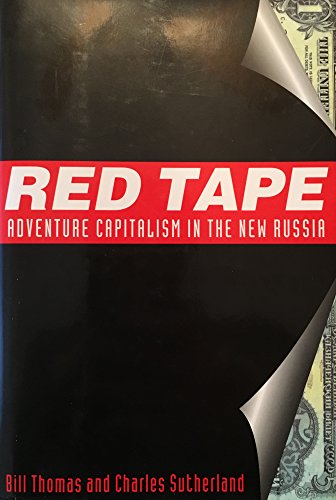
The authors inform, warn, and entertain as they spotlight the pitfalls and the potential of new Soviet business ventures. They examine the market and the maze of overt and covert rules, giving practical advice to entrepreneurs. No bibliography. Annotation c. by Book News, Inc., Portland, Or.
Includes index.
Reseñas proporcionadas por Syndetics
Library Journal Review
An American journalist and businessman provide an entertaining look at the pitfalls of foreign investment in Russia, which still lacks a banking system, a legal system, or a working class that actually works. Doing business with the former Soviets is like doing business with the Mafia, the authors report, despite bright spots like the Baltic republics. Elsewhere, former Communist functionaries remain in key positions, having been the first to take advantage of ``privatization.'' Most success stories in this anecdotal volume belong to Soviet natives and neighbors, not foreigners. While this is a useful deterrent to potential investors, a long magazine article could have conveyed the same information. For large collections.-- Robert Decker, Palo Alto, Cal. (c) Copyright 2010. Library Journals LLC, a wholly owned subsidiary of Media Source, Inc. No redistribution permitted.
Publishers Weekly Review
Thomas ( Lawyers and Thieves ) and investment consultant Sutherland lay it on the line for venture capitalists looking to do business in Russia: ``You have to start out with the clear understanding you could get royally screwed.'' And, they add, pack cartons of cigarettes ``to use as money,'' candy ``to use as food'' and take along a sense of humor. These cautions--and dozens more--made, the authors of this shrewd, pragmatic, spirited view of the new capitalist frontier guide readers through ``a gloomy, gray country full of hustlers and salesmen,'' and point out pitfalls in dealing with a byzantine banking system, currency auctions (``the ruble is currency in its most elastic and creative form'') and legal structure. Foreign investors, the authors stress, should commit themselves to establishing a long-term presence (witness PepsiCo and McDonald's) and they note that presently one of the few profitable ways of doing business is through ``countertrade'' (Xerox and General Electric, for example, barter photocopiers and turbines for building materials). The Soviets--the authors insist on this designation--``can wheel and deal with goods and money in ways the average capitalist couldn't imagine'' because the one-time apparatchiks, who are the only ones with know-how, are still in charge. (Oct.) (c) Copyright PWxyz, LLC. All rights reserved
Booklist Review
Today Russia--along with the other entities that make up the Commonwealth of Independent States--represents enormous contradictions. It possesses military and nuclear technology, but a major form of transportation is the horse-drawn cart. It offers the prospect of unlimited business opportunity but at the same time presents tremendous and forbidding risks. Thomas, who has written for Vanity Fair and Spy and coauthored Lawyers and Thieves (Simon & Schuster, 1990), and Sutherland, an investment specialist with experience in the Soviet Union, take irreverent delight in pointing out--usually with hilarious effect--the absurdities, incongruities, and paradoxes faced when trying to do business in Russia. We see Ford Motor Company hustled by a government representative into donating cars as prizes in a questionable national lottery scheme in exchange for the promise, which failed, of a Soviet manufacturing plant. We watch Pizza Hut deliveries to barricaded Yeltsin supporters being made through a tank blockade. The authors offer many such examples to serve as an ironic warning to would-be venture capitalists in Russia: Buyer Beware! ~--David Rouse