Imagen de portada de Amazon
Imagen de Amazon.com
Imagen de cubierta Syndetics
Portada de Syndetics
Imagen de OpenLibrary

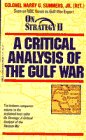
On strategy II a critical analysis of the Gulf war Harry G. Summers, Jr.

Por: Series The Dell war seriesDetalles de publicación: New York, N.Y. Dell Pub. c1992.Descripción: xiv, 302 p. ill. 17 cmISBN:
  • 0440211948
Tema(s): Clasificación CDD:
  • 959.704/42 20
Clasificación LoC:
  • DS79.72 .S86 1992
Valoración
    Valoración media: 0.0 (0 votos)
Existencias
Imagen de cubierta Tipo de ítem Biblioteca actual Biblioteca de origen Colección Ubicación en estantería Signatura topográfica Materiales especificados Info Vol URL Copia número Estado Notas Fecha de vencimiento Código de barras Reserva de ítems Prioridad de la cola de reserva de ejemplar Reservas para cursos
Libro Biblioteca Encarnación Valdés Colección General bev 959.70442 S955o (Navegar estantería(Abre debajo)) Disponible 80000001668303
Total de reservas: 0

Includes bibliographical references and index.

Reseñas proporcionadas por Syndetics

Library Journal Review

Summers's latest book is mistitled: its focus is not the Gulf War, but rather the renaissance of the U.S. military after the dark days of Vietnam. Summers argues perceptively and accurately that for 40 years, nuclear-tipped superpower diplomacy generated a defensive national strategy that was neither fully understood nor adequately explained. Only as containment of the Soviet Union gave way to cooperation did the offensive once again become a viable U.S. option. But the military system that translated political circumstances into battlefield victory was the product of comprehensive restructuring in the post-Vietnam armed forces. Separately and together, the services after 1975 found the moral courage to face their institutional shortcomings and develop the methods and doctrines so brilliantly successful in the Persian Gulf. Summers's clear account of the processes and personalities involved in America's military rebirth will inform general readers and provoke specialist inquiry. Recommended for all collections.-- D.E. Showalter, U.S. Air Force Acad., Colorado Springs (c) Copyright 2010. Library Journals LLC, a wholly owned subsidiary of Media Source, Inc. No redistribution permitted.

Publishers Weekly Review

Military strategist Summers ( On Strategy : A Critical Analysis of the Vietnam War ), who made some 125 television appearances during the Gulf war, here argues persuasively that changes in U.S. military doctrine, undertaken after the Vietnam war, helped U.S. forces prevail in the Gulf. Summers looks at overall strategy, not daily tactics. In Vietnam, he notes, the U.S. failed to follow the lesson of the classic war theorist Karl von Clausewitz: a successful war depends on public support. In the Gulf, Summers argues, such support was generated by participation of the reserves and the announcement of clear war goals. Moreover, after Vietnam, the military gave up its Cold War doctrine of limited war, its branches learned to work together and commanders finally stressed the training of troops for battle rather than troop maintenance and management. However, Summers fails to examine the role of oil in U.S war aims or why U.S. forces allowed Saddam Hussein to remain in power. He approvingly cites the international and Middle East coalitions against Iraq without noting the considerable arm-twisting by the U.S. Such lack of skepticism is perhaps predictable in a book dedicated to Summers's friend and Leavenworth classmate Gen. Colin Powell. (Feb.) (c) Copyright PWxyz, LLC. All rights reserved

Booklist Review

Summers was in the phalanx of military talking heads during the late Persian Gulf War, proffering instantaneous tactical commentary or speculation to an expectant TV audience. Given the passage of the months since, one might anticipate this being his more reflective sorting out, a critical analysis, of the blow-by-blow events culminating in the allied victory. It's not. Rather, the text discusses the army's agonizing doctrinal reappraisals following the Vietnam conflict, which paved the officer corps' mental way to success. In a nutshell, the whiz kids' systems analysis was out, and von Clausewitz was in. Well, what's the risk in peeling off a fin for this title, especially when its redeeming appendix contains the mother of all briefings by General Schwarzkopf? ~--Gilbert Taylor
Compartir
logopucpr-y-vive

Contáctanos

¡Queremos saber de ti!

Tel. 787.841.2000 Ext. 1801

bibliotecavaldes@pucpr.edu

⁣Búscanos en las redes

© 2026 Desarrollado por Ignite Online • All Rights Reserved • Powered by Koha.