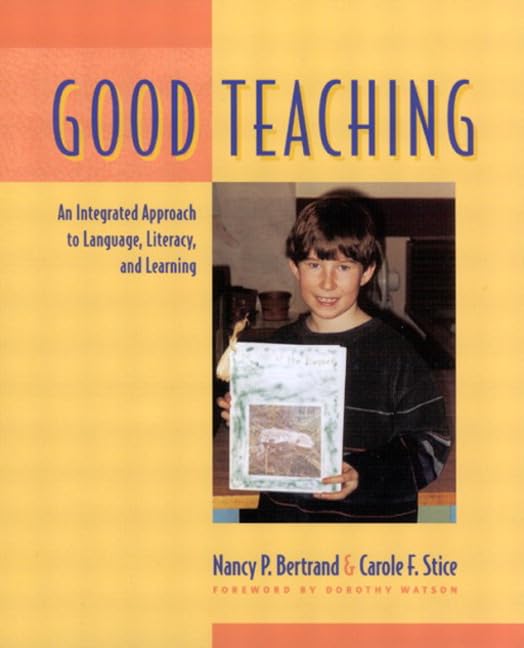

Good teaching an integrated approach to language, literacy, and learning Nancy P. Bertrand & Carole F. Stice.
Detalles de publicación: Portsmouth, NH Heinemann c2002.Descripción: xix, 339 p. ill. 24 cmISBN:- 0325003599
- 372.6 B548g 21
- LB1576 .B47 2002
| Imagen de cubierta | Tipo de ítem | Biblioteca actual | Biblioteca de origen | Colección | Ubicación en estantería | Signatura topográfica | Materiales especificados | Info Vol | URL | Copia número | Estado | Notas | Fecha de vencimiento | Código de barras | Reserva de ítems | Prioridad de la cola de reserva de ejemplar | Reservas para cursos | |
|---|---|---|---|---|---|---|---|---|---|---|---|---|---|---|---|---|---|---|
| Libro | Biblioteca Mons. Iñaki Mallona (Arecibo) Colección General ab | 372.6 B548g (Navegar estantería(Abre debajo)) | Disponible | 60000010022660 |
Descripciones mejoradas de Syndetics:
With Integrating Reading and the Language Arts , Stice, Bertrand, and Bertrand provided a lucid description of the theory and practice of an effective literacy education. Now, in their updated edition, Nancy Bertrand and Carole Stice go a step further-creating both a comprehensive textbook and an authoritative reference on every essential you need to know about teaching reading and writing, from language development, the reading and writing processes, curriculum, and assessment to organizing the classroom. The book gets preservice and new teachers off to a good start with a solid theoretical foundation, connecting theory to practice and providing a framework upon which they can build their knowledge. The book then offers compatible teaching experiences, with visits to real teachers in real classrooms.
Bertrand and Stice believe that literacy learning parallels oral language learning and that these processes happen best in classrooms where teachers understand what language is, how the brain works in learning and language development, and the implications of this knowledge for instruction. Therefore, they present an integrated language and literacy perspective in which they
detail their theoretical and research base provide connections to and a framework for instruction describe the major approaches offer a variety of sound, successful teaching techniques and strategies present accompanying evaluation procedures.The authors take the best of their original text and update it with
an expanded definition of literacy with relevant discussions of socio-cultural, psycholinguistic, and constructivist theory new research data, particularly in the areas of phonemic awareness, phonics, and guided reading more information on the reading process, learning to read, and teaching reading.Each chapter provides discussion points and summaries, theory-to-practice guides, and suggested readings and activities. Plus, scholarly commentary along the way reminds readers of what constitutes good teaching of language and literacy.
An ideal textbook for teacher education programs as well as an authoritative reference for school district professional development, Good Teaching is what one commentator calls a "strategy feast," strong on practice, comprehensive, yet easy to read and theoretically smart.
Rev. ed. of: Integrating reading and the other language arts. 1995.
Includes bibliographical references (p. [322]-[323]) and indexes.
Learning -- Language -- Children learning and constructing language -- Early literacy -- Speaking and listening in the elementary classroom -- Reading -- Reading: reflective evaluation, planning, and teaching -- Writing -- Writing: reflective evaluation, planning, and teaching -- Teaching ideas and tactical interventions -- Integrating curriculum in elementary classrooms -- Getting started: life in today's classroom.
With Integrating reading and the language arts, the authors provided a lucid description of the theory and practice of an effective literacy education. Now, in Good Teaching, Nancy Bertrand and Carole Stice's updated edition, the authors go a step further -- creating both a comprehensive textbook and an authoritative reference. They detail their theoretical and research base; provide connections to and a framework for instruction; describe the major approaches; offer a variety of sound, successful teaching techniques and strategies.
Tabla de contenidos provista por Syndetics
- Foreword(p. xi)
- Acknowledgments(p. xv)
- Preface(p. xvii)
- Chapter 1 Learning(p. 1)
- What Learning Is: Two Perspectives(p. 2)
- How the Brain Learns(p. 7)
- Multiple Intelligences(p. 12)
- The Conditions for Natural Learning(p. 13)
- Implications for Instruction: Toward a Socio-Personal, Constructivist View of Learning and Teaching(p. 17)
- Chapter 2 Language(p. 23)
- What Language Does(p. 23)
- What Language Is(p. 24)
- How Language Operates as a Whole(p. 32)
- Chapter 3 Children Learning and Constructing Language(p. 36)
- Language Learning as Reflective of Learning in General(p. 38)
- Child Language Development: Our Evolving Understanding(p. 41)
- Why Language Is Generative (and Constructivist)(p. 46)
- Chapter 4 Early Literacy(p. 51)
- The Relationships Between Oral and Written Language: Parallel But Not Identical Processes(p. 52)
- How Our Understanding of Early Literacy Has Changed over the Past Several Decades(p. 53)
- Similarities and Differences Between Learning to Talk and Learning to Read and Write(p. 54)
- Phases of Young Children's Early Literacy(p. 59)
- How Parents and Teachers Support Children's Early Literacy Development(p. 73)
- Chapter 5 Speaking and Listening in the Elementary Classroom(p. 80)
- Oral Language and Schools: Our Evolving Understanding(p. 81)
- Oral Language in the Inclusive Classroom(p. 83)
- The Talking and Listening Curriculum: Major Approaches(p. 85)
- Documenting and Evaluating Speaking and Listening(p. 87)
- Inviting Oral Language into the Classroom(p. 88)
- Formal Listening and Speaking Events(p. 97)
- Chapter 6 Reading(p. 103)
- What Reading Is(p. 104)
- What Reading Does(p. 108)
- Children's Reading Development: A Review(p. 109)
- Traditional Reading Instruction: A Historical Perspective(p. 111)
- The Reading Process: Current Perspectives(p. 113)
- Chapter 7 Reading: Reflective Evaluation, Planning, and Teaching(p. 125)
- Getting Started: Readers' Workshop(p. 127)
- Major Approaches to Teaching Reading Within a Literate Environment(p. 132)
- Assessing and Evaluating Reading(p. 142)
- Planning Focused Instruction(p. 152)
- Record Keeping(p. 155)
- What About Phonics, Phonemic Awareness, and Vocabulary Development?(p. 155)
- Chapter 8 Writing(p. 164)
- What Writing Is(p. 166)
- What Writing Does(p. 167)
- Children's Writing Development: Our Evolving Understanding(p. 169)
- Traditional Writing Instruction: A Historical Perspective(p. 181)
- The Writing Process: Current Perspectives(p. 183)
- Chapter 9 Writing: Reflective Evaluation, Planning, and Teaching(p. 191)
- Getting Started: Writers' Workshop(p. 193)
- One Teacher's Beginning(p. 200)
- The Writing Conference(p. 201)
- Teaching Approaches: Lessons Within a Literate Environment(p. 203)
- Assessing and Evaluating Writing(p. 206)
- Planning Focused Instruction(p. 213)
- Chapter 10 Teaching Ideas and Tactical Interventions(p. 221)
- Making Oral Language Connections to Print(p. 222)
- Engaging Less Proficient Readers and Writers in Comprehending and Producing Text(p. 228)
- Beyond Comprehending Single Texts(p. 235)
- Integrating All the Language Modes(p. 238)
- Reading, Writing, Listening, and Talking Ideas for the Upper Grades(p. 242)
- Chapter 11 Integrating Curriculum in Elementary Classrooms(p. 248)
- An Integrated Curriculum(p. 249)
- The Project Approach(p. 250)
- A Thematic Unit(p. 252)
- Inquiry(p. 265)
- Chapter 12 Getting Started: Life in Today's Classroom(p. 271)
- Inside Today's Classrooms(p. 273)
- Routines, Rituals, and Celebrations(p. 278)
- Getting Started and Moving Ahead(p. 280)
- Becoming a Reflective Practitioner(p. 285)
- Assisting Students' Self-Evaluation(p. 293)
- Keeping Your Passion for Teaching Alive and Well(p. 296)
- Appendix A Phonics Patterns(p. 301)
- Appendix B Bookbinding(p. 312)
- Appendix C Safe Websites That Kids Like(p. 321)
- Appendix D Technology in the Classroom(p. 322)
- Appendix E Professional Books for Novice Teachers(p. 323)
- Appendix F Journals in Reading and Language Arts Education(p. 324)
- Appendix G Examples of Additional Record-Keeping Devices(p. 326)
- Author Index(p. 331)
- Subject Index(p. 335)
Notas de autor provistas por Syndetics
Nancy P. Bertrand is Professor of Elementary and Special Education at Middle Tennessee State UniversityCarole F. Stice, Professor of Literacy Education at Tennessee State University