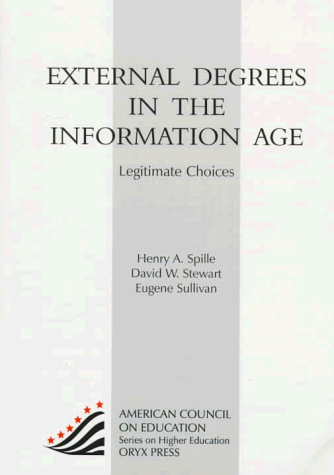

External degrees in the information age legitimate choices Henry A. Spille, David W. Stewart, Eugene Sullivan.
Series American Council on Education / Oryx Press series on higher educationDetalles de publicación: Phoenix Ameican Council on Education/Oryx Press 1997.Descripción: vii, 239 p 26 cmISBN:- 0897749979 (alk. paper)
- 378.1/75 21
- LC6251 .S75 1997
| Imagen de cubierta | Tipo de ítem | Biblioteca actual | Biblioteca de origen | Colección | Ubicación en estantería | Signatura topográfica | Materiales especificados | Info Vol | URL | Copia número | Estado | Notas | Fecha de vencimiento | Código de barras | Reserva de ítems | Prioridad de la cola de reserva de ejemplar | Reservas para cursos | |
|---|---|---|---|---|---|---|---|---|---|---|---|---|---|---|---|---|---|---|
| Referencia | Biblioteca Encarnación Valdés Sala de Referencia bev | 378.175 S756e (Navegar estantería(Abre debajo)) | Disponible | 80000002009580 |
Descripciones mejoradas de Syndetics:
There has been tremendous growth in the number of college and university degree programs designed specifically for adults who have family and career responsibilities. Telecommunications and computer technologies have even made it possible to earn some degrees without ever leaving home or work. Other adult degree programs require that students spend only a minimal amount of time on campus. As an added advantage, many of these external degree programs offer college credit for prior learning and work experience. Unfortunately, this revolution in adult higher education has also led to a proliferation of diploma mills_degree-granting institutions that lack recognized accreditation. External Degrees in the Information Age is a reliable and comprehensive guide designed to help adults make informed decisions about pursuing a postsecondary degree, and to help them avoid diploma mills. The book also describes 140 legitimately accredited external degree programs now in operation.
Includes indexes.
Tabla de contenidos provista por Syndetics
- Preface(p. v)
- Part 1(p. 1)
- Chapter 1 The New World of Going to College(p. 3)
- Chapter 2 External Degree Programs: What They Are and How They Work(p. 5)
- Chapter 3 What You Should Know about Accreditation and State Regulation(p. 15)
- Chapter 4 Diploma Mills: What They Look Like and How to Avoid Them(p. 28)
- Chapter 5 Choosing an External Degree Program: Hallmarks of Quality(p. 36)
- Part 2 (p. 41)
- Chapter 6 Institutional Listings(p. 43)
- Indexes(p. 217)
- Index to Part 1 (p. 219)
- Index to Part 2 Fields of Study(p. 223)
- Index to Part 2 Alphabetical List of Institutions(p. 237)
Reseñas proporcionadas por Syndetics
Booklist Review
This guide is aimed at the growing group of adults over the age of 25 who are looking for nontraditional ways to continue their education. The 140 accredited degree programs in the U.S. covered here offer options for persons with full-time jobs and otherwise busy lives to take classes and earn credits off campus. Technology is an integral part of the majority of the programs, including videotapes, satellite programs, and the Web, though some also include postal and/or e-mail correspondence segments. In addition, information is given on programs that allow credit for examinations such as the College Level Examination Program (CLEP) and for prior learning through job training, the military, independent study, and formal course work. The main section is divided by state and gives program descriptions, degrees offered, accrediting bodies, admission requirements, credit hour requirements, minimum campus time (some require none), and tuition. Separate sections include valuable guidance on how external degree programs operate, program accreditation and state regulation, the hazards of "diploma mills," and the hallmarks of a high-quality program. Indexes lead to topics covered, fields of study and degrees offered, and specific institutions. This volume builds upon and updates The Adult Learner's Guide to Alternative and External Degree Programs [RBB Mr 1 94], edited by Eugene Sullivan, and Diploma Mills: Degrees of Fraud (Macmillan, 1988), by David Stewart and Henry Spille. Although some of the other current guides to external and distance education cover more programs, this guide provides, in a well-organized style, more information than most. It would be a valuable resource for persons exploring their campus-free degree options.Notas de autor provistas por Syndetics
EUGENE SULLIVAN is director, Military Evaluations Program, The Center for Adult Learning and Educational Credentials, American Council on Education, Washington, D.C. He has held that position for over 20 years. As the head of staff, he is responsible for the biennial publication of the Guide to the Evaluation of Educational Experiences in the Armed Services, which is the standard reference used by colleges and universities to award credit for learning acquired in military life.::Stewart /f David /i W. /b DAVID W. STWEART retired in 1995 as director of program development at the American Council on Education's Center for Adult Learning and Educational Credentials, Washington, D.C. /e::Spille /f Henry /i A. /b HENRY A. SPILLE is vice president of the American Council on Education (ACE), and director of ACE's Center for Adult Learning and Educational Credentials in Washington, D.C. His previous positions at ACE include director of the GED Testing Program, associate director of the Office on Educational Credit and Credentials, and project director for the Military Occupational Specialty Feasibility Study at the Office on Educational Credit and Credentials. Spille has written numerous articles and book chapters and coauthored Diploma Mills: Degrees of Fraud (1988) with David Stewart, and Focus on Adults: A Self-Study Guide for Postsecondary Educational Institutions with David Stewart and Nancy Schlossberg.