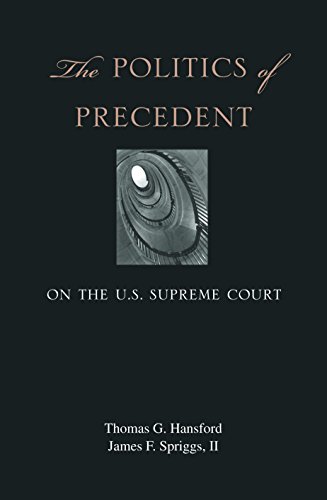

The politics of precedent on the U.S. Supreme Court Thomas G. Hansford, James F. Spriggs II.
Detalles de publicación: Princeton Princeton University Press c2006.Descripción: xii, 155 p. ill. 25 cmISBN:- 0691123543 (alk. paper)
- 9780691123547 (alk. paper)
- 347.73/262 22
- KF 8748 .H365 2006
| Imagen de cubierta | Tipo de ítem | Biblioteca actual | Biblioteca de origen | Colección | Ubicación en estantería | Signatura topográfica | Materiales especificados | Info Vol | URL | Copia número | Estado | Notas | Fecha de vencimiento | Código de barras | Reserva de ítems | Prioridad de la cola de reserva de ejemplar | Reservas para cursos | |
|---|---|---|---|---|---|---|---|---|---|---|---|---|---|---|---|---|---|---|
| Libro | Biblioteca de Derecho Mons. Fremiot Torres Oliver Colección General biblioteca derecho | KF 8748 .H365 2006 (Navegar estantería(Abre debajo)) | Disponible | 70000000842711 |
Descripciones mejoradas de Syndetics:
The Politics of Precedent on the U.S. Supreme Court offers an insightful and provocative analysis of the Supreme Court's most important task--shaping the law. Thomas Hansford and James Spriggs analyze a key aspect of legal change: the Court's interpretation or treatment of the precedents it has set in the past. Court decisions do not just resolve immediate disputes; they also set broader precedent. The meaning and scope of a precedent, however, can change significantly as the Court revisits it in future cases. The authors contend that these interpretations are driven by an interaction between policy goals and variations in the legal authoritativeness of precedent. From this premise, they build an explanation of the legal interpretation of precedent that yields novel predictions about the nature and timing of legal change.
Hansford and Spriggs test their hypotheses by examining how the Court has interpreted the precedents it set between 1946 and 1999. This analysis provides compelling support for their argument, and demonstrates that the justices' ideological goals and the role of precedent are inextricably linked. The two prevailing, yet contradictory, views of precedent--that it acts either solely as a constraint, or as a "cloak" that never actually influences the Court--are incorrect. This book shows that while precedent can operate as a constraint on the justices' decisions, it also represents an opportunity to foster preferred societal outcomes.
Includes bibliographical references (p. [139]-150) and index.
Tabla de contenidos provista por Syndetics
- List of Figures and Tables(p. ix)
- Acknowledgments(p. xi)
- Chapter 1 Introduction(p. 1)
- Chapter 2 Explaining the Interpretation of Precedent(p. 16)
- Chapter 3 Measuring the Interpretation of Precedent(p. 43)
- Chapter 4 The Interpretation of Precedent over Time(p. 55)
- Chapter 5 The Overruling of Precedent(p. 78)
- Chapter 6 The Interpretation of Precedent in Majority Opinions(p. 93)
- Chapter 7 Lower Federal Court Responses to the Supreme Court's Interpretation of Precedent(p. 109)
- Chapter 8 Concluding Remarks and Broader Implications(p. 124)
- Appendix(p. 135)
- References(p. 139)
- Index(p. 151)