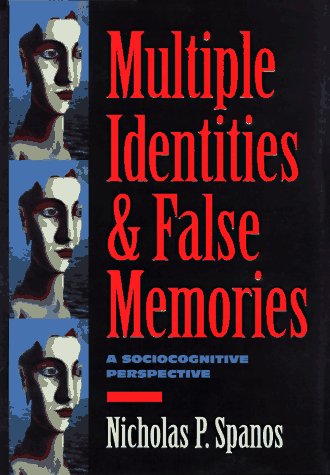

Multiple identities & false memories a sociocognitive perspective Nicholas P. Spanos.
Detalles de publicación: Washington, DC American Psychological Association c1996.Descripción: xiii, 371 p. port. 26 cmISBN:- 1557983402 (alk. paper)
- Multiple identities and false memories
- 616.85/236 20
- RC455.2.F35 S67 1996
| Imagen de cubierta | Tipo de ítem | Biblioteca actual | Biblioteca de origen | Colección | Ubicación en estantería | Signatura topográfica | Materiales especificados | Info Vol | URL | Copia número | Estado | Notas | Fecha de vencimiento | Código de barras | Reserva de ítems | Prioridad de la cola de reserva de ejemplar | Reservas para cursos | |
|---|---|---|---|---|---|---|---|---|---|---|---|---|---|---|---|---|---|---|
| Libro | Biblioteca Encarnación Valdés Colección General bev | 616.85236 S735m (Navegar estantería(Abre debajo)) | Disponible | 80000002023540 |
Descripciones mejoradas de Syndetics:
Spanos rejects the traditional view by arguing that MPD is in large part a sociohistorical product. To reinforce his case, he marshalls an extensive body of research that supports a sociocognitive alternative to the disease model. The book critically examines commonly held views about hypnotic amnesia as an altered state, which some investigators link with the amnesia purportedly experienced by MPD patients. It investigates the nature of memory and the complex issues surrounding the reported recovery during psychotherapy of memories of childhood abuse. It also explores the parallels between MPD and posits their relation to such historical and sociocultural phenomena as spirit possession, witchcraft, glossolalia and hysteria. And it evaluates the role of social learning and validation in the development of MPD.
Includes bibliographical references (p. 305-353) and index.