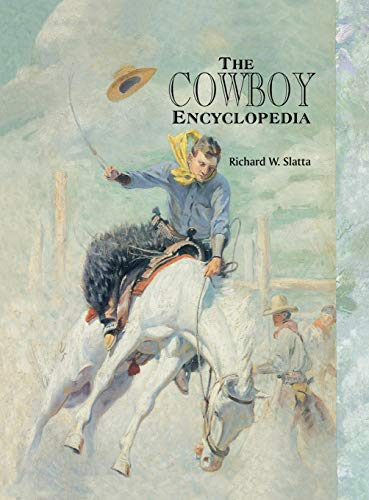
Imagen de portada de Amazon
Imagen de Amazon.com
Imagen de cubierta Syndetics
Portada de Syndetics
Imagen de OpenLibrary

The cowboy encyclopedia / Richard W. Slatta.

Por: Idioma: Español Detalles de publicación: Santa Barbara, Calif.: ABC-CLIO, c1994.Descripción: xv, 474 p. ill. 27 cmISBN:
  • 0874367387 (acid-free paper)
Tema(s): Clasificación CDD:
  • 978/.003 20
Clasificación LoC:
  • E20  .S56 1994
Valoración
    Valoración media: 0.0 (0 votos)
Existencias
Imagen de cubierta Tipo de ítem Biblioteca actual Biblioteca de origen Colección Ubicación en estantería Signatura topográfica Materiales especificados Info Vol URL Copia número Estado Notas Fecha de vencimiento Código de barras Reserva de ítems Prioridad de la cola de reserva de ejemplar Reservas para cursos
Libro Biblioteca de Mayagüez Sala de Referencia mb E20 .S56 1994 (Navegar estantería(Abre debajo)) Disponible 50000001955748
Referencia Biblioteca Encarnación Valdés Sala de Referencia bev 978.003 S631c (Navegar estantería(Abre debajo)) Disponible 80000001868507
Total de reservas: 0

Descripciones mejoradas de Syndetics:

Alphabetically organized and thoroughly cross-referenced entries provide information on cowboy history, culture, and myth in North and South America. Entries include cowboy types, equipment, dress, work, and recreation. illustrated, with informative appendixes, an index, and bibliography.

Includes bibliographical references (p. 427-451) and index.

Reseñas proporcionadas por Syndetics

Booklist Review

This past year brought forth a spate of cowboy reference books, notably a reediting of Ramon Adams' classic work of 1936, The Cowboy Dictionary (Perigee, 1993), Cowboys and the Wild West [RBB Ja 1 95], and several books of Western slang. Now we have an encyclopedic work, embodying many slang words; famous cowboy names; broad subjects, such as Food or Horses (entries of five or six pages), and narrower topics, such as Holster or Levi's (a column or so). Biographies of cowboys or of movie cowboys usually run to four or five pages. Required accent marks are printed in headings such as la{{ }}tigo and patro{{¢}}n unlike Adams' work, which omits all Spanish accents. There is generous use of see references, though in some cases the reference is to a long article, with no hint as to the precise location of the term referred from. Thus, the entry Coffee Grinder says "see Rope." The term is to be found in the middle of the fourth column of text: "coffee grinding" is what a novice vaquero does when he wraps his lariat the wrong way around his saddle horn. Many black-and-white illustrations supplement the text. Those copied from tintypes or other early processes, such as one of Billy the Kid, may be excused for poor quality, but a few photos of modern artists or of their work are disappointingly dark. Though primarily concerned with the cowboy of the western U.S., the book does not ignore Argentina or Canada. The article Gaucho runs to six pages, with several cartoons of F. Molina Campos, who affectionately lampooned gauchos for several decades with his popular illustrations for commercial calendars. There are several appendixes: a list of film and videotape sources, a list of cowboy museums, an annotated list of periodicals dealing with cowboys, a calendar of "western cultural happenings," a 24-page bibliography, and a detailed index. This work is recommended for any library with an interest in the West, even if it already has one or more dictionaries of cowboy slang. The Cowboy Encyclopedia is broader in scope, easy to use, and written in a clear, convincing style. (Reviewed Apr. 1, 1995)

Notas de autor provistas por Syndetics

Richard W. Slatta is professor of history at North Carolina State University, Raleigh, NC.
Compartir
logopucpr-y-vive

Contáctanos

¡Queremos saber de ti!

Tel. 787.841.2000 Ext. 1801

bibliotecavaldes@pucpr.edu

⁣Búscanos en las redes

© 2026 Desarrollado por Ignite Online • All Rights Reserved • Powered by Koha.