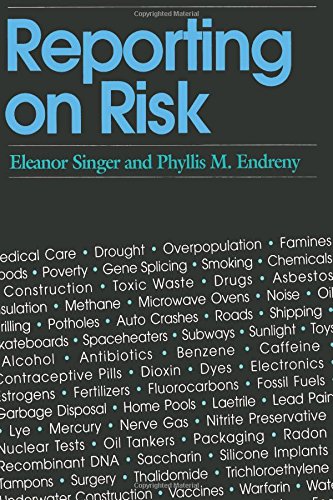

Reporting on risk how the mass media portray accidents, diseases, disasters, and other hazards Eleanor Singer and Phyllis M. Endreny.
Detalles de publicación: New York Russell Sage Foundation 1993.Descripción: x, 244 p. ill. 24 cmISBN:- 0871548011 (alk. paper)
- 070.4/49904 20
- PN4784.D57 S56 1993
| Imagen de cubierta | Tipo de ítem | Biblioteca actual | Biblioteca de origen | Colección | Ubicación en estantería | Signatura topográfica | Materiales especificados | Info Vol | URL | Copia número | Estado | Notas | Fecha de vencimiento | Código de barras | Reserva de ítems | Prioridad de la cola de reserva de ejemplar | Reservas para cursos | |
|---|---|---|---|---|---|---|---|---|---|---|---|---|---|---|---|---|---|---|
| Libro | Biblioteca Encarnación Valdés Colección General bev | 070.4 S617r (Navegar estantería(Abre debajo)) | Disponible | 80000002068735 |
Descripciones mejoradas de Syndetics:
After acts of airline terrorism, air travel tends to drop dramatically--yet Americans routinely pursue the far riskier business of driving cards, where accidents resulting in death or injury are much more likely to occur. Reporting on Risk argues that this selective concern with danger is powerfully shaped by the media, whose coverage of potentially hazardous events is governed more by a need to excite the public than to inform it. Singer and Endreny survey a wide range of print and electronic media to provide an unprecedented look at how hundreds of different hazards are presented to the public--from toxic waste and food poisoning to cigarette smoking, from transportation accidents to famine, and from experimental surgery to communicable diseases. Their investigations raise thought-provoking questions about what the media tell us about modern risks, which hazards are covered and which ignored, and how the media determine when hazards should be considered risky. Are natural hazards reported differently than man-made hazards? Is greater emphasis placed on the potential benefits or the potential drawbacks of complex new technologies? Are journalists more concerned with reporting on unproven cures or informing the public about preventative measures? Do newspapers differ from magazines and television in their risk reporting practices? Reporting on Risk investigates how the media place blame for disasters, and looks at how the reporting of risks has changed in the past twenty-five years as such hazards as nuclear power, birth control methods, and industrial by-products have grown in national prominence. The authors demonstrate that the media often fail to report on risks until energized by the occurrence of some disastrous or dramatic event--the Union Carbide pesticide leak in Bhopal, the Challenger explosion, the outbreak of famine in Somalia, or the failed transplant of a baboon heart to "Baby Fae." Sustained attention to these hazards depends less on whether the underlying issues have been resolved than on whether they continue to unfold in newsworthy events. Reporting on Risk examines the accuracy and the amount of information we receive about our environment. It offers a critical perspective on how our perceptions of risk, as shaped by the media, may contribute to misguided individual and public choices for action and prevention in an increasingly complex world. The authors' probing assessment of how the media report a vast array of risks offers insights useful to journalists, policy analysts, risk specialists, legislators, and concerned citizens.
Includes bibliographical references and index.