
Disability theory Tobin Siebers.
Series CorporealitiesDetalles de publicación: Ann Arbor University of Michigan Press c2008.Descripción: 231 p. ill. 23 cmISBN:- 9780472050390 (pbk. : alk. paper)
- 0472050397 (pbk. : alk. paper)
- 305.908 S5712d 22
- HV1568.2 .S54 2008
| Imagen de cubierta | Tipo de ítem | Biblioteca actual | Biblioteca de origen | Colección | Ubicación en estantería | Signatura topográfica | Materiales especificados | Info Vol | URL | Copia número | Estado | Notas | Fecha de vencimiento | Código de barras | Reserva de ítems | Prioridad de la cola de reserva de ejemplar | Reservas para cursos | |
|---|---|---|---|---|---|---|---|---|---|---|---|---|---|---|---|---|---|---|
| Libro | Biblioteca Encarnación Valdés Colección General bev | 305.908 S5712d (Navegar estantería(Abre debajo)) | c.2 | Disponible | 80000002397456 | |||||||||||||
| Libro | Biblioteca Encarnación Valdés Colección General bev | 305.908 S5712d (Navegar estantería(Abre debajo)) | Disponible | 80000002372848 |
Descripciones mejoradas de Syndetics:
" Disability Theory is just the book we've been waiting for. Clear, cogent, compelling analyses of the tension between the 'social model' of disability and the material details of impairment; of identity politics and unstable identities; of capability rights and human interdependence; of disability and law, disability as masquerade, disability and sexuality, disability and democracy---they're all here, in beautifully crafted and intellectually startling essays. Disability Theory is a field-defining book: and if you're curious about what 'disability' has to do with 'theory,' it's just the book you've been waiting for, too."
---Michael Bérubé, Pennsylvania State University
" Disability Theory is magisterially written, thoroughly researched, and polemically powerful. It will be controversial in a number of areas and will probably ruffle feathers both in disability studies as well as in realms of cultural theory. And that's all to the good."
---Michael Davidson, University of California, San Diego
"Not only is Disability Theory a groundbreaking contribution to disability studies, it is also a bold, ambitious and much needed revision to a number of adjacent and overlapping fields including cultural studies, literary theory, queer theory, and critical race studies. Siebers has written a powerful manifesto that calls theory to account and forces readers to think beyond our comfort zones."
---Helen Deutsch, University of California, Los Angeles
Intelligent, provocative, and challenging, Disability Theory revolutionizes the terrain of theory by providing indisputable evidence of the value and utility that a disability studies perspective can bring to key critical and cultural questions. Tobin Siebers persuasively argues that disability studies transfigures basic assumptions about identity, ideology, language, politics, social oppression, and the body. At the same time, he advances the emerging field of disability studies by putting its core issues into contact with signal thinkers in cultural studies, literary theory, queer theory, gender studies, and critical race theory.
Tobin Siebers is V. L. Parrington Collegiate Professor, Professor of English Language and Literature, and Professor of Art and Design at the University of Michigan.
A volume in the series Corporealities: Discourses of Disability
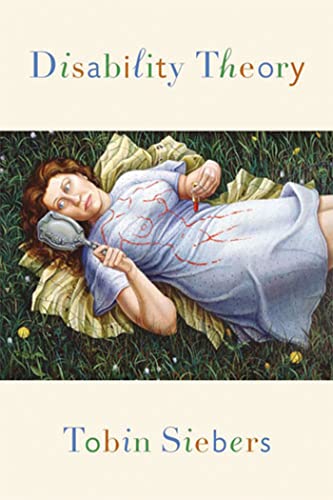
Illustration: Pattern by Riva Lehrer, acrylic on panel, 18" X 24", 1995
Includes bibliographical references (p. 213-225) and index.
Introduction -- Tender organs, narcissism, and identity politics -- Body theory : from social construction to the new realism of the body -- Disability studies and the future of identity politics -- Disability as masquerade -- Disability experience on trial -- A sexual culture for disabled people -- Sex, shame, and disability identity : with reference to Mark O'Brien -- Disability and the right to have rights -- Conclusion.
Tabla de contenidos provista por Syndetics
- 1 Introduction(p. 1)
- 2 Tender Organs, Narcissism, and Identity Politics(p. 34)
- 3 Body Theory: From Social Construction to the New Realism of the Body(p. 53)
- 4 Disability Studies and the Future of Identity Politics(p. 70)
- 5 Disability as Masquerade(p. 96)
- 6 Disability Experience on Trial(p. 120)
- 7 A Sexual Culture for Disabled People(p. 135)
- 8 Sex, Shame, and Disability Identity: With Reference to Mark O'Brien(p. 157)
- 9 Disability and the Right to Have Rights(p. 176)
- 10 Conclusion(p. 187)
- Acknowledgments(p. 197)
- Notes(p. 199)
- Works Cited(p. 213)
- Index(p. 227)