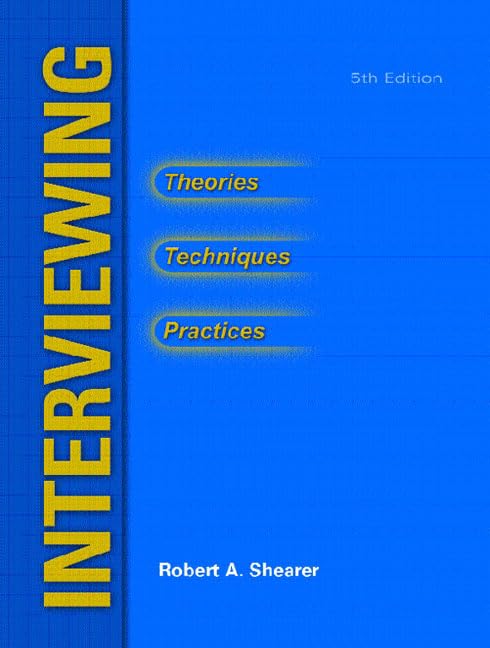
Imagen de portada de Amazon
Imagen de Amazon.com
Imagen de cubierta Syndetics
Portada de Syndetics
Imagen de OpenLibrary

Interviewing theories, techniques, and practices Robert A. Shearer.

Por: Colaborador(es): Detalles de publicación: Upper Saddle River, N.J. Pearson/Prentice Hall c2005.Edición: 5th edDescripción: xvii, 347 p. ill. 28 cmISBN:
  • 0131190709 (pbk.)
Tema(s): Clasificación CDD:
  • 364 22
Clasificación LoC:
  • HV8073 .S423 2005
Contenidos:
Introduction to interviewing -- Preliminary interviewing considerations -- Diversity and special needs -- The basic skills model -- Skillfully communicating accurate empathy -- Skillful use of speed and pacing -- Summarization skills -- Immediacy skills -- Concreteness skills -- Confrontational skills -- Assertion skills -- Skill integration.
Valoración
    Valoración media: 0.0 (0 votos)
Existencias
Imagen de cubierta Tipo de ítem Biblioteca actual Biblioteca de origen Colección Ubicación en estantería Signatura topográfica Materiales especificados Info Vol URL Copia número Estado Notas Fecha de vencimiento Código de barras Reserva de ítems Prioridad de la cola de reserva de ejemplar Reservas para cursos
Libro Biblioteca de Mayagüez Colección General mb HV8073 .S423 2005 (Navegar estantería(Abre debajo)) Disponible 50000002127644
Libro Biblioteca Encarnación Valdés Colección General bev 364 S5396i5 (Navegar estantería(Abre debajo)) Disponible 80000002302126
Total de reservas: 0

Descripciones mejoradas de Syndetics:

Using a systematic training approach based on scientifically validated research, the book combines "how-to" guidelines and "hands-on" practice to expose readers to key interviewing concepts and basic interrogation skills. Focusing on basic interviewing concepts and skills for criminal justice professionals, this book provides coverage of basic interviewing, interrogation and counseling skills & strategies. For people that plan to work in the criminal justice system.

Rev. ed. of: Interviewing in criminal justice. 4th ed.

Includes bibliographical references (p. 323-332) and index.

Introduction to interviewing -- Preliminary interviewing considerations -- Diversity and special needs -- The basic skills model -- Skillfully communicating accurate empathy -- Skillful use of speed and pacing -- Summarization skills -- Immediacy skills -- Concreteness skills -- Confrontational skills -- Assertion skills -- Skill integration.

Tabla de contenidos provista por Syndetics

  • 1 Introduction to Interviewing
  • Learning Objectives
  • The Need
  • The Interviewing
  • Interviewing Skills
  • Interviews as Verbal Skills
  • Interviewing as Instantaneous Response
  • Interviewing as Influencing
  • Neutrality
  • Interviewing as Assessment
  • Interview Styles
  • Interview Viability
  • Interviewing and Interrogation
  • Suggestibility and Compliance
  • Purposes of Interviewing
  • Prediction
  • Art or Science? Criminal Justice and the Parent Role
  • Barriers to Communication
  • Interview Biases
  • Optimum Environment for Communication (OEC)
  • Agency Interviews
  • Direction of Training
  • Summary
  • Study Questions
  • Exercise 1.1 Reliability/Validity
  • Exercise 1.2 Targets
  • Exercise 1.3 Skeptical/Suggestible Profile (SSP)
  • Interview Challenge
  • 2 Preliminary Interviewing Considerations
  • Learning Objectives
  • Professional Development
  • Preparing for Interviews
  • Note Taking
  • Electronic Documentation
  • Role Playing
  • Unfreezing and Refreezing
  • Focused Audio or Video Feedback
  • Legal and Ethical Standards
  • Interviewing and Interrogation Research
  • Stereotypical Interrogation Reliefs
  • Interviewing with Time Constraints
  • Nonverbal Communication
  • Types of Nonverbal Communication
  • Risks in the Use of Nonverbal Communication
  • Nonverbal Interviewing Techniques
  • Detecting Deception in a n Interviewing
  • Basic Terms
  • Notes of Caution
  • Why is It So Difficult to Detect Deception
  • How to Catch a Liar
  • Diversions
  • Advice
  • Aversive Language
  • Gossip
  • Red-Crossing or Band-Aiding
  • Mind Raping
  • Summary
  • Study Questions
  • Exercise 2.1 Aversive and Technical Language
  • Exercise 2.2 Extended Role plays/Psychodrama
  • Interview Challenge
  • 3 Diversity and Special Needs
  • Learning Objectives
  • A Framework for Multiculturalism and Diversity
  • Traumatized Interviewees
  • Interviewees with Special Challenges
  • Interviewees with Special Learning Challenges
  • Children
  • Adolescents
  • Offenders
  • Sociopaths
  • Zones of Questioning
  • Confidential Informants
  • Sexual Aggressors
  • Addicted Offenders
  • Interviewees Under the Influence (IUI). Multicultural Interviewing
  • Basic Concepts in Multiculturalism
  • Interviewing and Worldview Dimensions
  • Language and Cultural Differences
  • Multiculturalism and Emotions
  • Diversity and Deception
  • Multicultural Interviewing Skills
  • Summary
  • Study Questions
  • Exercise 3.1 Multicultural Interviewing Competency and Knowledge Inventory (MICKI)
  • Interview Challenge
  • 4 The Basic Skills Model
  • Learning Objectives
  • Introduction. to the Basic Skills Model
  • Interviewing Communication Theory
  • Pre-Assessment
  • Interview Appraisal Scales
  • Basic and Specialized Skills Hierarchy
  • Levels of Encounter
  • The Primary Interviewing Skills
  • Preliminary Training Considerations
  • Summary
  • Study Questions
  • Exercise 4.1 Class Interview Rating Worksheet
  • Assessment 4.1 Self-Ratings and Communication Pre-Test
  • Exercise 4.2 Stress, Memory, and Information Processing and theInverted-U
  • Assessment 4.2 Interview Appraisal Scales
  • Exercise 4.3 Distinguishing Between Thoughts, Feelings, and Behaviors
  • Assessment 4.3 Pre-Interviewing Self-Rating
  • Interview Challenge
  • 5 Skillfully Communicating Accurate Empathy
  • Learning Objectives
  • Benefits of Empathy
  • Intellectual vs
  • Therapeutic Empathy
  • Empathy vs
  • Sympathy
  • Empathy, Experience, and Talent
  • Cautions on the Use of Empathy
  • Communicating Empathy
  • The Basic Model of Empathy
  • Rating Responses
  • Modes of Interchangeable Responses
  • Semantic Hierarchy of Emotions
  • Diagnosing Emotional Content Conservatively
  • Summary
  • Study Questions
  • Exercise 5.1 Empathy
  • Interview Challenge
  • 6 Skillful Use of Speed and Pacing

Extracto provisto por Syndetics

After teaching, Interviewing to Criminal justice students and training professional employees in agencies for thirty years, this text is probably long overdue. After thirty years, it could be thought that all had been seen and all had been said about interviewing, but each new clays or training group brims mw ideas and new questions about the Criminal Justice System. In the early days, there was little available on the subject. Those of us who taught in the late 1960s and early 1970s had to rely on our experience, creativity, and imagination. We borrowed, adapted, and improvised materials for instruction. Fortunately, our students and trainees were not bashful, and they candidly indicated which techniques worked and which didn't. Their honesty and helpful criticism has been a major contribution to the production of this book on interviewing. If any generalization could be made about professionals in the Criminal Justice System, it is that they are very practical. They view an endless parade of quick-fix nostrums proposed by politicians, philosophers, and academicians. Consequently, they have a keen eye for practical people. The purpose of this book is to provide a practical interviewing guide for persons who work with people in the Criminal Justice System. Police officers, correctional officers, probation officers, parole officers, counselors, and social workers are the personnel likely to find this book useful. These individuals are called upon to interview, and their practical needs dictate that this book contain critical theory and research support but not be overburdened with such information. The book has several specific purposes. First, the book combines for the student the basic concepts of interviewing and criminal justice considerations. This includes the goal of the student being able to discriminate between interviewing, interrogation, and counseling. Second, the book tries to help the student prepare for interviews in criminal justice through professional development, avoidance of hazards, and recognition of human diversity. Third, the book tries to help the student develop interviewing skills based on a systematic theoretical training model. The structural foundations for the book are the fields of police psychology, communications/ human relations training, counseling psychology, forensic psychology, and multicultural training. Fourth, the book approaches interviewing from a scientifically validated research perspective. Hopefully, through this approach, the book will help move the field of interviewing toward greater understanding of human interaction in the Criminal Justice System. Many specialists are needed in criminal justice to cope with the problem of crime and associated human problems, but this book is written mainly for non-specialists. It is designed so they have the understanding, skills, and techniques to meet their day-to-day encounters with people. Therefore, all criminal justice professionals who encounter people as a part of their job will find this book useful. On the other hand, it would be pretentious anal foolish to suggest that this book will have immediate practical application to all interviews conducted in the diverse and vast collection of agencies found in our system of criminal justice. An attempt is made in the book to bridge the enormous gap between traditional interviewing practices and criminal justice needs. The needs in criminal justice are 0great. The challenge to accomplish this task has been exciting and humbling. Hopefully, if the design of the text is followed and the stated objectives are met, a significant degree of success will be evident in the accomplishment of this task. You the reader will ultimately make that judgment. The objectives of this book are achieved through a combination of "how to," "hands on" instruction, illustration, theory, and research support. This book contains the more traditional with the practical and mirrors the development of criminal justice education in this country in the last twenty years. This book first presents the basic concepts of interviewing and topics related to interviewing and then presents basic interviewing skills. This format allows the reader to progress from general concepts to specific techniques. Chapters 1, 2, and 3 introduce basic concepts in interviewing in criminal justice. Chapter 4 is a detailed description of the interviewing skills model that provides the basis of learning in this book. Chapters 5 through 11 focus on specific interviewing skills. Chapter 12 concludes the text by drawing together all of the skills and techniques and the future of interviewing. A complete list of references appears at the end of the book. Additionally, several of the interviewing skill chapters contain exercises for additional skill development at the end of the chapter. Each chapter ends with study questions and an interviewing challenge. The text is based on fifteen years of training workshop and undergraduate classroom use. Consequently, the curriculum of the text and supplementary exercises and assessments have been both academically and field tested. A valuable and effective textbook must be current with the discipline. It is my sincere hope that my efforts have led to this result so that the learning and instructional value of this text will not only be a contribution to the field, but also be a source of knowledge to the student or trainee. Excerpted from Interviewing: Theories, Techniques and Practices by Robert A. Shearer All rights reserved by the original copyright owners. Excerpts are provided for display purposes only and may not be reproduced, reprinted or distributed without the written permission of the publisher.
Compartir
logopucpr-y-vive

Contáctanos

¡Queremos saber de ti!

Tel. 787.841.2000 Ext. 1801

bibliotecavaldes@pucpr.edu

⁣Búscanos en las redes

© 2026 Desarrollado por Ignite Online • All Rights Reserved • Powered by Koha.