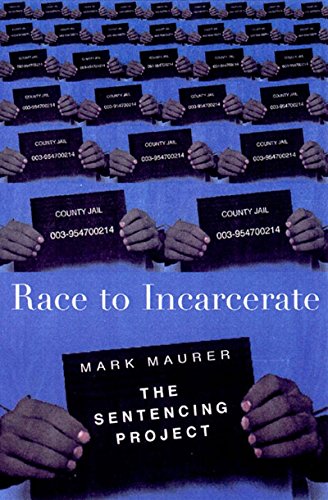
Imagen de portada de Amazon
Imagen de Amazon.com
Imagen de cubierta Syndetics
Portada de Syndetics
Imagen de OpenLibrary

Race to incarcerate Marc Mauer (&) the Sentencing Project.

Por: Colaborador(es): Detalles de publicación: New York New Press Distributed by W.W. Norton c1999.Descripción: xiv, 208 p. ill. 22 cmISBN:
  • 1565844297
Tema(s): Clasificación LoC:
  • HV9950 .M32 1999
Premios: Haga clic para abrir en una nueva ventana
Valoración
    Valoración media: 0.0 (0 votos)
Existencias
Imagen de cubierta Tipo de ítem Biblioteca actual Biblioteca de origen Colección Ubicación en estantería Signatura topográfica Materiales especificados Info Vol URL Copia número Estado Notas Fecha de vencimiento Código de barras Reserva de ítems Prioridad de la cola de reserva de ejemplar Reservas para cursos
Libro Biblioteca de Derecho Mons. Fremiot Torres Oliver Colección General biblioteca derecho HV9950 .M32 1999 (Navegar estantería(Abre debajo)) Disponible 70000000654470
Total de reservas: 0

Descripciones mejoradas de Syndetics:

A stunning examination of how the United States became the incarceration capital of the world, from one of the country's leading experts on sentencing policy, race, and the criminal justice system

In this revised edition of his seminal book on race, class, and the criminal justice system, Marc Mauer, former executive director of one of the United States' leading criminal justice reform organizations, offers the most up-to-date look available at three decades of prison expansion in America.

Race to Incarcerate tells the tragic story of runaway growth in the number of prisons and jails and the overreliance on imprisonment to stem problems of economic and social development. Called "sober and nuanced" by Publishers Weekly, Race to Incarcerate documents the enormous financial and human toll of the "get tough" movement, and argues for more humane--and productive--alternatives.

Includes bibliographical references and index.

Tabla de contenidos provista por Syndetics

  • Acknowledgments(p. xi)
  • Preface(p. xiii)
  • 1 Introduction: The Race to Incarcerate(p. 1)
  • 2 The Incarceration "Experiment"(p. 15)
  • 3 The Rise of the "Tough on Crime" Movement(p. 42)
  • 4 Crime as Politics(p. 56)
  • 5 The Prison-crime Connection(p. 81)
  • 6 The Limits of the Criminal Justice System on Crime Control(p. 100)
  • 7 African Americans and the Criminal Justice System(p. 118)
  • 8 The War on Drugs and the African American Community(p. 142)
  • 9 What's Class Got to Do with It?(p. 162)
  • 10 "Give the Public What It Wants": Media Images and Crime Policy(p. 171)
  • 11 Unintended Consequences(p. 178)
  • 12 A New Direction for a New Century(p. 189)
  • Index(p. 195)

Reseñas proporcionadas por Syndetics

Publishers Weekly Review

In recent years, Mauer, the assistant director of the Sentencing Project in Washington, D.C., has raised one of the few voices in the media decrying the explosive increase in the U.S. prison population, and especially the high percentages of incarcerated young black men. In this sober, nuanced analysis, he assesses how we have come to lock up offenders "at a rate 6 to 10 times that of most comparable countries"Äa rate that represents a 500% increase since 1972. Meanwhile, "about the best that can be said is that crime rates in some categories are no worse than they were when only one sixth as many inmates filled the nation's prisons." The major culprits for the expanded rolls, he contends, are mandatory sentencing statues and the "war on drugs" that began in the early '80s. Yet the evidence is too murky to prove that increased incarceration leads to a lowered crime rate, Mauer argues. With some crimes, notably drug peddling, offenders are often "replaced" on the streets, since "a thriving market exists with the potential for lucrative profits." His policy solutionsÄjobs, educationÄmight be dismissed as "hopelessly liberal," he acknowledges, but they're what work for the middle class; while they may not fully address the complexities of the underclass, there is evidence that they help. He also argues for increased drug treatment. Pointing out some potent unintended consequences of overcrowded prisons, Mauer cites displaced criminal justice resources, significant African-American disenfranchisement and family disruption (including increased sexual bargaining power for unimprisoned black men, and thus more illegitimacy). (Aug.) (c) Copyright PWxyz, LLC. All rights reserved

Notas de autor provistas por Syndetics

Marc Mauer is the assistant director of The Sentencing Project, a national organization based in Washington, D.C., that promotes criminal justice reform and the development of alternatives to incarceration. He has served as a consultant to the Bureau of Justice Assistance, the National Institute of Corrections, and the American Bar Association. He lives in the Washington, D.C. area.
Compartir
logopucpr-y-vive

Contáctanos

¡Queremos saber de ti!

Tel. 787.841.2000 Ext. 1801

bibliotecavaldes@pucpr.edu

⁣Búscanos en las redes

© 2026 Desarrollado por Ignite Online • All Rights Reserved • Powered by Koha.